
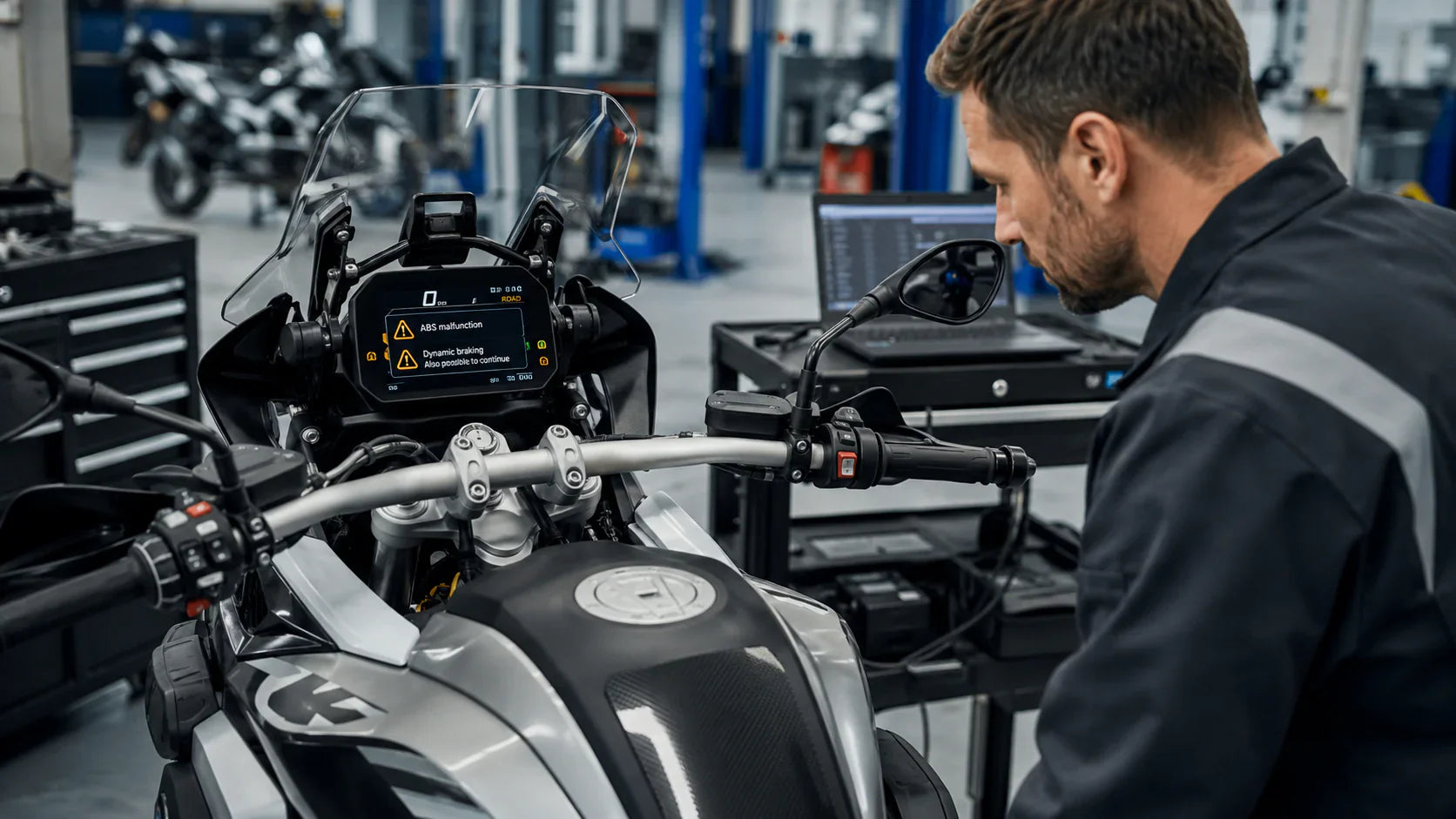
Modern BMW motorcycles are smarter than ever.
Features like Dynamic ESA, Ride Modes Pro, ABS Pro, Keyless Ride, TFT displays, cruise control, and tire pressure monitoring have transformed the riding experience. Instead of operating independently, these systems constantly exchange information to help the motorcycle respond to changing road conditions in real time.
That communication happens through the CAN bus.
When everything is working properly, you'll never notice it. The network quietly transfers thousands of messages between electronic control units every minute, allowing different systems to work together almost instantly.
When communication is interrupted, however, the symptoms can be confusing.
One ride might begin with an ABS warning. The next day, the TFT display flashes a Dynamic ESA fault. Sometimes multiple warning lights appear together, even though the motorcycle still starts and rides normally. In other cases, a recently installed accessory or a weak battery seems to trigger a series of electrical problems that don't appear to be related at all.
It's easy to blame the CAN bus itself.
In reality, true CAN bus failures are relatively uncommon.
More often, communication problems are caused by low battery voltage, poor electrical connections, charging system issues, damaged wiring, or a control module that's unable to communicate properly. The CAN bus simply reports that something in the network isn't behaving as expected.
Understanding that difference can save both time and money.
Replacing expensive electronic modules without identifying the root cause is one of the most common mistakes made when diagnosing modern motorcycles. A structured approach almost always leads to a more accurate—and less expensive—repair.
In this guide, you'll learn what the BMW motorcycle CAN bus system does, the warning signs that riders commonly experience, what actually causes communication problems, how to tell whether the CAN bus is really to blame, and the most effective ways to resolve these issues before they become more serious.
Quick Answer
Can the CAN bus fail on a BMW motorcycle?
Yes, but it's uncommon.
In most cases, what riders describe as a "CAN bus problem" is actually a communication issue caused by another fault. Low battery voltage, poor ground connections, charging system problems, damaged wiring, water intrusion, or an improperly installed accessory are all far more likely to interrupt communication than a failure of the CAN bus network itself.
That's why experienced technicians focus on finding the cause of the communication loss, rather than assuming the network has failed.
What Is the BMW Motorcycle CAN Bus?
The Controller Area Network (CAN) bus is the communication system that allows your BMW motorcycle's electronic control units to exchange information with one another.
Think of it as the motorcycle's internal communication network.
Rather than every component operating independently, major systems share information continuously. This allows the motorcycle to react faster, reduce unnecessary wiring, and coordinate complex electronic functions that would otherwise require dozens of additional electrical circuits.
For example, when you apply the brakes on a BMW R1250GS, the braking system isn't the only component involved.
Wheel-speed sensors send data to the ABS control unit. At the same time, the engine management system monitors throttle position, traction control evaluates available grip, and the TFT display updates warning indicators if necessary. Depending on the riding mode, the Dynamic ESA suspension may also adjust damping characteristics in response to changing road conditions.
All of these systems are communicating almost simultaneously.
The rider simply feels a motorcycle that behaves predictably and confidently.
Without the CAN bus, each module would require dedicated wiring to communicate with every other module. As electronic features increased, the wiring harness would become larger, heavier, and significantly more complicated to maintain.
The CAN bus solves that problem by allowing multiple control units to share a common communication network.
It's important to understand one key point:
The CAN bus is not a control module.
It isn't a sensor.
It isn't a relay.
And it isn't a component that typically "wears out."
Instead, it's the pathway through which electronic systems communicate.
When communication stops, the network is usually reporting a problem elsewhere—not causing it.
Why BMW Motorcycles Rely on the CAN Bus
BMW Motorrad has been at the forefront of integrating advanced electronics into motorcycles. As rider assistance systems became more sophisticated, traditional wiring methods simply couldn't keep up.
Using a CAN bus network offers several important advantages.
Faster Communication Between Systems
Modern safety features depend on rapid data exchange.
If the rear wheel begins to lose traction while accelerating out of a corner, multiple systems need to react almost immediately. The engine management system, traction control, ABS, and suspension controller all rely on shared information to make accurate adjustments within milliseconds.
Without fast communication, these systems couldn't work together as effectively.
Reduced Wiring Complexity
Older motorcycles often required separate wiring for every switch, sensor, and electronic component.
As more features were added, wiring harnesses became heavier and increasingly difficult to troubleshoot.
By allowing electronic modules to communicate over a shared network, the CAN bus significantly reduces the number of wires needed throughout the motorcycle. Fewer wires also mean fewer connectors, lower overall weight, and fewer potential failure points.
Smarter Diagnostics
One of the biggest advantages of a networked electrical system is its ability to monitor itself.
If a control module loses communication, receives unexpected information, or detects an abnormal operating condition, it can store a fault code for future diagnosis.
This doesn't mean the reported module has failed. It simply provides technicians with valuable information about where communication was interrupted, making troubleshooting more systematic than relying on guesswork alone.
Supporting the Features Riders Expect
Many technologies that BMW riders now take for granted depend on reliable communication between electronic control units.
These may include:
- Dynamic ESA
- ABS Pro
- Dynamic Traction Control (DTC)
- Ride Modes Pro
- Keyless Ride
- TFT Connectivity
- Tire Pressure Monitoring (TPMS)
- Cruise Control
- Hill Start Control
Each system has a different purpose, but none of them operates completely alone.
They work together by continuously exchanging information across the CAN bus network.
Common Symptoms of BMW Motorcycle CAN Bus Problems
One of the reasons CAN bus issues are so often misdiagnosed is that the symptoms rarely point to a single component.
Instead, several electronic systems may appear to malfunction at the same time.
An ABS warning may be followed by a suspension fault. The TFT display might briefly restart during startup. Cruise control suddenly becomes unavailable, yet the motorcycle still rides normally.
To the rider, these seem like unrelated problems.
To the motorcycle, they often share one thing in common—interrupted communication between electronic control units.
Recognizing these symptoms is the first step toward finding the real cause.
Multiple Warning Lights Appear at the Same Time
This is probably the symptom most commonly associated with CAN bus communication problems.
Imagine starting your BMW R1250GS on a cold morning.
Within seconds, the TFT display shows:
- ABS warning
- Dynamic ESA fault
- TPMS unavailable
- General warning indicator
Seeing several warnings together naturally leads many riders to believe that multiple systems have failed.
Fortunately, that is rarely the case.
Because these systems exchange information continuously, a single interruption in communication—or a temporary voltage drop during startup—can prevent several control modules from completing their self-checks successfully.
Rather than indicating four separate failures, the warnings may all be pointing to the same underlying electrical issue.
ABS Warning That Comes and Goes
An ABS warning doesn't always mean there's a problem with the braking system.
The ABS control module relies on information from several other electronic systems. If communication is interrupted during startup or while riding, the module may temporarily report a fault until communication is restored.
Many riders notice that the warning disappears after restarting the motorcycle.
Intermittent warnings like this shouldn't be ignored, but they also shouldn't immediately lead to replacing ABS components without further investigation.
Dynamic ESA or Suspension Fault Messages
Electronic suspension is another system that depends heavily on continuous communication.
If the suspension controller cannot exchange data with other modules, you may see messages such as:
- Dynamic ESA fault
- Suspension adjustment unavailable
- Suspension malfunction
In many situations, the suspension hardware itself is functioning correctly.
The fault simply indicates that the controller couldn't receive or verify the information it needed at that moment.
TFT Display Behaves Unexpectedly
The TFT display acts as the central information hub on many modern BMW motorcycles.
When communication between control modules becomes unstable, the display may begin showing unusual behavior, including:
- Slow startup
- Temporary freezing
- Unexpected restarts
- Missing menu options
- Communication warnings
- Flickering during ignition
Software bugs can occasionally produce similar symptoms, but unstable system voltage and communication interruptions should always be ruled out first.
Ride Modes Become Unavailable
One moment you're switching between Road and Dynamic mode.
The next, the motorcycle refuses to change modes or displays a message indicating that the selected riding mode is unavailable.
This doesn't necessarily mean the ride mode system has failed.
Changing ride modes requires multiple control units to exchange information before the request can be completed safely.
If communication is interrupted, the motorcycle may temporarily disable the feature as a protective measure.
Cruise Control Stops Working
Cruise control depends on accurate information from several systems, including engine management, throttle position, wheel-speed sensors, and braking inputs.
If one of these modules loses communication—even briefly—the motorcycle may automatically disable cruise control.
Many riders mistake this for a cruise control fault when the actual issue lies elsewhere in the electrical network.
Tire Pressure Monitoring Becomes Unavailable
It's not unusual for TPMS readings to disappear temporarily after startup or during a communication interruption.
Instead of displaying tire pressure values, the TFT may show dashes or indicate that tire pressure information is unavailable.
If the warning clears after riding for a short distance, the problem may simply have been a temporary communication issue rather than a failed pressure sensor.
Persistent TPMS warnings, however, should be investigated further.
Accessories Stop Working Unexpectedly
BMW motorcycles are frequently equipped with additional accessories such as:
- Auxiliary driving lights
- GPS units
- USB charging ports
- Heated gear controllers
- Phone mounts with wireless charging
If one or more accessories suddenly stop working after previously operating normally, don't immediately assume the accessory itself has failed.
Electrical modifications, loose connections, or power supply issues can all affect communication within the motorcycle's electrical system.
This is particularly true if the problem began shortly after installing new equipment.
Intermittent Electrical Problems
Some of the most frustrating CAN bus-related complaints aren't dramatic at all.
Instead, they appear randomly.
The motorcycle behaves perfectly for weeks.
Then one day:
- A warning light appears.
- The TFT briefly reboots.
- Cruise control stops working.
- The warning disappears after restarting.
These intermittent faults are often the most difficult to diagnose because they may not be present during inspection.
In many cases, they're eventually traced back to a weak battery, a loose connector, moisture inside an electrical connection, or wiring that's beginning to fail under vibration.
Communication Fault Codes During Service
Sometimes the rider notices no symptoms whatsoever.
Instead, communication faults are discovered during routine maintenance or diagnostic inspections.
A technician may find stored faults indicating that one or more control modules temporarily lost communication with the rest of the motorcycle.
This doesn't automatically mean a repair is needed.
Modern motorcycles record historical events, and not every stored communication fault reflects an active problem.
What's important is identifying whether the fault occurred once under unusual conditions or continues to return repeatedly.
When Several Symptoms Point to One Cause
One of the biggest mistakes riders make is treating every warning as an individual problem.
Modern BMW motorcycles don't work that way.
Because electronic systems are connected through the CAN bus, one underlying electrical issue can trigger several seemingly unrelated symptoms at the same time.
That's why experienced technicians look for patterns rather than isolated faults.
A weak battery may cause the ABS warning, disable cruise control, interrupt communication with the TFT display, and generate multiple stored fault codes—all from a single voltage-related problem.
The warning lights are only the symptoms.
Finding the condition that caused them is the real challenge.
What Actually Causes BMW Motorcycle CAN Bus Problems?
One of the biggest misconceptions surrounding BMW motorcycle electronics is that a CAN bus fault means the communication network has failed.
In reality, that's rarely the case.
The CAN bus is designed to carry information between electronic control units. When that communication is interrupted, the network records the event—but the root cause is often somewhere else.
Experienced technicians don't begin by replacing control modules. They start by identifying the conditions most likely to interrupt communication, beginning with the simplest checks before moving on to more complex electrical diagnostics.
Here are the most common causes, ranked by how frequently they're encountered in real-world repairs.
1. A Weak or Aging Battery
If there's one component that deserves attention before anything else, it's the battery.
Modern BMW motorcycles rely on stable voltage during startup. Before the engine even fires, multiple control modules perform self-checks and begin exchanging information across the CAN bus. If battery voltage drops too low during this process, one or more modules may fail to initialize correctly.
The result can look much worse than it actually is.
A single weak battery may trigger several seemingly unrelated warnings, such as:
- ABS fault
- Dynamic ESA unavailable
- TPMS warning
- Cruise control disabled
- TFT communication messages
This often leads riders to believe that multiple electronic systems have failed simultaneously, when in fact they're all reacting to the same low-voltage condition.
If your battery is more than four or five years old, struggles to hold a charge, or the motorcycle has been sitting unused for an extended period, it's worth checking the battery before investigating anything more complicated.
2. Charging System Problems
A healthy battery alone isn't enough.
Once the engine is running, the charging system must supply enough power to operate the motorcycle while recharging the battery at the same time.
If the alternator (stator) or voltage regulator isn't performing correctly, battery voltage may gradually fall during the ride.
As system voltage drops, communication between control modules becomes less stable.
Early signs may include occasional warning lights or intermittent electrical faults. If the problem continues, additional systems may begin reporting errors until the motorcycle eventually struggles to restart after being switched off.
Replacing the battery without checking charging performance may only provide temporary relief if the real issue lies elsewhere.
3. Loose or Corroded Electrical Connections
Electrical communication depends on reliable connections.
A loose battery terminal, corroded connector, or poor ground point can interrupt the flow of both power and data, producing symptoms that are difficult to reproduce consistently.
Unlike a completely disconnected wire, these faults are often intermittent.
You may ride for several days without a problem, only to see multiple warning messages appear after hitting a bump or riding in heavy rain.
Areas worth paying particular attention to include:
- Battery terminals
- Main ground connection
- Connectors beneath the seat
- Wiring near the steering head
- Areas exposed during recent maintenance
Even a small amount of corrosion can increase electrical resistance enough to affect sensitive electronic systems.
4. Water Intrusion
BMW adventure motorcycles are built to handle demanding environments, but no electrical system is completely immune to moisture.
Over time, water can work its way into damaged connectors or poorly sealed electrical components. Once corrosion begins to develop, communication may become unreliable, especially in damp or humid conditions.
You might notice that the problem only appears:
- After riding in heavy rain
- Following a thorough wash
- During periods of high humidity
If the symptoms consistently follow wet-weather riding, inspecting connectors for moisture or corrosion is often a sensible place to start.
5. Damaged Wiring Harness
Although less common than battery or charging issues, wiring damage remains a possible cause of communication problems.
Years of vibration, steering movement, previous repairs, or incorrectly routed accessory wiring can gradually wear through insulation or place stress on electrical conductors.
The result is often an intermittent fault that's difficult to trace.
Because the wiring may only lose contact in certain handlebar positions or under vibration, the motorcycle can appear perfectly normal during a visual inspection.
Patience is essential when diagnosing this type of problem.
6. Aftermarket Accessories
Additional accessories don't automatically cause CAN bus problems.
In fact, many BMW owners successfully install auxiliary lighting, GPS units, heated gear, and USB chargers without experiencing any electrical issues.
Problems usually arise when accessories are installed incorrectly.
Examples include drawing power from unsuitable circuits, creating poor ground connections, or damaging the original wiring harness during installation.
If communication faults begin shortly after electrical modifications have been made, reviewing that installation is often far more productive than assuming an internal electronic failure.
We'll explore this topic in more detail later in the article.
7. Faulty Electronic Control Modules
Control modules can fail, but they are much lower on the list than many riders assume.
Modern BMW motorcycles contain multiple electronic controllers, each responsible for a specific function. If one stops communicating, other modules may report communication-related faults.
However, a fault code stating that communication has been lost with a particular module doesn't automatically prove that module is defective.
A power supply issue, poor ground connection, damaged wiring, or unstable system voltage can all produce similar results.
For that reason, experienced technicians typically treat module replacement as a last step rather than the first.
8. Software or Firmware Issues
Not every communication problem is caused by hardware.
Occasionally, software inconsistencies, interrupted updates, or firmware bugs can affect how electronic modules communicate with one another.
These situations are relatively uncommon, but manufacturers sometimes release updated software to improve system stability or address known issues.
If no mechanical or electrical fault can be identified, checking whether software updates are available may be worthwhile.
The CAN Bus Is Often the Messenger, Not the Problem
Looking at this list, one pattern becomes clear.
Very few communication faults are caused by the CAN bus network itself.
Most originate from a more fundamental issue—an aging battery, unstable charging voltage, poor electrical connections, moisture, damaged wiring, or an accessory installation that introduced an unexpected fault.
That's why replacing expensive electronic components based solely on warning lights is rarely the right approach.
The goal isn't to ask, "Which module failed?"
It's to ask, "What interrupted communication in the first place?"
Answering that question correctly is what leads to an accurate repair.
Before You Blame the CAN Bus
When several warning lights appear at once, it's easy to assume the CAN bus is failing.
After all, the fault messages often mention communication errors, and multiple electronic systems may stop working at the same time. To many riders, that seems like clear evidence that the network itself has broken down.
In reality, that's rarely the case.
The CAN bus is simply the pathway that allows electronic control units to exchange information. If communication stops, the network reports the interruption—but it doesn't necessarily reveal what caused it.
That's why replacing electronic modules based on a single warning message can quickly become an expensive guessing game.
Before assuming the CAN bus is to blame, it's worth considering a few questions.
Did Multiple Warnings Appear at the Same Time?
If the TFT suddenly displays an ABS warning, followed by a Dynamic ESA fault and a TPMS message within a few seconds, it's tempting to think that several systems have failed simultaneously.
In practice, that's unlikely.
Modern BMW motorcycles are highly interconnected. A single electrical issue—such as unstable voltage during startup—can affect several control modules at once, causing multiple warning lights to appear together.
When several systems report faults at the same time, look for a shared cause before investigating each warning individually.
Did the Problem Start After the Motorcycle Sat Unused?
Motorcycles that spend weeks or months without being ridden often develop battery-related issues before anything else.
Even if the engine eventually starts, a partially discharged battery may not provide the stable voltage needed for every control module to complete its startup sequence successfully.
If communication faults appear after winter storage or an extended period of inactivity, checking the battery should be one of your first priorities.
Has Anything Changed Recently?
Electrical problems often appear shortly after something has changed.
Ask yourself:
- Was a new battery recently installed?
- Were auxiliary lights or a USB charger added?
- Has the motorcycle just returned from routine service?
- Were body panels or the fuel tank removed for maintenance?
A connector that's not fully seated or a wiring harness that's been pinched during reassembly can produce communication faults that closely resemble a CAN bus problem.
Looking at recent changes often provides valuable clues.
Are the Faults Consistent or Intermittent?
The pattern of the problem matters.
If the same warning appears every time you start the motorcycle, the fault is likely active and repeatable.
If the warning appears only occasionally—or disappears after restarting the engine—it may indicate an intermittent issue such as:
- A weak battery
- An unstable electrical connection
- Moisture inside a connector
- Wiring affected by vibration
Intermittent faults can be frustrating, but they're also a reminder not to replace parts based on a single occurrence.
Don't Let Fault Codes Tell the Whole Story
Fault codes are an important part of diagnosing modern motorcycles, but they should never be viewed in isolation.
A communication-related fault code tells you that one control module lost contact with another.
It doesn't automatically identify the root cause.
The interruption may have been triggered by low voltage, a damaged connector, a charging system problem, or another electrical issue elsewhere on the motorcycle.
For that reason, professional diagnosis always combines fault-code information with the motorcycle's symptoms, service history, and overall electrical condition.
Think Systematically, Not Emotionally
Electrical problems have a way of making riders think the worst.
It's understandable. Modern motorcycles contain dozens of electronic components, and warning messages often sound more serious than they actually are.
The key is to avoid jumping to conclusions.
Instead of asking:
"Has the CAN bus failed?"
Ask:
- Is the battery healthy?
- Is the charging system working properly?
- Has anything recently changed?
- Could multiple symptoms share the same cause?
Approaching the problem methodically often leads to a much simpler answer than the warning messages first suggest.
Most CAN Bus Problems Aren't Actually CAN Bus Problems
This is perhaps the most important takeaway from the entire article.
In many cases, the CAN bus is doing exactly what it was designed to do—detecting that communication has been interrupted and informing the rider that something requires attention.
The network isn't necessarily defective.
It's acting as the messenger.
Finding the real source of the interruption is what ultimately restores reliable communication and prevents the same warnings from returning.
Are CAN Bus Problems Serious?
Not always.
Although CAN bus-related warning messages can look alarming, they don't all indicate a major electrical failure. In many cases, the motorcycle is simply reporting that communication between one or more control modules has been interrupted.
The severity depends on what caused the communication loss, not the warning message itself.
For example, a weak battery after winter storage may trigger several temporary communication faults during startup. Once the battery is fully charged or replaced, those warnings may never return.
On the other hand, communication faults caused by damaged wiring, water intrusion, or a failing control module are more likely to become progressively worse if left unresolved.
The key is understanding the difference.
Situations That Are Usually Less Serious
Some communication faults can be monitored while basic inspections are carried out, particularly if the motorcycle continues to operate normally.
Examples include:
- A warning that appears only once during startup
- Temporary faults after replacing the battery
- Communication errors following long-term storage
- Warnings that disappear after the battery is fully charged
These situations often point to unstable voltage rather than permanent electronic damage.
Even so, repeated occurrences should not be ignored.
Situations That Require Immediate Attention
Some symptoms deserve prompt diagnosis before the motorcycle is ridden again.
These include:
- Multiple warning lights appearing on every ride
- Repeated communication failures while riding
- Loss of ABS or braking-related functions
- TFT display repeatedly restarting
- Engine performance changing unexpectedly
- The motorcycle failing to start because control modules cannot communicate
When communication failures begin affecting safety systems or engine operation, continuing to ride may increase the risk of further damage or unsafe riding conditions.
Can You Continue Riding?
It depends on the symptoms.
If the motorcycle starts normally and only displays a temporary warning that disappears after restarting, riding a short distance to monitor the situation may be reasonable.
However, if communication faults continue to return, additional warning lights appear, or important safety systems become unavailable, the motorcycle should be inspected as soon as possible.
Ignoring persistent communication problems rarely makes them disappear.
More often, the underlying electrical issue gradually becomes worse until it affects additional systems.
How to Fix BMW Motorcycle CAN Bus Problems
The good news is that most CAN bus-related problems don't require replacing the communication network itself.
Successful repairs almost always involve correcting the condition that interrupted communication in the first place.
Rather than replacing parts based on warning messages, work through the most likely causes in a logical order.
Start With the Battery
Before investigating anything else, make sure the battery is fully charged and in good condition.
Many communication faults are caused by voltage instability during startup, especially on motorcycles that haven't been ridden for several weeks or months.
If the battery is old, struggles to hold a charge, or repeatedly becomes discharged, addressing the battery issue may resolve multiple warning messages at once.
Inspect Battery Terminals and Ground Connections
A healthy battery can't perform properly if electrical connections are poor.
Check that the battery terminals are clean, secure, and free from corrosion.
It's also worth inspecting the motorcycle's main ground connection, as excessive resistance can affect multiple electronic systems throughout the motorcycle.
Simple cleaning and tightening may restore reliable communication without replacing any components.
Check the Charging System
If communication faults continue returning after the battery has been verified, the charging system should be inspected.
A battery that repeatedly becomes discharged despite regular riding may indicate that the stator or voltage regulator isn't supplying adequate charging voltage.
Replacing the battery alone won't solve the problem if the charging system is unable to maintain it.
Inspect Wiring and Connectors
Communication faults caused by damaged wiring can be difficult to diagnose because they are often intermittent.
Pay close attention to connectors that may have been exposed during recent maintenance, as well as areas where wiring bends repeatedly with steering movement.
Look for signs of:
- Loose connectors
- Corrosion
- Pinched wiring
- Damaged insulation
- Moisture intrusion
Even minor wiring damage can interrupt communication between electronic control units.
Review Recently Installed Accessories
If electrical problems began shortly after installing accessories, don't overlook the possibility that the modification is related.
Auxiliary lights, USB chargers, GPS units, heated gear controllers, and other aftermarket equipment should always be installed using appropriate power sources and secure electrical connections.
Incorrect wiring doesn't always damage the CAN bus, but it can create electrical conditions that lead to communication faults.
Disconnecting or temporarily isolating recently installed accessories can help determine whether they're contributing to the problem.
Clear Fault Codes After Repairs
Once the underlying issue has been corrected, stored communication faults may still remain in the motorcycle's memory.
Clearing the fault codes and verifying that they don't return after several riding cycles is an important final step.
If the same communication faults reappear shortly afterward, further diagnosis may be necessary.
Don't Replace Expensive Modules Too Quickly
Electronic control units are among the most expensive components on a modern BMW motorcycle.
Fortunately, they're also among the least common causes of communication faults.
Before replacing any module, confirm that the battery, charging system, wiring, connectors, and power supply have all been thoroughly checked.
In many cases, solving a relatively simple electrical problem restores communication across the network without replacing a single control unit.
A Methodical Approach Saves Time and Money
Modern BMW motorcycles contain sophisticated electronic systems, but diagnosing communication faults doesn't have to be complicated.
Working through the most common causes one step at a time is usually far more effective than replacing parts based on assumptions.
Patience, careful inspection, and a systematic troubleshooting process remain the most reliable tools for solving CAN bus-related problems.
Common Myths About BMW CAN Bus Systems
Modern BMW motorcycles are packed with advanced electronics, and that naturally leads to a lot of misconceptions.
Some of these myths have been repeated on forums and social media for years, making it difficult for riders to separate fact from fiction.
Understanding how the CAN bus actually works can help you avoid unnecessary repairs, incorrect modifications, and a great deal of frustration.
Myth 1: A CAN Bus Fault Means the CAN Bus Has Failed
This is probably the most common misunderstanding.
A communication-related fault code doesn't automatically indicate that the CAN bus network is defective.
More often, it means that one or more control modules were temporarily unable to exchange information.
The interruption may have been caused by low battery voltage, poor electrical connections, damaged wiring, or another issue elsewhere in the electrical system.
Think of the CAN bus as a highway.
If traffic stops because of an accident, the highway isn't broken—the obstruction is somewhere along the route.
Myth 2: Multiple Warning Lights Mean Multiple Components Have Failed
Seeing several warning lights appear together can be alarming.
However, on a CAN bus-equipped motorcycle, different systems are closely connected.
A single communication interruption may cause the ABS, Dynamic ESA, TPMS, and TFT display to report faults at the same time.
That doesn't necessarily mean four different components require replacement.
In many cases, all of those warnings can be traced back to a single electrical issue.
Myth 3: You Can't Install Accessories on a CAN Bus Motorcycle
Many riders believe that adding electrical accessories will automatically interfere with the CAN bus.
That's simply not true.
BMW owners routinely install auxiliary lights, GPS units, heated gear, phone chargers, and other accessories without affecting the communication network.
Problems usually arise from incorrect installation rather than the accessory itself.
Using appropriate power sources, quality wiring, and proper installation methods greatly reduces the risk of electrical issues.
Myth 4: Disconnecting the Battery Fixes Every CAN Bus Problem
Disconnecting the battery may clear temporary faults or reset certain electronic systems, but it doesn't repair the condition that caused the communication problem.
If a loose connector, charging system fault, or damaged wire is responsible, the warning will usually return once the motorcycle is back in operation.
Resetting the system without addressing the underlying cause only delays the repair.
Myth 5: Every Communication Fault Requires Dealer Repair
Modern BMW motorcycles are undeniably more complex than older models, but that doesn't mean every communication fault requires immediate dealership service.
Many issues begin with relatively simple problems such as a weak battery, loose battery terminals, or poor electrical connections.
Basic inspections can often identify these faults before more advanced diagnosis becomes necessary.
However, if communication problems persist after the obvious causes have been ruled out, professional diagnosis is recommended to avoid replacing parts unnecessarily.
Understanding the System Makes Troubleshooting Easier
The CAN bus often sounds more intimidating than it really is.
While the technology behind it is sophisticated, the principles of troubleshooting remain surprisingly straightforward.
Most communication faults can be traced back to one of a few common areas:
- Battery condition
- Charging system performance
- Wiring integrity
- Electrical connections
- Control module communication
Approaching the problem logically—and resisting the temptation to blame the CAN bus immediately—usually leads to a faster and more accurate diagnosis.
Frequently Asked Questions
Can aftermarket LED lights cause CAN bus problems?
Not by themselves.
Properly installed LED lights designed for motorcycle use generally won't interfere with the CAN bus. Problems are more likely when accessories are wired incorrectly, overload existing circuits, or create poor electrical connections.
How long does a BMW motorcycle battery typically last?
Most batteries last between three and five years, depending on riding habits, climate, storage conditions, and maintenance.
Motorcycles that spend long periods without being ridden may require battery maintenance or a smart charger to maximize battery life.
Can water damage affect the CAN bus?
Yes.
Although the CAN bus network itself is well protected, water entering electrical connectors or wiring harnesses can interrupt communication between control modules.
Moisture-related faults are often intermittent and may become more noticeable after riding in heavy rain or washing the motorcycle.
Does disconnecting the battery reset CAN bus fault codes?
Disconnecting the battery may reset some temporary system states, but it doesn't necessarily erase stored diagnostic fault codes or fix the underlying problem.
If the original fault remains, communication warnings are likely to return.
Is replacing the CAN bus expensive?
In most cases, the CAN bus isn't a replaceable component.
Repairs typically focus on the underlying cause of the communication problem, such as repairing wiring, replacing a battery, cleaning electrical connections, or addressing a faulty control module if necessary.
How can I reduce the risk of CAN bus problems?
Regular battery maintenance, keeping electrical connections clean, inspecting wiring during routine service, and installing aftermarket accessories correctly are among the most effective ways to prevent communication-related issues.
Conclusion
The CAN bus is one of the most important technologies found on modern BMW motorcycles, quietly connecting the many electronic systems that enhance safety, comfort, and performance.
Because so many features rely on this communication network, a single interruption can trigger several warning messages that appear unrelated at first glance.
Fortunately, true CAN bus failures are uncommon.
In most cases, communication faults are symptoms of another issue, such as a weak battery, charging system problems, poor electrical connections, damaged wiring, or an incorrectly installed accessory.
Understanding that distinction is the key to accurate troubleshooting.
Rather than focusing on the warning message itself, focus on identifying what interrupted communication between the motorcycle's control modules.
A systematic approach not only saves time and repair costs but also helps avoid replacing expensive components that may be functioning perfectly.
With routine maintenance and careful diagnosis, most BMW motorcycle CAN bus problems can be identified and resolved long before they develop into more serious electrical issues.
Disclaimer
The information provided in this article is intended for educational and informational purposes only. BMW motorcycle models vary by year, platform, and equipment level, and diagnostic procedures may differ accordingly. Always consult your owner's manual, official BMW repair documentation, or a qualified motorcycle technician before performing electrical repairs or modifying your motorcycle's electrical system.
References
- Robert Bosch GmbH. CAN Specification Version 2.0.
- BMW Motorrad. Owner's Manuals (model-specific publications).
- BMW Motorrad. Repair and Service Documentation.
- ISO 11898 Road Vehicles — Controller Area Network (CAN).
- NHTSA (National Highway Traffic Safety Administration). Vehicle Electrical System Safety Resources.
- SAE International. Technical Papers on Controller Area Network (CAN) Communication.
- Bosch Automotive Handbook, latest available edition.