
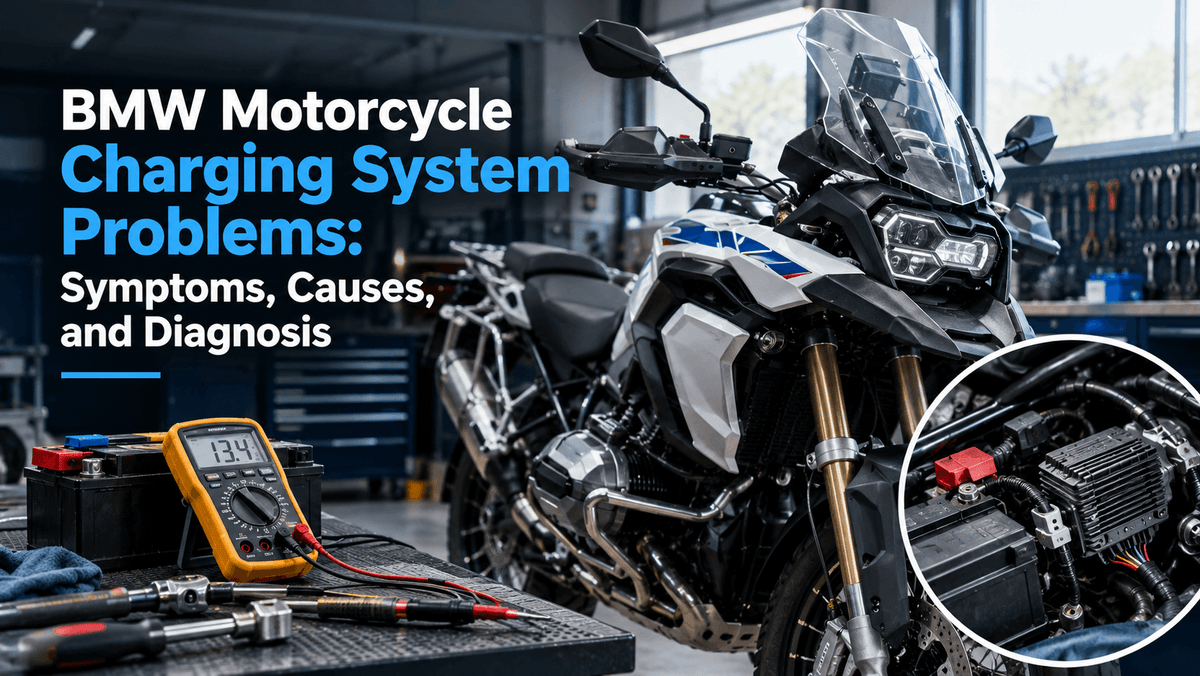
Your BMW motorcycle starts normally in the morning, but after a short ride, the battery warning light comes on. Or perhaps you have already installed a new battery, only to find it weak again a few days later.
These problems can be frustrating, especially when the motorcycle seems to run perfectly at first. But a battery that keeps losing power does not automatically mean the battery itself is bad.
BMW motorcycle charging system problems can result from a failing battery, a faulty alternator, a defective voltage regulator, damaged wiring, or poor electrical connections. The key is to identify where the problem starts before replacing expensive components.
In this guide, we’ll look at the most common symptoms, explain what can cause a BMW motorcycle not to charge, and walk through the basic diagnostic steps. We’ll also cover charging voltage, safety considerations, and when it makes sense to seek professional help.
How Does a BMW Motorcycle Charging System Work?
A motorcycle charging system supplies electrical power while the engine is running and helps keep the battery charged for the next start. Its main components work together, so a fault in one area can affect the entire system.
The battery stores electrical energy. It supplies power to the starter and supports the motorcycle’s electrical systems, particularly when demand is high or the engine is not running.
The alternator generates electrical power as the engine operates. Depending on the motorcycle’s design, the charging system may use a stator and rotor or a different alternator arrangement.
The voltage regulator controls the charging output, while rectification is required in systems that generate alternating current (AC) and must convert it to direct current (DC) for the battery and electrical system.
Wiring, connectors, grounds, and fuses complete the circuit. A loose connection or corroded terminal can interfere with charging, even when the main components are still functional.
BMW motorcycles do not all use identical charging-system designs. The exact components and test procedures depend on the model and year. That is why the correct BMW service manual is essential when diagnosing a suspected charging fault.
Common Symptoms of BMW Motorcycle Charging System Problems
Charging faults do not always produce the same warning signs. Some develop gradually, while others become obvious during a ride.
1. The Battery Keeps Dying
A repeatedly discharged battery is one of the most common signs of a possible charging problem.
You might fully charge the battery, ride for a while, and then discover that the motorcycle struggles to start the next morning. In other cases, the battery works normally for several days before losing power again.
A BMW motorcycle battery that keeps dying may have a charging-system fault, but there are other possibilities. The battery itself could be worn out, or an electrical load may be drawing power while the motorcycle is parked.
Pay attention to when the problem occurs. A battery that loses charge after riding suggests a different diagnostic path from one that drains only after several days of storage.
2. A Battery or Charging Warning Appears on the Dashboard
A battery-related warning on the instrument panel deserves attention, especially if it remains illuminated while the engine is running.
Depending on the model, the motorcycle may display a warning light, a message, or a specific electrical-system alert. Record the exact wording before switching the ignition off, if it is safe to do so.
Do not assume that every battery symbol means the battery needs replacing. The warning may indicate that the battery is not receiving charge because of an alternator fault, a damaged connection, or a related electrical problem.
BMW Motorrad owner’s manuals describe charging warnings and their possible causes. If the motorcycle reports that the battery is not being charged, the manual advises having the fault corrected as soon as possible.
3. The Motorcycle Has Trouble Starting
Slow cranking, clicking when you press the starter, or an instrument panel that dims during startup can all point to a weak battery or a problem in the starting circuit.
However, these symptoms alone do not confirm a BMW motorcycle charging system fault.
A worn battery may no longer hold enough charge, even if the charging system is working correctly. Loose battery terminals, poor ground connections, and starter-related faults can also cause starting difficulties.
Check the battery’s condition and connections before assuming the alternator has failed.
4. Electrical Problems Develop While Riding
In some cases, charging problems become apparent on the road. You may notice a warning message, an unexplained drop in system voltage, or other electrical irregularities.
If the battery is no longer receiving sufficient charge, the motorcycle may continue operating temporarily by drawing on the battery’s remaining energy. Eventually, that reserve can run out.
If your BMW displays a serious charging warning, do not assume it is safe to continue riding. Find a safe place to stop and follow the instructions in your model’s owner’s manual. Continuing to ride with an uncharged battery can leave too little power for the motorcycle’s electrical systems.
What Causes a BMW Motorcycle Not to Charge?
Several faults can produce similar symptoms. A methodical inspection is more useful than replacing parts based on guesswork.
1. A Weak or Defective Battery
Sometimes, the battery really is the problem.
Motorcycle batteries deteriorate with age, repeated deep discharge, improper storage, and charging problems. A battery can also develop an internal fault that prevents it from holding a charge.
If the battery is old or has been discharged repeatedly, have its condition checked before testing other components. A fully charged battery that fails a suitable load or condition test may need replacement.
If the battery repeatedly becomes discharged, though, do not stop the diagnosis there. A new battery will not fix an underlying charging fault.
2. Alternator or Charging-Generator Problems
The alternator generates the electrical power required to operate the motorcycle and recharge the battery.
If the alternator or its drive mechanism fails, charging output may fall below the required level. The battery can then gradually lose charge while the motorcycle is running.
The design varies by model. Some BMW R-series motorcycles use an alternator arrangement that differs from the stator-based systems commonly described in general motorcycle repair guides. Therefore, the correct inspection method depends on the motorcycle.
A charging-output test can help determine whether the generating system is working within specification. Further testing may be necessary before condemning the alternator.
3. A Faulty Voltage Regulator or Rectifier
The regulator and rectifier perform related but distinct jobs in charging systems that use both functions.
The rectifier converts AC output into DC, while the regulator controls charging voltage. If either function fails, the battery may receive insufficient or excessive voltage.
Undercharging can leave the battery repeatedly depleted. Overcharging can damage the battery and potentially affect other electrical components.
A voltage reading outside the specified range is a reason to investigate, not automatic proof that the regulator is faulty. Wiring, connectors, grounding, the generating system, and the battery itself should also be considered.
4. Loose Connections, Corrosion, or Damaged Wiring
Electrical connections are easy to overlook, but they can cause persistent problems.
Inspect the accessible battery terminals, ground connections, connectors, and wiring for looseness, corrosion, damaged insulation, or signs of overheating. Pay particular attention to connectors associated with the charging system, where accessible.
A poor connection can create resistance and interfere with current flow. In some situations, the charging components may still function correctly, but the power cannot reach the battery as intended.
Do not pull apart sealed connectors or remove components unnecessarily. Follow the model-specific service procedure when further access is required.
5. A Blown Fuse or Related Electrical Fault
A fuse or electrical circuit problem can also interfere with charging. The exact fuse arrangement depends on the motorcycle, so consult the owner’s manual or wiring diagram rather than relying on a generic fuse location.
If a fuse has blown, determine why before installing another one. Repeatedly replacing a fuse without investigating the cause can allow the underlying fault to remain unresolved.
Other electrical problems may also contribute to battery discharge. For example, excessive key-off current can drain a battery while the motorcycle is parked, even if the charging system works normally when the engine runs.
How to Diagnose a BMW Motorcycle Charging System Problem
You do not need to replace parts immediately. Start with the basic checks, then move to more specific tests if the symptoms remain.
Step 1: Inspect the Battery and Connections
With the ignition switched off, inspect the battery and any easily accessible electrical connections.
Look for loose terminals, visible corrosion, damaged wiring, or signs of overheating. Make sure the battery is the correct type for the motorcycle and is installed according to the manufacturer’s instructions.
If the battery is discharged, charge it using a suitable charger for its battery chemistry. A weak or deeply discharged battery can make subsequent measurements difficult to interpret.
If the battery fails a suitable condition test, address that issue before drawing conclusions from charging-system readings.
Step 2: Measure Battery Voltage With a Multimeter
A digital multimeter is useful for checking battery voltage and assessing charging performance.
With the motorcycle switched off, measure the voltage across the battery terminals after the battery has been charged and allowed to stabilize according to the battery manufacturer’s guidance.
This resting-voltage measurement gives an initial indication of battery state, but it cannot establish battery health on its own. A battery can show a plausible resting voltage and still fail under load.
If you are comfortable doing so, record the reading and compare it with the specifications for the battery type and motorcycle. A proper battery load or condition test may be needed if the results are unclear.
Step 3: Check Charging Voltage With the Engine Running
Next, check the voltage at the battery under the operating conditions specified in the BMW service manual.
In general, you would expect a functioning charging system to raise the battery voltage above its resting level under the appropriate test conditions. However, the expected result depends on the motorcycle’s design, engine speed, temperature, electrical load, and battery type.
Do not rely on a single universal number for every BMW motorcycle. Use the specified engine speed and model-specific charging-voltage range when evaluating the result.
If the reading remains too low, rises excessively, or does not behave as expected, further testing is necessary.
Never disconnect the battery while the engine is running to test the charging system. Doing so can cause electrical damage. Keep test leads and hands clear of moving or hot components, and do not perform running-engine tests unless you can do so safely.
Step 4: Test the Alternator and Related Components
If the battery and basic connections check out but the charging voltage remains abnormal, the next step is to test the generating system and associated components.
The correct procedure depends on the motorcycle. Some systems require checking stator resistance, insulation to ground, or AC output. Other designs require a different set of alternator tests.
Compare all measurements with the specifications in the correct service manual. Resistance values, output readings, connector layouts, and test conditions should not be borrowed from an unrelated motorcycle.
If the generating system meets its specifications, attention can turn to the regulator, wiring, grounds, fuses, and other parts of the charging circuit. If you do not have the tools or experience needed for these tests, a qualified motorcycle technician can perform them safely.
Step 5: Investigate Other Causes if Charging Tests Pass
A normal charging-voltage result does not rule out every battery-related problem.
If the battery keeps dying even though the charging system passes its tests, check the battery’s ability to hold charge and consider whether an electrical load is draining it while parked.
Parasitic-draw testing requires the correct procedure and equipment. Modern motorcycles can have electronic modules that remain active for a period after the ignition is switched off, so an immediate current measurement may be misleading.
Follow the manufacturer’s procedure or seek professional help rather than disconnecting circuits at random.
What Is Normal Charging Voltage on a BMW Motorcycle?
There is no single charging-voltage specification that should be applied to every BMW motorcycle.
Many conventional motorcycle charging systems produce a running battery voltage in the mid-13-volt to mid-14-volt range under appropriate test conditions. Some systems operate outside a narrow generic range depending on their design and operating state. This is a general reference, not a BMW-wide pass/fail specification.
The more important question is whether the measured value matches the service specification for your exact model and test conditions.
A reading that remains close to resting battery voltage while the engine is running may indicate that the battery is not receiving sufficient charge. A reading above the specified maximum can suggest a regulation problem or another electrical fault.
Neither result identifies the failed component by itself. Check the battery condition, charging output, connections, and relevant wiring before deciding which part needs repair.
For accurate diagnosis, consult the model-specific BMW service manual. This is especially important when comparing motorcycles with different charging-system designs or battery technologies.
Can You Keep Riding With a BMW Motorcycle Charging Warning?
If your BMW motorcycle displays a serious warning stating that the battery is not being charged, the safest choice is to stop riding as soon as you can do so safely.
The motorcycle may continue running temporarily on the battery’s remaining energy, but that reserve is limited. If the battery becomes depleted, electrical systems may stop functioning as intended, potentially leaving you stranded.
Do not ignore a warning simply because the motorcycle still starts or appears to run normally. Nor should you assume that switching the ignition off and restarting the bike has resolved the underlying problem.
Follow the instructions in your owner’s manual. If the warning persists, arrange professional diagnosis or recovery rather than risking an unexpected loss of electrical power on the road.
Frequently Asked Questions
Why Does My BMW Motorcycle Battery Keep Dying?
A repeatedly discharged battery may be caused by a worn battery, insufficient charging output, damaged wiring, poor electrical connections, or excessive current draw while parked. Start by testing the battery and checking its connections. If those are satisfactory, measure charging voltage under the correct conditions and investigate further according to the motorcycle’s service specifications.
Will a New Battery Fix a BMW Motorcycle Charging Problem?
Not necessarily. A new battery can solve a problem caused by an old or defective battery, but it will not repair a faulty alternator, regulator, fuse, or damaged wire. If the new battery also loses charge, investigate the charging system and any possible electrical drain before purchasing another one.
How Can I Tell if My BMW Motorcycle Is Charging Properly?
A multimeter can help you compare resting battery voltage with the voltage measured while the engine is running. The result needs to be evaluated against the correct model-specific specifications and test conditions. A battery load or condition test may also be necessary. If the readings are abnormal, additional testing is needed to identify the cause.
Can I Diagnose a Charging Problem With an OBD2 Scanner?
A compatible motorcycle diagnostic scanner may help identify supported electronic faults and provide useful information from accessible vehicle systems. However, an OBD2 scanner cannot be expected to detect every alternator, regulator, battery, or wiring problem.
A charging-system diagnosis often requires a multimeter and, for more advanced checks, the equipment and procedures specified by the manufacturer. Diagnostic trouble codes can provide useful clues, but they should not replace electrical testing when the fault involves charging output or current flow.
Conclusion: Find the Cause Before Replacing Parts
BMW motorcycle charging system problems can stem from several different sources, and the symptoms often overlap. A battery that keeps dying may be defective, but it may also be the result of insufficient charging output, a faulty regulator, damaged wiring, or an electrical drain.
Start with the battery and its connections. Then measure charging voltage under the conditions specified for your motorcycle and investigate further if the readings are abnormal. The right diagnosis depends on the model, not guesswork.
If a serious charging warning appears, prioritize safety and follow the instructions in your owner’s manual. Identifying the cause before replacing parts can save both time and money.
References
-
RevZilla — How to Check Your Motorcycle’s Battery and Charging System
-
RevZilla — How to Test Your Motorcycle’s Stator and Regulator Rectifier
-
BMW R-Series Charging-System Diagnosis Guide — Model-Specific Reference
Note: Charging-system design, specifications, and diagnostic procedures vary by model and year. Always use the correct BMW Motorrad owner’s manual or service documentation for your motorcycle.