
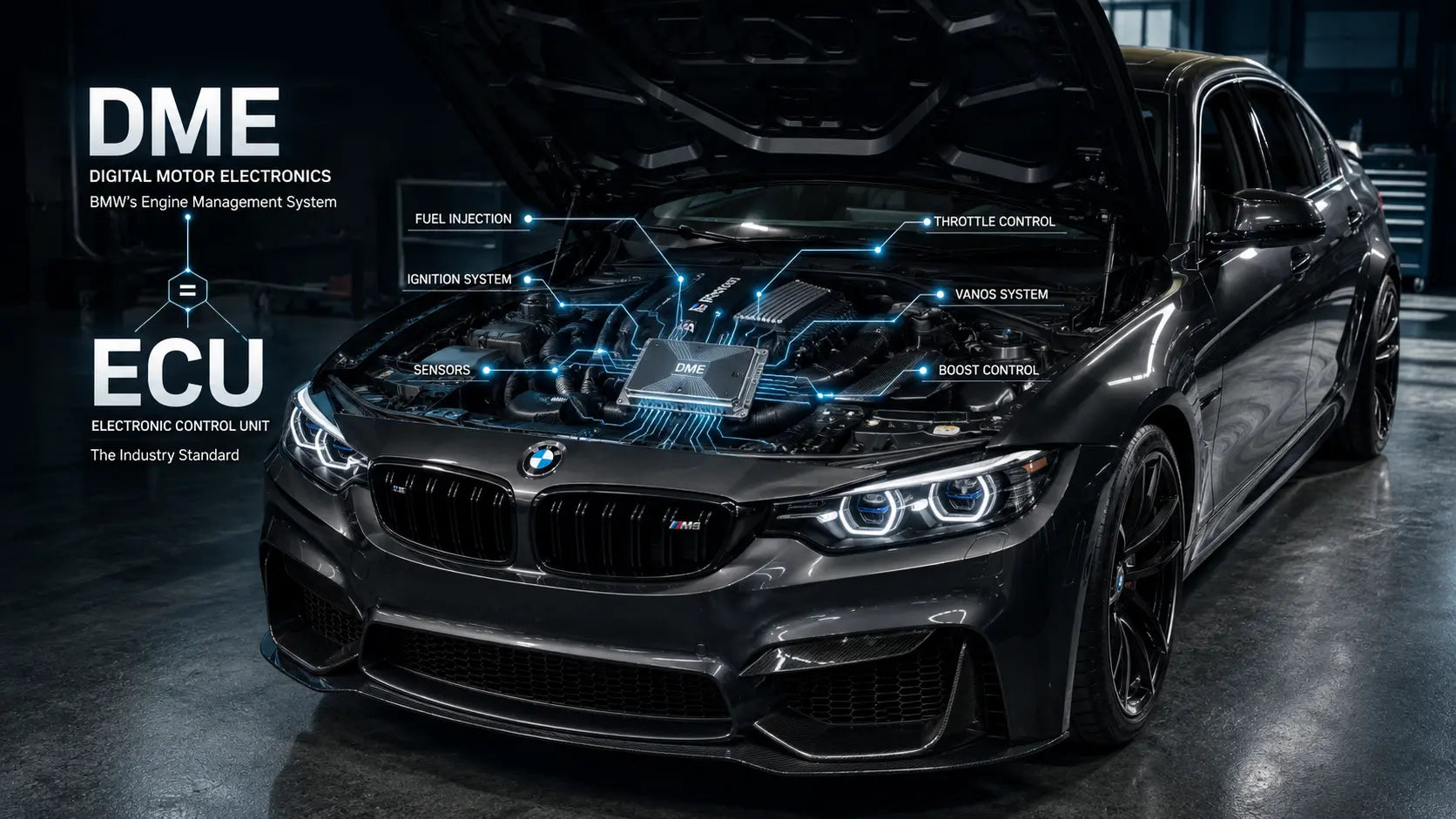
If you have spent any time diagnosing a BMW, you have probably seen the terms DME and ECU used almost interchangeably.
That can make things confusing.
Is the BMW DME a different component from the ECU? Does “DME fault” mean the engine computer has failed? And why do some BMWs use DME while others use terms such as DDE for engine management?
The basic answer is straightforward: DME is BMW terminology for its engine management electronics, while ECU is a broader term used throughout the automotive industry for an electronic control unit. In many BMW repair and diagnostic discussions, the DME is effectively the engine ECU. BMW technical training documents identify DME as “Digital Motor Electronics” and describe it as the computing and switching center of the engine management system.
The details become more interesting when you look at what the module actually does, how it communicates with other control units, and what a DME fault code really tells you.
What Does DME Mean on a BMW?
DME Stands for Digital Motor Electronics
DME stands for Digital Motor Electronics.
BMW has used this terminology for its engine management systems for decades, although the exact hardware, software, and architecture have changed significantly from one generation to another. On BMW technical documentation, DME is identified as an engine control unit responsible for processing sensor inputs, calculating engine operating commands, and controlling various actuators.
In practical terms, the DME is the computer that manages the engine.
It continuously receives information from sensors and other vehicle systems, evaluates that information against programmed operating strategies, and then commands components such as fuel injectors, ignition coils, throttle systems, and other engine actuators.
BMW's N20 engine training documentation describes the DME as the “computing and switching center” of the engine management system. Sensor signals are processed by the DME, which uses calculated values and stored program maps to determine actuator commands.
That makes the DME much more than a simple diagnostic module.
It is an active part of nearly every electronic engine-management decision.
What Is the BMW DME?
The BMW DME is a vehicle control module dedicated to engine management.
Its exact responsibilities depend on the engine, model year, fuel system, emissions equipment, and electrical architecture. Modern BMW engines can use highly sophisticated DME systems with extensive communication and control capabilities, while older vehicles may have simpler architectures.
BMW's technical material also shows how closely the DME works with the rest of the vehicle. For example, on certain BMW platforms, the DME is awakened through communication with the Car Access System (CAS), illustrating that engine management does not operate as an isolated system.
That distinction is important when diagnosing a modern BMW.
An engine problem may involve the DME, but the root cause can exist elsewhere in the vehicle.
What Does a BMW DME Do?
The easiest way to understand a DME is to think of it as the engine's central electronic decision-maker.
It takes information from multiple inputs and uses that information to control engine operation.
Depending on the specific BMW engine, the DME can be involved in areas such as:
| Engine Function | What the DME Does |
|---|---|
| Fuel injection | Determines fuel delivery based on operating conditions |
| Ignition | Controls ignition timing and ignition-related strategies |
| Air management | Processes airflow information and regulates engine air delivery |
| Electronic throttle | Controls throttle operation on electronically managed systems |
| Variable valve timing | Coordinates systems such as variable camshaft timing |
| Valvetronic | Controls or coordinates variable valve lift systems on equipped engines |
| Turbocharging | Manages boost-related control strategies on turbocharged engines |
| Emissions | Monitors and manages systems used to meet emissions requirements |
| Mixture control | Uses sensor feedback to maintain the desired air-fuel mixture |
| Torque management | Coordinates engine torque with other vehicle systems |
The exact functions are not identical across every BMW.
For example, BMW's technical documentation for the N20 engine explains that the DME processes signals from engine sensors, applies stored program maps and calculated values, and activates actuators directly or through relays.
On newer BMW platforms, the engine control electronics can be even more complex. BMW documentation for the G29, for example, identifies an eighth-generation Bosch engine control unit and describes the DME architecture used on gasoline engines.
This is why it is risky to describe the DME simply as a “computer that controls fuel and spark.”
It does far more than that.
BMW DME vs ECU: Are They the Same?
Short Answer: Essentially, Yes
For most practical diagnostic discussions, the BMW DME is the engine ECU.
The important difference is terminology.
ECU means Electronic Control Unit, a general automotive term for an electronic module that controls a particular system. A vehicle can have many ECUs, including modules for the engine, transmission, braking system, body electronics, airbags, and more.
DME, by comparison, is BMW's terminology for the engine management electronics.
So when someone says:
“The BMW ECU has a problem.”
They may be referring to the same engine control module BMW calls the DME.
But there is one terminology trap to avoid: not every ECU is a DME.
A BMW transmission controller, for example, is a different control unit with a different function. BMW documentation identifies separate systems such as DME/DDE for engine management and EGS for electronic transmission control.
Think of it this way:
ECU = broad category
DME = BMW's name for a particular type of engine control electronics
That is the simplest way to understand the BMW DME vs ECU relationship.
Why Does BMW Call It DME Instead of ECU?
BMW has its own naming conventions for control modules.
The company uses terms such as DME, DDE, EGS, DSC, CAS, FEM, BDC, and ICM to identify different electronic systems or control functions. BMW technical documentation has used DME for Digital Motor Electronics and, on many previous architectures, DDE for Digital Diesel Electronics.
These names are useful because they tell technicians what a module is responsible for.
For example:
-
DME — engine management electronics
-
DDE — diesel engine electronics on applicable BMW architectures
-
EGS — electronic transmission control
-
DSC — Dynamic Stability Control
-
CAS — Car Access System on applicable generations
-
FEM/BDC — body and vehicle electrical functions on applicable generations
The naming system also helps distinguish engine management from the many other computers installed in a modern BMW.
And there is another reason to be careful with terminology: BMW's newest engine-control documentation shows that the underlying DME platform has evolved. A recent BMW technical training document describes an eighth-generation DME platform used across modular engines and notes applications involving both gasoline and diesel engine variants.
So the safest approach is to treat DME as BMW-specific terminology whose exact architecture depends on the vehicle generation, rather than assuming every BMW uses the same module design.
BMW DME vs DDE: What's the Difference?
This is one area where older BMW terminology is especially useful.
Traditionally:
DME = Digital Motor Electronics
DDE = Digital Diesel Electronics
BMW documentation for the N57 diesel engine, for example, specifically identifies the engine control unit as Digital Diesel Electronics (DDE).
That means the distinction has historically been closely associated with the engine's fuel type.
For many BMWs:
-
Gasoline engine → DME
-
Diesel engine → DDE
However, BMW's newer technical architecture shows that terminology is not completely static. BMW describes an eighth-generation engine-electronics platform as a common control-unit platform for modular gasoline and diesel engines, while individual applications can still use their own control-unit designations.
Therefore, DME vs DDE should be understood in the context of the specific BMW generation and engine, especially when dealing with newer vehicles.
BMW DME Fault Codes: Does a DME Fault Mean the ECU Is Bad?
No.
This is one of the most important points to understand about BMW diagnostics.
A fault code stored in the DME means the DME detected an abnormal condition or recorded a problem associated with a particular system. It does not automatically prove that the DME itself is defective.
That distinction can save you from replacing an expensive control module unnecessarily.
Consider a BMW mixture-control fault. One BMW service-data example for fault code P0171 lists possible causes that include a wiring problem, rail-pressure sensor fault, HFM fault, induction leak, exhaust leak, injector problem, or high-pressure fuel-system issue. The DME stores the fault, but the DME itself is not listed as the only possible cause.
Another example involves injector activation.
BMW service data for certain injector-related faults lists defective wiring, a defective injector, or a defective DME as potential causes. The diagnostic procedure is designed to distinguish between those possibilities rather than immediately condemning the DME.
That is why reading the fault code is only the beginning.
You still have to diagnose the circuit and the related components.
What Can Cause a DME Fault Code?
Depending on the fault, possible causes include:
-
Faulty sensors
-
Damaged wiring
-
Poor electrical connections
-
Injector problems
-
Ignition problems
-
Intake or exhaust leaks
-
Fuel-pressure problems
-
Faulty actuators
-
Power-supply problems
-
Communication issues
-
Internal DME failure
BMW's own service information repeatedly shows this principle in action: the presence of a DME fault does not necessarily identify the DME as the failed component.
The code tells you where the system detected a problem.
It does not always tell you where the problem started.
Common BMW DME Problems and Symptoms
A genuine DME problem can produce a wide range of symptoms because the module controls so many aspects of engine operation.
Common symptoms may include:
Check Engine Light
A DME-related fault can trigger the engine or emissions warning lamp when the system detects an abnormal condition.
However, a check engine light by itself does not mean the DME has failed.
Rough Running or Misfires
Problems involving DME-controlled fuel, ignition, airflow, or actuator circuits can lead to rough engine operation and misfires.
BMW service data for certain DME faults specifically lists misfiring and poor engine operation as possible symptoms.
Reduced Engine Power
Some faults can cause the engine to enter a reduced-power or limp-home strategy.
BMW documentation for certain injector and DME-related faults describes power reduction and restricted drivability when the control system detects significant problems.
Stalling or No-Start Conditions
A major engine-management fault can contribute to stalling or a crank-no-start condition.
The DME must receive valid sensor information, have an adequate power supply, communicate properly with other systems, and command the necessary engine actuators. A problem in any of those areas can interfere with normal starting and running.
DME Communication Faults
If the diagnostic system cannot communicate properly with the DME, the problem may involve the module itself, its power supply, wiring, grounds, network communication, or another related system.
That is why “no communication with DME” should be treated as a diagnostic condition rather than an automatic diagnosis of a failed DME.
BMW DME Coding vs Programming
Another common source of confusion is the difference between DME coding and DME programming.
They are related, but they are not the same process.
BMW's technical training material explains that coding assigns a specific set of operating data to a control module's existing operating program. In other words, the required data is already available in the module, and coding selects the appropriate configuration for that application.
Programming is different.
Programming involves loading or updating the control-unit operating software itself.
This distinction matters when working on a BMW DME because a technician may be dealing with:
-
Configuration changes
-
Software updates
-
Module replacement
-
Vehicle integration
-
Control-unit programming procedures
These terms should not be used as though they describe the same operation.
For a deeper explanation of the difference, see our related guide:
BMW ECU Coding vs Programming vs Adaptation: What's the Difference?
The exact procedure required after a DME replacement depends on the BMW model, control-unit generation, software state, and vehicle configuration.
How Is a BMW DME Diagnosed?
Proper DME diagnosis is usually a process rather than a single test.
A useful diagnostic approach looks something like this.
1. Confirm the Symptoms
Start with what the vehicle is actually doing.
Is it hard to start? Running rough? Losing power? Stalling? Showing a check engine light? Or simply storing a fault code without any obvious drivability problem?
The symptom gives the fault code context.
2. Check the Vehicle's Electrical Condition
Voltage and power supply should not be ignored.
A control module cannot operate correctly without a stable electrical supply, and BMW service information includes power-supply checks as part of diagnosing certain DME-related problems.
3. Scan the DME
Read the DME fault memory with a diagnostic system capable of communicating with the vehicle.
Look at both current and stored faults rather than focusing on one code in isolation.
4. Review Related Data
Depending on the fault, technicians may need to evaluate live data, sensor readings, actuator operation, and other control modules.
A mixture fault, for example, may require checking airflow, fuel pressure, oxygen-sensor information, injectors, or intake-system integrity rather than simply replacing the DME.
5. Inspect Wiring and Connectors
Electrical faults are easy to overlook.
BMW service procedures frequently call for inspecting wiring, connectors, power supply, and circuits before replacing the DME.
6. Determine Whether the DME Is Actually Defective
Only after related components and circuits have been checked should internal DME failure become the conclusion.
That may sound obvious.
In practice, it is one of the easiest steps to skip when a scan tool displays the word “DME.”
Can a BMW Diagnostic Scanner Read DME Faults?
Yes, but the depth of information depends on the diagnostic system being used.
A basic generic OBD2 scanner can typically access standardized emissions-related diagnostic information. However, BMW-specific diagnostic equipment can provide much deeper access to manufacturer-specific systems, fault memory, test functions, and control modules.
BMW's own technical information system describes ISTA as providing diagnostic functions, fault-code information, test plans, repair instructions, technical data, wiring information, and related service information. BMW also provides programming capabilities through its service ecosystem, subject to the appropriate hardware and system requirements.
This difference matters.
A generic scanner may tell you that an engine fault exists. A BMW-capable diagnostic system can often provide considerably more information about the module, fault condition, and diagnostic path.
The exact capabilities still depend on the scanner, software version, BMW model, model year, and control-unit architecture.
BMW DME and Other Control Modules
The DME does not work alone.
Modern BMW vehicles use multiple networked control units that exchange information with one another.
For example, BMW technical documentation identifies systems such as DME/DDE for engine management, EGS for transmission control, DSC for stability and braking functions, and CAS or newer vehicle-access architectures depending on generation.
This networked design is one reason a fault in one system can create symptoms in another.
For example, engine torque information may be shared with the transmission and stability-control systems. Vehicle-start authorization can involve communication between access and engine-management systems. A communication failure may therefore result in multiple fault codes across several modules.
The DME is central to engine management.
But it is still only one part of the vehicle's electronic architecture.
Does Replacing a BMW DME Require Programming?
In many BMW applications, replacing a DME is not simply a matter of unplugging the old unit and plugging in another one.
A replacement control unit may need to be configured, programmed, coded, or otherwise integrated with the vehicle, depending on the model and control-unit generation.
BMW's service ecosystem provides dedicated diagnostic and programming functions for supported vehicles, and BMW technical material distinguishes coding from programming as separate operations.
The exact procedure varies.
That is especially important with used or replacement DMEs, because compatibility is not determined only by whether the hardware physically fits the vehicle.
Software, configuration, vehicle identity, and immobilizer-related integration may also matter.
What Happens If the BMW DME Fails?
A completely failed DME can prevent normal engine operation because the engine-management system relies on it to process sensor information and control key actuators.
Possible results include:
-
Crank-no-start or no-start conditions
-
Engine stalling
-
Loss of engine power
-
Rough running
-
Multiple actuator or communication faults
-
Warning lights
-
Reduced-power operation
But these symptoms are not unique to DME failure.
A bad injector, damaged wiring harness, power-supply problem, sensor failure, or communication fault can create similar symptoms.
BMW service documentation provides examples where DME-related fault conditions require checking external components and circuits before the DME itself is replaced.
That is the key diagnostic lesson.
Symptoms can suggest a DME problem, but testing is what confirms it.
Frequently Asked Questions About BMW DME vs ECU
Is the BMW DME the same as an ECU?
For practical purposes, yes. The DME is BMW's terminology for engine management electronics, while ECU is the broader industry term for an electronic control unit.
What does DME stand for on a BMW?
DME stands for Digital Motor Electronics. BMW technical documentation uses DME to identify the engine control electronics on applicable vehicles.
What does the BMW DME control?
Depending on the engine and vehicle generation, the DME can control or coordinate fuel injection, ignition, airflow, throttle operation, variable valve systems, turbocharging, emissions functions, and other engine-management processes.
Does a BMW DME fault mean the ECU is bad?
No. A DME fault code can be caused by a sensor, actuator, injector, wiring problem, power-supply issue, intake leak, fuel-system fault, communication problem, or an internal DME failure.
Can a BMW DME cause a no-start?
Yes. Because the DME is responsible for critical engine-management functions, a serious DME problem can contribute to a no-start condition. However, many other faults can produce the same symptom.
What is the difference between DME and DDE?
Historically, BMW commonly used DME for Digital Motor Electronics and DDE for Digital Diesel Electronics. The terminology and underlying control-unit architecture can vary by BMW generation, so newer vehicles should be checked against their specific technical documentation.
Does replacing a BMW DME require programming?
It can. Depending on the vehicle and control-unit generation, replacement may require programming, coding, or other integration procedures.
Can a diagnostic scanner read BMW DME fault codes?
Yes, provided the scanner supports the relevant BMW control unit and diagnostic functions. Generic OBD2 tools may provide limited information, while BMW-specific systems can provide deeper module-level diagnostics.
Final Takeaway: BMW DME vs ECU
The difference between BMW DME and ECU is mainly one of terminology.
DME is BMW's term for its engine management electronics, while ECU is the broader industry term for an electronic control unit.
That does not mean DME faults should automatically be interpreted as DME hardware failures.
A BMW DME receives information from sensors, processes that information, and controls a wide range of engine functions. When the system records a fault, the cause may be the DME itself—but it may also be a sensor, injector, actuator, wiring circuit, power supply, fuel system, or another component. BMW service documentation provides multiple examples where those possibilities must be separated through diagnosis.
The same principle applies to DME coding and programming.
They are different operations, and knowing the difference becomes particularly important when a control unit is being updated, configured, or replaced.
So when you see “BMW DME” on a scan report, don't immediately think “failed ECU.”
Think “BMW engine management system.”
Then diagnose the fault from there.
Sources & References
-
BMW Group Technical Training – ST406: Coding & Programming
BMW Technical Training -
BMW Group Technical Training – N20 Engine
BMW N20 Engine Technical Training Manual -
BMW Technical Information System (TIS)
BMW Technical Information System -
BMW Service Information – DME Fault Diagnosis
BMW Service Information