
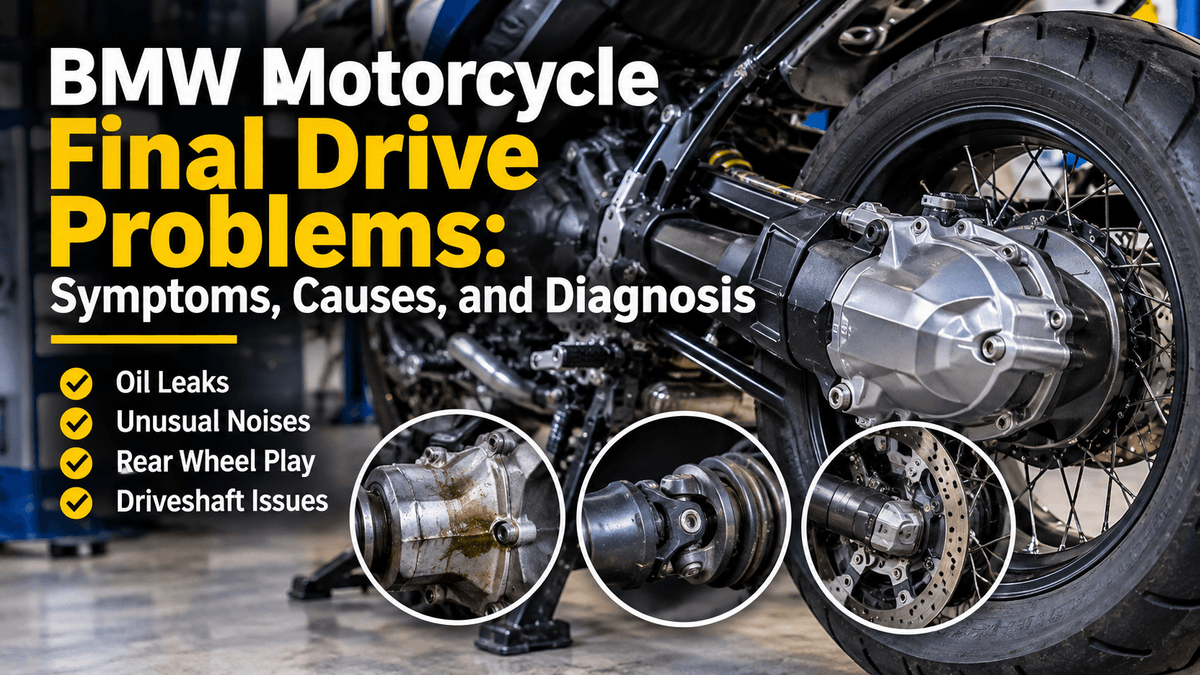
A new whining noise from the rear wheel. Oil collecting around the final drive housing. A vibration that becomes more noticeable under acceleration. These are the kinds of changes that can make a BMW motorcycle owner wonder whether something is wrong with the rear drivetrain.
BMW's shaft-drive system is known for its low routine-maintenance requirements compared with a conventional chain drive. That does not make it maintenance-free, though. Bearings, seals, universal joints, splines, and other drivetrain components still need attention.
BMW motorcycle final drive problems can involve several different parts of the rear drivetrain, and the symptoms are not always easy to distinguish. A leak near the rear wheel does not automatically mean the final drive has failed. Likewise, a clunk during acceleration may come from the driveshaft, a connection, or another part of the motorcycle.
This guide explains how the BMW shaft-drive system works, which symptoms deserve attention, what can cause common failures, and how to approach a proper diagnosis. It also covers BMW's model-specific maintenance requirements and when a motorcycle should be taken out of service.
1. How Does a BMW Motorcycle Final Drive Work?
On a shaft-driven BMW motorcycle, engine power travels through the transmission and driveshaft before reaching the rear wheel. The final drive is the assembly at the rear that transfers this power to the wheel.
Although the terms are often used interchangeably in everyday conversation, the final drive, driveshaft, and Paralever are not the same component.
The Role of the Driveshaft
The driveshaft, also called a Cardan shaft, transfers rotational power from the gearbox to the rear-wheel drive assembly. Universal joints allow the shaft to accommodate changes in angle as the rear suspension moves.
Splines connect the relevant drivetrain components and transmit torque. These connections must remain in good condition. Wear, corrosion, or improper lubrication can affect how power is transferred.
BMW Motorrad describes the Cardan shaft as the secondary drive between the gearbox and rear wheel. Its arrangement varies by motorcycle generation and model.
How the Final Drive Transfers Power
At the rear of the motorcycle, the final-drive assembly transfers torque to the rear wheel. On the BMW designs described in its Paralever technical documentation, bevel gears change the direction of power transmission, allowing the driveshaft to drive the rear wheel.
The assembly also contains bearings and seals. Bearings support rotating components, while seals help retain lubricant and keep contaminants out.
A problem in any of these areas can affect drivetrain performance.
What Is BMW Paralever?
Paralever is a rear-suspension and drivetrain arrangement used on certain BMW shaft-drive motorcycles. It helps manage the torque reaction produced by the shaft drive while allowing the rear suspension to move.
It is not another name for the driveshaft or final drive.
The distinction matters during troubleshooting. A noise or movement near the rear of the motorcycle may originate from the final-drive housing, driveshaft, suspension pivots, or their associated bearings. Identifying the correct component is the first step toward an accurate repair.
For a closer look at the engineering, see BMW Motorrad's technical explanation of Paralever and Cardan.
2. Common Symptoms of BMW Motorcycle Final Drive Problems
A failing drivetrain component can produce more than one symptom. Some problems develop gradually, while others appear suddenly.
The following signs are worth investigating, particularly when they are new or becoming more pronounced.
1. Oil Leaks Around the Final Drive Housing
Oil around the rear-drive assembly is one of the more visible warning signs.
You may notice residue on the final-drive housing, around the axle area, or near a fill or drain point. In some cases, fresh oil can collect on the inside of the rear wheel or surrounding components.
Possible sources include:
-
A worn or damaged oil seal.
-
A deteriorated O-ring or gasket.
-
A loose or improperly sealed service plug.
-
Damage to the housing or a related sealing surface.
The location of the oil matters. A leak from the final-drive assembly is not necessarily the same as a leak from the transmission or another nearby component.
Clean the affected area only when it is safe to do so, then check whether fresh fluid appears again. If oil reaches the tire or brake components, do not continue riding. Even a relatively small leak can become a safety concern when it affects braking or traction.
2. Unusual Noises From the Rear Drive
A new noise from the rear of the motorcycle can indicate a drivetrain problem, but the sound alone rarely identifies the failed part.
Different noises may provide useful clues:
-
Whining: A continuous high-pitched sound may be associated with gear or bearing problems.
-
Grinding: A rough mechanical sound may suggest internal wear, damage, or a component that is not rotating smoothly.
-
Clunking: A noticeable knock when accelerating, decelerating, or changing load may point toward excessive play in a drivetrain connection.
These are diagnostic clues, not definitive diagnoses.
Tires, wheel bearings, brakes, suspension pivots, and other components can produce similar sounds. A technician needs to isolate the source before recommending a repair.
3. Excessive Rear Wheel Play or Rough Rotation
Unusual rear-wheel movement is another symptom that deserves attention.
A technician may find excessive play, rough rotation, or resistance when inspecting the rear wheel and final-drive assembly. Depending on the motorcycle, possible causes include worn bearings, pivot-related problems, or damage within the final-drive unit.
One important distinction: not every amount of movement is abnormal. BMW motorcycles have different drivetrain and suspension arrangements, and the acceptable tolerances depend on the specific model.
A proper inspection should follow the manufacturer's procedure. Do not assume that a small amount of movement automatically means the final-drive bearing has failed.
4. Vibration or Harshness During Acceleration
A worn or damaged driveshaft connection may cause vibration or unusual mechanical feedback.
Some riders notice the change most clearly when accelerating, rolling off the throttle, or transitioning between drive and deceleration. Others describe it as a clunk or a rough feeling from the rear of the motorcycle.
Possible sources include universal joints, splines, bearings, and other drivetrain connections. Tire condition, wheel balance, brake components, and suspension issues should also be considered.
A change in vibration is worth investigating, especially when it appears together with noise or abnormal play.
5. Loss of Power to the Rear Wheel
A serious driveshaft or final-drive failure can interrupt power delivery to the rear wheel.
This is not a symptom to monitor casually. If the motorcycle suddenly loses drive, produces severe mechanical noise, or develops a noticeable mechanical bind, stop riding as soon as it is safe and arrange professional inspection or recovery.
Loss of propulsion while riding can create a serious crash risk.
3. What Causes BMW Motorcycle Final Drive Problems?
The same symptom can have several possible causes. Understanding the components involved helps narrow down the diagnosis.
1. Worn Final Drive Bearings
Bearings support the rotating parts inside the final-drive assembly. They are designed to operate under specific loads and lubrication conditions.
Over time, wear or damage can affect bearing smoothness and clearance. Depending on the location and severity, the result may be unusual noise, rough rotation, excessive play, or heat.
However, a noisy rear wheel does not automatically mean the final-drive bearing is at fault. Wheel bearings, swingarm pivots, and other nearby components need to be checked as well.
2. Damaged Oil Seals and Fluid Leaks
Oil seals keep lubricant inside the final-drive housing and help prevent dirt and moisture from entering.
Age, wear, heat, contamination, or mechanical damage can compromise a seal. A damaged sealing surface or incorrectly installed component may also cause leakage.
Low lubricant levels can place additional stress on internal components. If a leak is confirmed, the important step is to identify its source and correct it before further damage develops.
Do not simply top up the oil and assume the problem is solved.
3. Driveshaft and Universal Joint Wear
The driveshaft and its universal joints operate as part of a moving mechanical assembly. They must transmit torque while accommodating the movement required by the rear suspension.
Wear or damage at a universal joint can affect smooth power transfer. Splines can also deteriorate, particularly when corrosion, contamination, or insufficient maintenance affects the connection.
BMW Motorrad's K5x driveshaft maintenance bulletin specifically introduces regular driveshaft inspections and spline lubrication for the listed R 1200 and R 1250 platforms. This is an important reminder that shaft-drive components still require attention, even when there is no traditional chain to maintain.
The exact maintenance requirement depends on the model and year.
4. Water Intrusion and Corrosion
The driveshaft operates within the rear drivetrain assembly, where protective boots and sealing components help keep out moisture and contaminants.
A damaged boot, compromised seal, or failed protective component can allow water and dirt to reach areas that should remain protected.
Over time, corrosion may affect the shaft, splines, or related connections. This can make inspection and maintenance more important, especially for motorcycles regularly exposed to rain, water crossings, road salt, or off-road conditions.
Corrosion is not inevitable, and its presence alone does not prove that a component has failed. The actual condition of the affected parts must be assessed.
5. Incorrect or Neglected Final Drive Maintenance
Final-drive lubrication matters. Using an incorrect fluid, an incorrect quantity, or an unsuitable service procedure can compromise the assembly.
Maintenance requirements also change between BMW generations. The oil specification, fill quantity, service interval, and replacement procedure must be checked against the correct model-specific documentation.
A maintenance schedule from an older R 1200 GS should not automatically be applied to an R 1250 GS, R 1300 model, or K-series motorcycle.
4. How to Diagnose BMW Motorcycle Final Drive Problems
A useful diagnosis starts with the motorcycle's exact model and a clear description of the symptoms. Replacing parts before identifying the source can become expensive very quickly.
The following sequence provides a sensible starting point.
Step 1: Identify the Exact Model and Drivetrain
First, confirm that the motorcycle actually uses a shaft-drive system.
BMW has produced motorcycles with different final-drive arrangements, including shaft, chain, and belt drives. The procedures in this guide apply to shaft-driven motorcycles, not every BMW model.
Record the model year and VIN. Then identify the correct owner's manual, service information, and any applicable service campaigns or recalls.
This matters because component design and maintenance requirements can differ substantially between generations.
Step 2: Inspect the Final Drive for Oil Leaks
Look for fresh oil around the final-drive housing, axle area, service plugs, and accessible sealing points.
Also check the surrounding components. Oil can travel along a housing or collect somewhere other than its original leak point, so the visible residue may not reveal the actual source.
If a protective boot is damaged, that also deserves attention. Depending on the model, the boot may help protect the driveshaft and its connections from dirt and moisture.
A leak should be diagnosed before the motorcycle is returned to regular use, particularly if lubricant has reached the rear tire or brake assembly.
Step 3: Check for Rear Wheel Play and Abnormal Rotation
Rear-wheel movement and rotation can provide useful diagnostic information, but the inspection must be performed correctly.
The motorcycle needs to be supported using the procedure specified by the manufacturer. A qualified technician can then check for abnormal play, roughness, binding, and bearing-related movement.
It is important to distinguish among rear-wheel bearings, final-drive bearings, suspension pivot bearings, and other possible sources.
Do not use a generic movement test or a measurement from another BMW model as a pass/fail standard. The correct tolerances and inspection procedure are model-specific.
Step 4: Inspect the Driveshaft and Universal Joints
If the symptoms point toward the driveshaft, further inspection may be required.
Relevant components include:
-
The driveshaft and its universal joints.
-
Splined connections.
-
Protective boots and related sealing components.
-
Connections between the transmission, shaft, and rear drive.
Some of these areas cannot be fully assessed through a simple external visual inspection. Access may require partial disassembly, specialized tools, or a manufacturer-specific diagnostic procedure.
BMW's SIB 33 04 23 specifies an ISTA-guided driveshaft inspection for the applicable K5x models. That is a good example of why professional testing may be necessary rather than relying on appearance alone.
Step 5: Review the Service History and Recall Status
Before authorizing a major repair, check the motorcycle's service history.
Useful records include:
-
Final-drive oil service.
-
Previous driveshaft inspections.
-
Spline lubrication records.
-
Driveshaft or final-drive replacements.
-
Previous repairs involving seals, bearings, or the rear suspension.
Also check for applicable BMW service campaigns and safety recalls.
A particularly important point is that a service campaign and a safety recall are not necessarily the same thing. Both may involve a specific component, but their scope, eligibility, and corrective procedures differ.
Use the VIN to verify applicability. Do not assume that a recall affecting one production batch applies to every motorcycle with the same model name.
5. BMW Motorcycle Final Drive Maintenance: What Owners Should Know
A BMW shaft drive generally requires less routine attention than a conventional chain drive. It still needs scheduled service.
The most reliable approach is to follow the maintenance plan for the exact motorcycle rather than relying on a generic internet interval.
Follow the Correct Final-Drive Oil Service Schedule
Final-drive oil helps lubricate the gears and related internal components.
Use the lubricant specified for the motorcycle, along with the correct quantity and service procedure. Fill levels, fluid specifications, and replacement intervals can vary across BMW models and generations.
BMW Motorrad includes rear-drive oil changes among its service-plan items. Its U.S. Ultimate Care information also states that gearbox and rear-drive oil service intervals are model-dependent.
For that reason, there is no single oil-change interval or fluid specification that should be applied to every BMW motorcycle.
Always check the current owner's manual or service information before performing the work.
Inspect the Driveshaft and Related Components
A shaft-drive system should not be treated as a maintenance-free assembly.
During scheduled inspections, pay attention to protective boots, signs of oil or moisture intrusion, corrosion, unusual play, and changes in drivetrain noise or vibration.
There are also model-specific requirements worth knowing.
BMW Motorrad USA published SIB 33 04 23 — K5X Driveshaft Maintenance Schedule Change for specified R 1200 and R 1250 K5x models, including the GS, GS Adventure, RT, R, and RS.
For the covered model years 2023 and earlier, the bulletin specifies:
-
An ISTA-guided Cardan shaft inspection and spline lubrication every 12,000 miles (20,000 km).
-
Driveshaft replacement every 36,000 miles (60,000 km), with the shaft's actual accumulated mileage taken into account.
The bulletin also explains that the revised maintenance schedule applies retroactively to the listed K5x models, while 2024 and later models have the revised schedule in their owner's manuals.
These are specific BMW requirements for the models covered by the bulletin. They should not be treated as universal intervals for every BMW shaft-drive motorcycle.
Owners should confirm the applicable schedule and service history with an authorized BMW Motorrad dealer.
Do Not Assume Shaft Drive Means Maintenance-Free
One of the advantages of shaft drive is that it eliminates the regular chain cleaning, lubrication, and tension adjustments associated with chain-driven motorcycles.
That is a real convenience.
However, the driveshaft, universal joints, splines, bearings, seals, and final-drive lubricant still have service requirements. Ignoring them can turn a relatively straightforward inspection into a more expensive repair.
A little attention at the correct service intervals is far better than waiting for a new noise or vibration to become impossible to ignore.
6. When Should You Stop Riding and Seek Professional Help?
Not every small oil stain or unfamiliar noise means the motorcycle has an immediate mechanical failure. Some symptoms, however, should never be ignored.
Stop riding and arrange a professional inspection if you notice:
-
A significant or continuing final-drive oil leak.
-
Oil on the rear tire or brake components.
-
Severe grinding, binding, or abnormal mechanical noise.
-
Clearly abnormal rear-wheel play.
-
Strong vibration or repeated impacts from the drivetrain.
-
Sudden loss of drive or an inability to transmit power normally.
Do not continue riding to see whether the problem gets worse. A compromised bearing, driveshaft connection, or final-drive assembly can deteriorate further and create a safety risk.
If the cause is uncertain, have the motorcycle transported to a qualified BMW Motorrad service facility.
7. Frequently Asked Questions
How Often Should BMW Final Drive Oil Be Changed?
The interval depends on the motorcycle's model year and maintenance schedule. BMW specifies model-dependent gearbox and rear-drive oil service intervals, so there is no universal mileage figure for all BMW motorcycles.
Check the correct owner's manual or ask an authorized BMW Motorrad dealer to confirm the required fluid, quantity, and interval.
Does a BMW Motorcycle Shaft Drive Need Maintenance?
Yes. Shaft drive reduces routine maintenance compared with a chain, but it does not eliminate maintenance altogether.
The final-drive oil, driveshaft, splines, universal joints, seals, and protective boots may all require inspection or service. Some BMW models also have specific driveshaft inspection and replacement schedules.
How Long Does a BMW Motorcycle Driveshaft Last?
There is no single service-life figure that applies to every BMW driveshaft.
Mileage, riding conditions, maintenance history, model design, and the condition of the universal joints and splines all matter. Some motorcycles may require driveshaft attention much earlier than expected, while others may remain in good condition for many years.
Follow the maintenance schedule for the specific model rather than relying on a general lifespan estimate.
Can I Ride With a Leaking BMW Final Drive?
That depends on the location and severity of the leak, but it should not be ignored.
A small amount of old residue may not indicate an active leak. Fresh or continuing leakage is different. If oil reaches the tire or brake components, or the motorcycle develops abnormal noise, play, or vibration, stop riding and arrange an inspection.
The source of the leak should be identified before deciding whether the motorcycle is safe to use.
Is a Final Drive Problem the Same as a Driveshaft Problem?
No. They are related parts of the same drivetrain, but they perform different jobs.
The driveshaft transfers power from the transmission to the rear-drive assembly. The final drive transfers that power to the rear wheel. A fault in either area can cause similar symptoms, which is why proper diagnosis is important.
8. Conclusion: Keep Your BMW Motorcycle Drivetrain in Good Condition
BMW motorcycle final drive problems can involve seals, bearings, driveshaft connections, universal joints, or other parts of the rear drivetrain. Oil leaks, unusual noise, vibration, and abnormal rear-wheel play are useful warning signs, but none of them identifies a failed component on its own.
Start with the motorcycle's exact model and service history. Inspect the accessible areas, then follow the correct BMW diagnostic procedure when further testing is needed.
A shaft drive is convenient, but it is not maintenance-free. Regular inspections and model-specific servicing can help identify problems before they become more serious. When the symptoms suggest a major mechanical fault, stop riding and have the motorcycle checked by a qualified technician.
References
Disclaimer
The information in this article is provided for general educational and informational purposes only. BMW motorcycle drivetrain designs, maintenance schedules, fluid specifications, and repair procedures vary by model and year. The information presented here should not be used as a substitute for the official BMW Motorrad owner's manual, service documentation, or professional mechanical advice.
Always verify the correct procedures and specifications for your motorcycle before performing any inspection or repair. Some drivetrain components require specialized tools, technical knowledge, and proper safety equipment. Improper maintenance or repair may result in mechanical damage, personal injury, or unsafe riding conditions.
If you are unsure about the condition of your final drive or driveshaft, have your motorcycle inspected by a qualified BMW Motorrad technician. Always check your VIN for applicable safety recalls through BMW Motorrad or the National Highway Traffic Safety Administration (NHTSA).