
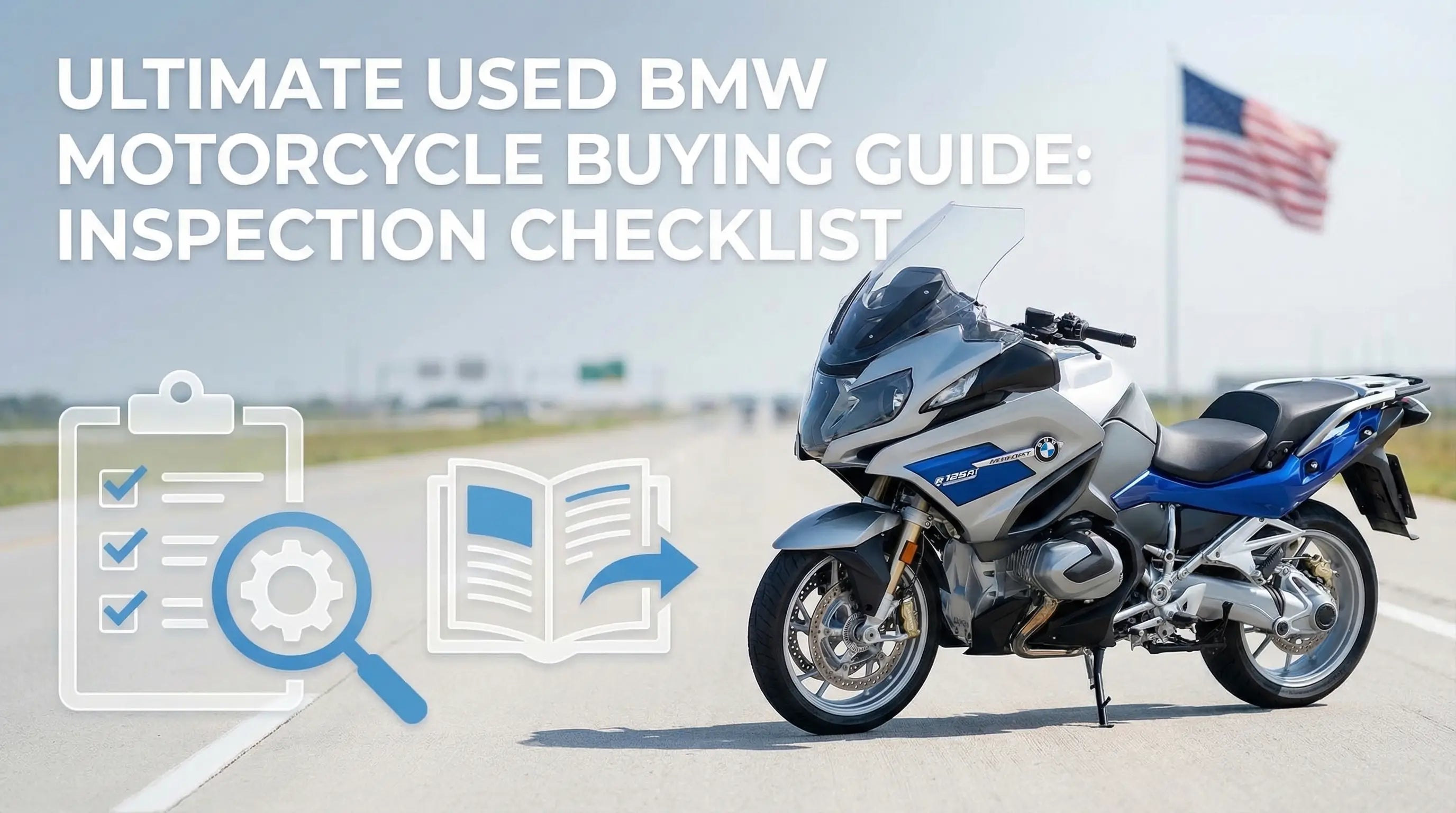
Introduction: The Part Nobody Tells You About Buying Used
Buying a used BMW motorcycle in the U.S. is supposed to be the smart move.
You save money. You skip depreciation. You get a machine that, in many cases, is still capable of crossing states without breaking a sweat.
That’s the idea.
The reality is a bit more complicated.
Because today’s BMW motorcycles aren’t just bikes anymore. They’re tightly integrated systems—engines, electronics, sensors, and software all working together. When everything is right, they’re incredible. When something is slightly off, they can quietly turn into very expensive problems.
And here’s the catch.
Most of those problems don’t show up during a quick inspection.
They don’t announce themselves on a clean dashboard.
They don’t always affect a short test ride.
They sit there. Hidden. Waiting.
This guide isn’t just about what to check. It’s about how to think when you’re looking at a used BMW—and how to avoid paying for someone else’s problems.
1. The U.S. Used BMW Motorcycle Market (What You’re Actually Walking Into)
If you’ve been browsing listings recently, you’ve probably noticed how many BMW motorcycles are available right now.
That’s not random.
Over the last few years, BMW has pushed hard into the adventure and touring segments. Bikes like the GS series dominate long-distance riding in the U.S., and they hold their value unusually well. Riders buy them, ride them hard for a few seasons, and then upgrade.
Which means the used market is full of:
-
R1250GS and newer GS models
-
Mid-range GS bikes like the F850GS
-
Sport bikes like the S1000RR
-
Occasional touring and cruiser models
On paper, this is great for buyers. More supply means more choice.
But there’s a second layer most people don’t think about.
These bikes are often sold right at the point where maintenance starts to matter.
Not catastrophic failure. Not obvious damage. Just… that stage where things begin to wear out.
That’s why two identical-looking bikes can have completely different futures.
One will run flawlessly for years.
The other will slowly drain your wallet.
Your job is to tell which is which.
2. Choosing the Right BMW (Before You Even Start Inspecting)
A lot of people jump straight into listings. That’s a mistake.
The smarter move is to decide what kind of bike fits your use first—because that decision affects everything else: price, reliability expectations, even how hard the previous owner likely rode it.
Adventure Bikes (GS Series)
These are everywhere in the U.S. for a reason.
They’re comfortable, versatile, and built for long distances. But they’re also often used the hardest. Long trips. Off-road sections. Fully loaded with gear.
Which means when you’re buying one used, you’re not just buying a bike—you’re buying its history.
And that history is rarely “light use.”
Sport Bikes (S1000RR and Similar)
Completely different story.
These bikes are fast. Aggressive. And often ridden that way.
You’re less worried about mileage here. More worried about how that mileage happened.
Hard acceleration. Late braking. Track days.
A clean-looking sport bike can still have lived a very hard life.
Touring and Cruiser Models
Generally, these are the safest used buys.
They’re built for comfort, not abuse. Owners tend to maintain them better. But repairs, when needed, can be expensive due to complexity.
3. The Inspection: What Matters (and What Doesn’t)
Most inspection guides give you a checklist. That’s useful—but incomplete.
Because the real skill isn’t checking items. It’s knowing which details actually matter.
Exterior Inspection: Reading Between the Lines
Anyone can spot scratches.
What you’re looking for is inconsistency.
A slightly different paint tone on one panel. A bolt that looks newer than the ones around it. A bracket that’s just slightly misaligned.
Individually, these mean nothing.
Together, they tell a story.
Usually: the bike has been down at some point.
That doesn’t automatically make it a bad buy. But it should change how you evaluate everything else.
Engine Behavior: Listen Like It Matters
Starting a bike and hearing it run is not enough.
What matters is how it runs—and more importantly, how it changes as it warms up.
A cold engine can hide a lot.
A warm engine tells the truth.
Pay attention to rhythm. Not just sound.
A BMW engine should feel consistent. If the idle fluctuates slightly, or there’s an uneven mechanical tick, that’s worth investigating. Not panicking—but not ignoring either.
The Test Ride: Where Problems Start to Show
Five-minute rides are useless.
Most bikes can behave well for five minutes.
You want:
-
15–20 minutes minimum
-
Mixed conditions (slow traffic + open road)
-
Full warm-up
Watch for subtle things:
-
Slight hesitation when opening throttle
-
Brake feel changing over time
-
Minor vibrations that weren’t there at the start
These are early warning signs. Not failures—but signals.
Electrical Systems: Don’t Trust the Dashboard Alone
Here’s something many buyers don’t realize.
A clean dashboard does not mean a clean system.
Warning lights can be cleared. Temporarily.
And some issues don’t trigger lights immediately.
So yes—check everything visually.
But don’t stop there.
4. The Hidden Layer: Why a Diagnostic Scanner Changes Everything
This is where the gap between average buyers and smart buyers becomes obvious.
Modern BMW motorcycles record everything.
Not just active problems—but history.
And that history doesn’t always disappear.
What You Can’t See (But the Bike Remembers)
A bike may have:
-
Intermittent sensor failures
-
Past misfires
-
ABS communication errors
-
Voltage irregularities
None of these may show up during your visit.
But they’re stored.
And once you know that, it changes how you approach every purchase.
How a Simple Scan Can Save You Thousands
The process itself is simple.
Connect a scanner. Turn the ignition on. Run a full system check.
What you’re looking for isn’t just “is there a code.”
It’s patterns.
A single stored code from months ago? Probably nothing.
Multiple related codes? That’s a story.
And that story usually leads to cost.
Real-World Example (This Happens More Than You Think)
A buyer finds a clean BMW GS.
Low mileage. Great price. No warning lights.
Test ride feels fine.
A scan shows:
-
Stored ABS fault
-
Intermittent wheel speed sensor issue
Nothing urgent. The bike runs fine.
But that repair? Easily $800–$1500.
Now the buyer has a choice:
-
Walk away
-
Or negotiate
Without the scan, they would have paid full price.
Step-by-Step: Scanning Before You Buy
You don’t need to be technical.
-
Locate the port (usually under the seat)
-
Plug in the scanner
-
Turn ignition on
-
Run a full scan
-
Review codes (active + stored)
That’s it.
Simple step. Big difference.
Common BMW Fault Codes (What They Actually Mean)
-
P0300 — Not just “misfire.” Could be ignition coils, injectors, or deeper wear
-
P0170 — Fuel imbalance. Sometimes minor, sometimes a sign of sensor drift
-
P0500 — Speed sensor issue. Often tied to ABS
Codes are not the problem.
They’re clues.
5. Common BMW Problems (The Ones That Cost Money)
Every brand has patterns. BMW is no exception.
Oil Leaks
Not always dramatic. Sometimes just a slight seep.
But left alone, they become real repairs.
ABS Issues
One of the more expensive ones.
Often starts as intermittent faults. Easy to miss without scanning.
Sensor Problems
This is where modern bikes get tricky.
Sensors fail partially. Not completely.
Which means:
-
No warning light
-
But inconsistent behavior
Exactly the kind of issue that shows up after you buy the bike.
6. Final Buying Advice: Think Like This
At the end of the day, buying a used BMW motorcycle isn’t about finding the cheapest option.
It’s about understanding risk.
Two bikes can look identical.
One is a great deal.
The other is a future repair bill.
The difference is rarely obvious.
Unless you look deeper.
The Smart Buyer’s Approach
-
Don’t rush
-
Don’t trust appearances
-
Always verify
And most importantly:
Don’t rely on what you can see.
Because in today’s market, the expensive problems are the ones you can’t.
FAQ
How do I inspect a used BMW motorcycle properly?
Combine visual inspection, a full test ride, and a diagnostic scan. Each step reveals different types of issues.
Can a motorcycle have problems even if it runs fine?
Yes. Many issues—especially electronic ones—don’t affect short-term performance but appear later.
Is a diagnostic scanner really necessary?
For modern BMW motorcycles, yes. It’s the only way to access system history and hidden faults.
What mileage is too high for a used BMW motorcycle?
Mileage matters less than maintenance. A well-maintained high-mile bike can be more reliable than a neglected low-mile one.
Where can I buy used BMW motorcycles in the U.S.?
Common platforms include CycleTrader, Craigslist, and Facebook Marketplace.
Conclusion
Buying a used BMW motorcycle is not risky by default.
It becomes risky when you skip steps.
Take the time. Check properly. Use the right tools.
Because the difference between a great purchase and a costly mistake usually comes down to one thing:
How deep you’re willing to look.
Data Sources
-
BMW Motorrad Sales Reports (2025)
-
U.S. used motorcycle market observations
-
Google Trends (motorcycle and diagnostic tool search trends)