
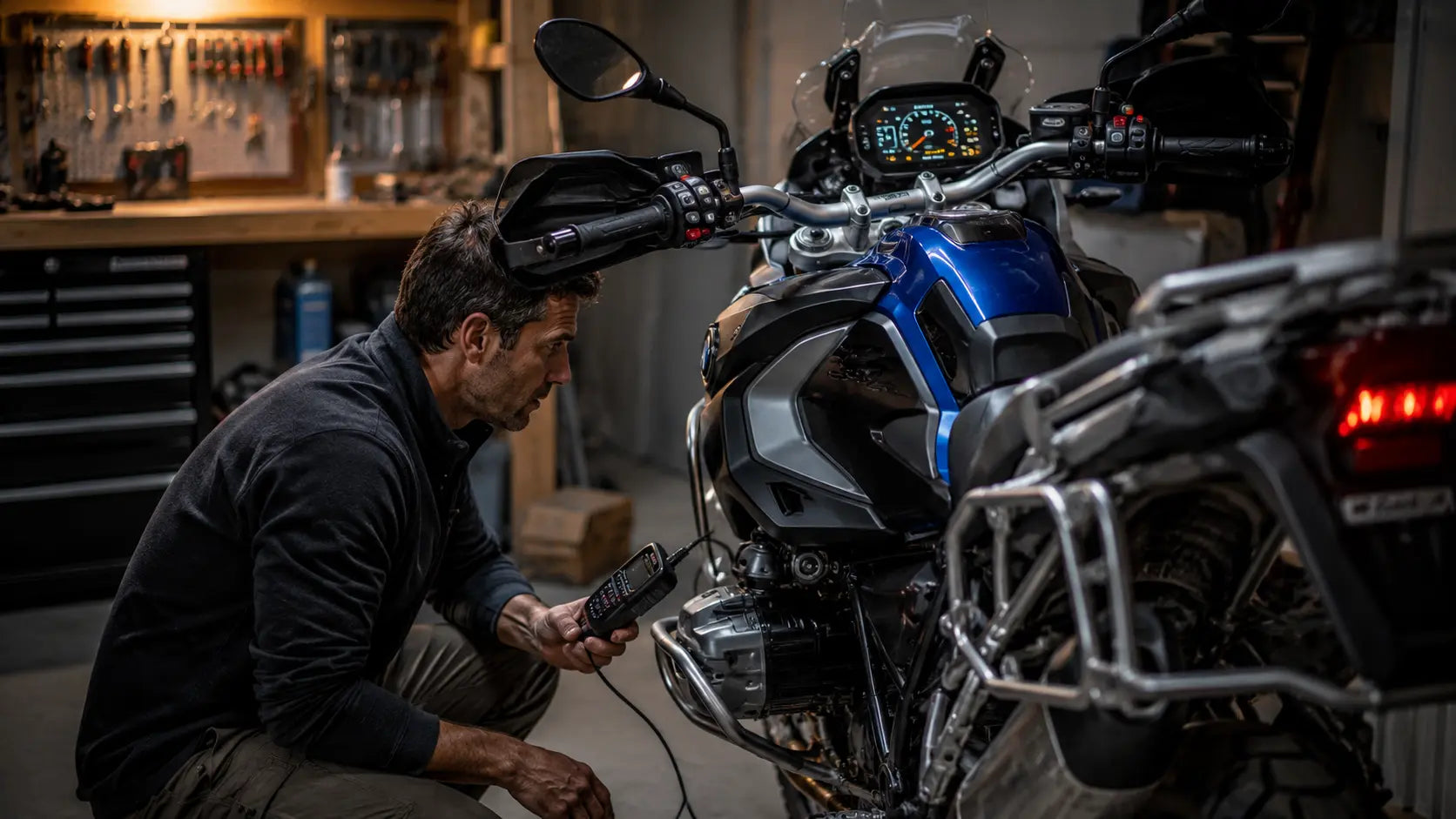
A Complete Troubleshooting Guide for BMW Riders Experiencing Rough Idle, Surging, or Unstable RPM
You start your BMW motorcycle, let it warm up, and immediately notice something doesn't feel right.
The engine shakes more than usual. The RPM needle fluctuates. The idle sounds uneven. In some cases, the bike may even stall when sitting at a traffic light.
A rough idle can be frustrating, especially when the motorcycle otherwise seems to ride normally. Fortunately, rough idle problems are often symptoms—not failures. Many can be diagnosed systematically and resolved before they become expensive repairs.
Whether you ride a BMW R 1250 GS, F 900 GS, R 18, RT, or another BMW Motorrad model, understanding the potential causes of rough idle can save time, money, and unnecessary dealership visits.
In this guide, we'll explain the most common causes of BMW motorcycle rough idle, how to diagnose the issue, and when a diagnostic scanner or adaptation reset may help restore smooth engine operation.
What Does a Rough Idle Feel Like?
Before diagnosing the problem, it's important to understand what qualifies as a rough idle.
A healthy BMW motorcycle should maintain a relatively stable idle speed with minimal vibration. Depending on the model, idle speed typically ranges between 1,000 and 1,300 RPM.
A rough idle may include:
- Fluctuating RPM
- Engine vibration while stopped
- Surging or hunting idle speed
- Occasional stalling
- Delayed throttle response
- Uneven exhaust sound
- Difficulty maintaining idle when cold
Some symptoms may appear only when the engine is cold, while others become noticeable after the motorcycle reaches operating temperature.
Understanding when the problem occurs often provides valuable clues during diagnosis.
Common Cause #1: Dirty Throttle Body
One of the most common causes of rough idle on modern BMW motorcycles is carbon buildup inside the throttle body.
Over time, small deposits accumulate around the throttle plate. These deposits can disrupt airflow and affect how the engine management system controls idle speed.
Common Symptoms
- Rough idle
- Hesitation when opening the throttle
- Inconsistent idle speed
- Reduced throttle responsiveness
Possible Solution
Inspect the throttle body for visible contamination and clean it according to BMW service recommendations.
After cleaning, some motorcycles may require an adaptation relearn procedure so the ECU can properly adjust to the restored airflow characteristics.
Common Cause #2: Adaptation Values Need Relearning
Modern BMW motorcycles continuously adapt to riding conditions.
The engine control unit (ECU) stores adaptation values that help optimize:
- Fuel delivery
- Air-fuel mixture
- Idle control
- Throttle response
In some situations, these learned values may become outdated or less effective.
Situations That May Affect Adaptation Values
After Battery Replacement
Disconnecting power can sometimes affect learned settings.
After Throttle Body Service
Cleaning or replacing throttle-related components changes airflow characteristics.
After Sensor Replacement
New sensors may provide different readings than the ECU has previously learned.
After Long-Term Storage
Motorcycles that sit unused for extended periods may occasionally exhibit temporary idle irregularities.
Can an Adaptation Reset Help?
Sometimes, yes.
An adaptation reset allows the ECU to relearn operating parameters based on current engine conditions.
However, adaptation resets are not miracle fixes. If a mechanical problem exists, resetting adaptations alone will not solve it.
For a detailed explanation, see our guide:
When Should You Reset Adaptation Values on a BMW Motorcycle?
Common Cause #3: Vacuum Leaks
A vacuum leak occurs when unmetered air enters the intake system.
Because the ECU is unaware of this additional air, the engine may struggle to maintain a stable air-fuel ratio.
Common Leak Locations
- Intake boots
- Vacuum hoses
- Hose clamps
- Cracked rubber components
Typical Symptoms
- High idle speed
- Surging idle
- Lean-running conditions
- Inconsistent RPM
Vacuum leaks are often overlooked because they may not trigger an immediate warning light.
Common Cause #4: Worn or Dirty Spark Plugs
Spark plugs play a critical role in combustion quality.
As plugs age, deposits accumulate and electrode wear increases.
The result can be incomplete combustion at idle speeds.
Common Symptoms
- Rough idle
- Misfires
- Hard starting
- Reduced fuel economy
Fortunately, spark plug inspection is relatively straightforward and often reveals issues quickly.
Common Cause #5: Fuel Delivery Problems
Your BMW motorcycle depends on precise fuel delivery.
Any disruption in that process can affect idle quality.
Potential Fuel System Issues
Dirty Fuel Injectors
Restricted injector spray patterns can create uneven combustion.
Contaminated Fuel
Water or debris in fuel may affect engine performance.
Fuel Pressure Problems
Insufficient fuel pressure can lead to unstable idle and hesitation.
Common Symptoms
- Rough idle
- Poor acceleration
- Engine hesitation
- Difficult starting
Fuel-related issues become more common when motorcycles sit unused for extended periods.
Common Cause #6: Faulty Engine Sensors
Modern BMW motorcycles rely on multiple sensors to calculate fuel delivery and engine management strategies.
A sensor that provides inaccurate information can create idle problems without causing obvious mechanical symptoms.
Oxygen (O2) Sensor
The O2 sensor helps regulate fuel mixture.
Incorrect readings may contribute to unstable idle behavior.
Intake Air Temperature Sensor
This sensor influences fuel calculations based on incoming air temperature.
Throttle Position Sensor
The ECU uses throttle position data to control fueling and idle stability.
When sensors begin to fail, diagnostic trouble codes are often stored in memory even before a warning light appears.
Common Cause #7: Low Battery Voltage
Many riders underestimate how much modern BMW motorcycles depend on stable voltage.
A weak battery can affect:
- ECU operation
- Idle control systems
- Sensor communication
- Electronic throttle functions
Common Symptoms
- Rough idle
- Random warning lights
- Hard starting
- Electrical glitches
Battery-related problems often become more noticeable after winter storage or during colder weather.
Testing battery voltage should always be one of the first diagnostic steps.
How to Diagnose a BMW Motorcycle Rough Idle
Rather than replacing parts randomly, follow a systematic troubleshooting process.
Step 1: Check Battery Health
Confirm battery voltage meets BMW specifications.
Step 2: Inspect the Throttle Body
Look for carbon buildup and contamination.
Step 3: Check for Vacuum Leaks
Inspect intake components and hoses.
Step 4: Examine Spark Plugs
Check for wear, deposits, or damage.
Step 5: Scan for Fault Codes
Retrieve stored diagnostic information before replacing parts.
Step 6: Consider an Adaptation Reset
If recent maintenance has been performed, adaptation relearning may be appropriate.
Following these steps can dramatically reduce diagnostic time and unnecessary repairs.
When Should You Use a Diagnostic Scanner?
Modern motorcycles generate an enormous amount of diagnostic information.
A motorcycle diagnostic scanner can help you:
- Read fault codes
- Clear diagnostic trouble codes
- View live sensor data
- Reset service reminders
- Perform adaptation resets
- Monitor engine parameters
Without diagnostic data, troubleshooting often becomes guesswork.
For BMW owners who perform their own maintenance, a diagnostic scanner is one of the most valuable tools available. Check our >> CGSULIT SC530 Pro for BMW Motorcycle
Can an Adaptation Reset Fix Rough Idle?
This is one of the most common questions BMW owners ask.
The answer depends on the root cause.
Situations Where It May Help
- After battery replacement
- After throttle body cleaning
- After sensor replacement
- After certain ECU-related repairs
Situations Where It Will Not Help
- Vacuum leaks
- Bad fuel injectors
- Worn spark plugs
- Mechanical engine problems
- Fuel pressure issues
An adaptation reset should be viewed as part of the diagnostic process, not a universal solution.
For additional insight, read:
BMW Motorcycle Throttle Body Relearn vs Adaptation Reset: What's the Difference?
When to Seek Professional Service
While many idle-related issues can be diagnosed at home, some situations require professional attention.
Consider consulting a qualified BMW motorcycle technician if you experience:
- Persistent warning lights
- Repeated fault codes
- Compression-related issues
- Fuel system failures
- Internal engine noises
- Severe performance loss
Professional diagnostic equipment may be necessary to identify more complex problems accurately.
Frequently Asked Questions
Why is my BMW motorcycle idling rough but rides fine?
Minor issues such as adaptation irregularities, early sensor problems, or slight vacuum leaks may affect idle quality before impacting overall riding performance.
Can a dirty throttle body cause rough idle?
Yes. Carbon buildup can disrupt airflow and interfere with idle control.
Can a weak battery cause rough idle?
Absolutely. Modern BMW motorcycles rely heavily on stable voltage for proper ECU and sensor operation.
Will an adaptation reset fix rough idle?
Sometimes. It may help after battery replacement, throttle body service, or sensor replacement, but it will not fix mechanical faults.
How do I diagnose rough idle on a BMW motorcycle?
Start with battery testing, throttle body inspection, vacuum leak checks, spark plug evaluation, and fault code scanning before replacing components.
References
This article is based on general motorcycle diagnostic principles and information commonly referenced from:
- BMW Motorrad Owner's Manuals
- BMW Motorrad Service Information
- Bosch Engine Management Documentation
- SAE International Technical Papers
- Haynes Motorcycle Repair Manuals
Disclaimer
This guide is intended to help BMW motorcycle owners understand common causes of rough idle conditions and possible troubleshooting steps. It is not a substitute for professional diagnosis or repair. Symptoms such as rough idle, stalling, warning lights, or engine performance issues may have multiple causes that cannot be accurately identified without proper inspection and diagnostic equipment. Always refer to official BMW Motorrad service information and consult a qualified technician when necessary.
Most Rough Idle Problems Can Be Diagnosed Systematically
A rough idle doesn't automatically mean your BMW motorcycle needs expensive repairs.
In many cases, the issue can be traced to a handful of common causes, including dirty throttle bodies, outdated adaptation values, weak batteries, vacuum leaks, or sensor-related problems.
The key is to approach diagnosis methodically.
Start with the basics. Verify battery health. Inspect the intake system. Scan for fault codes. Consider whether recent maintenance may have affected ECU adaptations.
By following a structured troubleshooting process, riders can often identify the root cause quickly, avoid unnecessary parts replacement, and keep their BMW motorcycle running as smoothly as the engineers intended.