
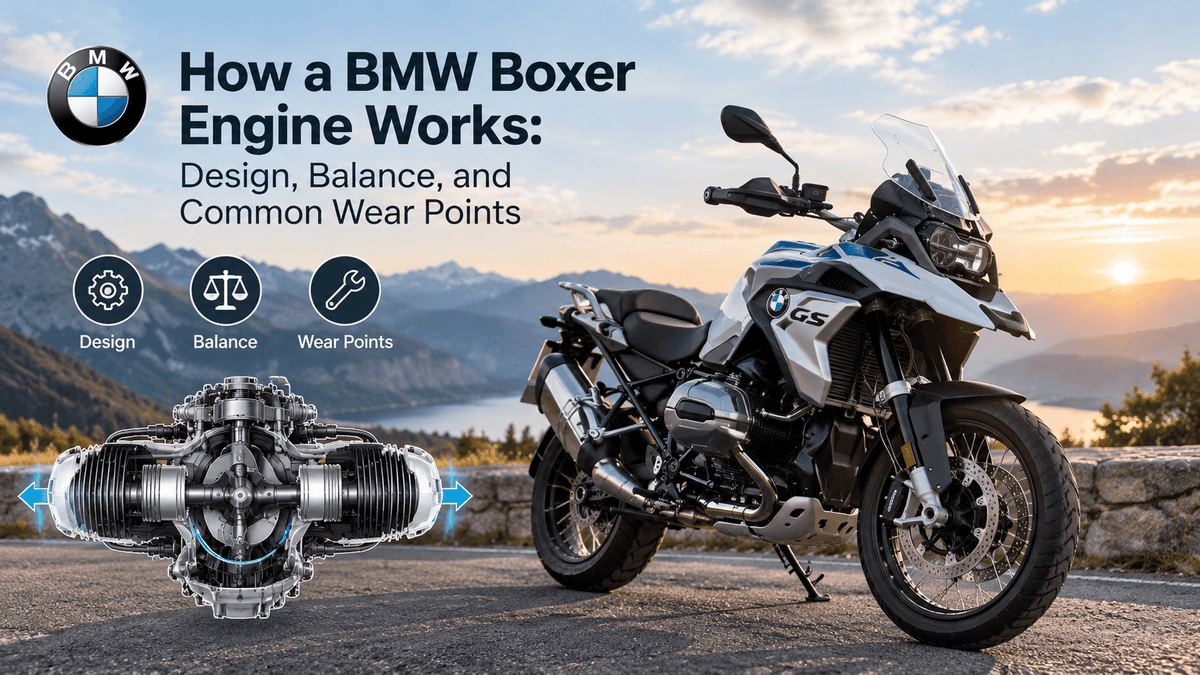
A BMW boxer engine has a distinctive look. Its cylinders extend out from either side of the motorcycle, giving the engine a shape that is instantly recognizable among riders. But the design is more than a styling choice. It influences how the engine produces power, how its moving parts interact, and what owners should pay attention to during maintenance.
BMW Motorrad has used the boxer configuration across its R-series motorcycles for decades. Modern versions combine the traditional flat-twin layout with electronic fuel injection, advanced valve technology, and increasingly sophisticated engine management. The R 1250 GS and R 1250 RT, for example, introduced BMW ShiftCam technology to series-production boxer engines.
Understanding the design makes routine maintenance easier to understand, too. It helps explain normal engine characteristics, recognize changes that deserve attention, and avoid replacing parts based on symptoms alone.
In this guide, we’ll look at how a BMW boxer engine works, why its balance and vibration characteristics are different from those of other engine layouts, and which components deserve attention as the motorcycle accumulates miles.
What Is a BMW Boxer Engine?
A BMW boxer engine is a horizontally opposed engine with two cylinders positioned on opposite sides of the motorcycle. Each cylinder faces outward, and the pistons move in opposite directions along a shared crankshaft axis.
This arrangement is also called a flat-twin engine. Unlike a parallel-twin, whose cylinders stand side by side in the same general direction, a boxer spreads its cylinders across the motorcycle. A V-twin places its cylinders at an angle to each other instead.
The layout affects more than the engine’s appearance. It influences the distribution of engine mass, the forces created by moving pistons, airflow around the cylinder heads, and access to certain service components.
Why Does BMW Use the Boxer Design?
The boxer layout has long been associated with BMW Motorrad’s R-series motorcycles. Its horizontally opposed cylinders allow the engine to sit relatively low in the chassis, although the motorcycle’s actual center of gravity depends on the entire vehicle, including its fuel tank, transmission, frame, and other components.
There is another practical advantage. The cylinder heads are positioned on the sides of the motorcycle, making some maintenance tasks—such as accessing the valve covers—more straightforward than on certain tightly packaged engine designs.
That does not mean every repair is easy. Access to a component is only one part of the job; the required measurements, tools, and model-specific procedures still matter.
BMW’s boxer engines have also evolved considerably. Modern designs incorporate electronic fuel injection, four-valve cylinder heads, and, on selected models, variable intake valve timing and lift. The basic layout remains recognizable, but the technology inside it varies by generation.
How Does a BMW Boxer Engine Work?
The boxer engine follows the same fundamental four-stroke combustion cycle used by many gasoline-powered motorcycles. What makes it distinctive is the arrangement of the cylinders and the way the pistons connect to the crankshaft.
The Four-Stroke Combustion Cycle

1. Intake
The intake valve opens, and the descending piston draws air into the cylinder. In a fuel-injected engine, the fuel delivery system supplies fuel according to the engine’s operating requirements.

2. Compression
The piston moves upward with the valves closed, compressing the charge inside the cylinder. Compression prepares the mixture for combustion.

3. Power
The spark plug ignites the compressed mixture. Expanding combustion gases push the piston downward, transferring force through the connecting rod to the crankshaft.

4. Exhaust
The exhaust valve opens as the piston moves upward, pushing spent gases out of the cylinder. The cycle then repeats.
Each cylinder completes the four-stroke cycle over two crankshaft revolutions. The two cylinders operate in a coordinated sequence, producing the torque that ultimately drives the motorcycle.
How the Pistons and Crankshaft Create Power
Inside the engine, each piston moves back and forth within its cylinder. A connecting rod transfers that motion to the crankshaft, which converts the pistons’ linear movement into rotation.
The crankshaft then delivers rotational power through the drivetrain to the rear wheel.
The opposing piston arrangement is central to the boxer’s character. Both pistons move toward or away from the center of the engine together, which helps counteract certain primary reciprocating forces. However, the engine does not eliminate every force or vibration. Crankshaft geometry, combustion pulses, rotating components, and the engine’s mounting all influence how it feels.
The Role of Valves, Camshafts, and Fuel Injection
The pistons cannot produce power efficiently without precisely timed gas exchange.
The camshaft operates the intake and exhaust valves, allowing fresh air into the cylinder and spent gases out. Fuel injection meters fuel, while the ignition system controls when the spark occurs. The engine control unit coordinates these processes using sensor inputs and programmed operating strategies.
Some newer BMW boxer engines go further. BMW ShiftCam, introduced on the R 1250 engine generation, varies intake valve timing and lift to balance smooth operation and efficiency at part load with stronger performance when more power is demanded. It is not a feature found on every BMW boxer engine.
Boxer Engine Balance and Vibration Explained
One of the most discussed characteristics of a BMW boxer engine is its balance. The opposing pistons help reduce certain vibration forces, but understanding why requires looking beyond the direction in which the pistons move.
How Opposing Pistons Affect Engine Balance
In a conventional boxer arrangement, the pistons move in opposite directions. Their reciprocating motion helps cancel much of the primary inertial force associated with each piston moving back and forth.
That is an important advantage. It is not the same as saying the engine is completely vibration-free.
The crankshaft, connecting rods, rotating masses, and combustion events still generate forces and torque fluctuations. Their effects depend on the specific engine design, crankshaft configuration, balance shaft arrangements, and operating speed.
Why Boxer Engines Still Vibrate
Even a mechanically well-balanced engine produces some vibration. Combustion happens in pulses rather than as a perfectly continuous force, and those pulses change with engine speed and load.
Riders may also notice a characteristic rocking reaction when the engine is revved while the motorcycle is stationary. This is related to the reaction torque generated by the rotating engine components and does not automatically indicate a fault.
What matters is whether the behavior is consistent with the motorcycle’s normal operating characteristics.
A sudden increase in vibration, a new metallic knocking sound, or rough running accompanied by a loss of power deserves investigation. Possible causes range from ignition or fuel-delivery issues to valve-train problems or other mechanical faults.
What Is Normal—and What May Need Attention?
Use the motorcycle’s operating history as a reference. A familiar vibration that has remained unchanged is different from a new vibration that appears under the same conditions.
Pay attention to three things:
-
When it happens: At idle, during acceleration, at a particular engine speed, or only under load.
-
What accompanies it: Misfires, warning lights, unusual noises, smoke, or fluid leaks.
-
Whether it is getting worse: A developing symptom is more concerning than a stable characteristic that has always been present.
These observations help narrow the diagnostic path. They do not replace inspection or measurements.
Common BMW Boxer Engine Wear Points
A boxer engine is not immune to wear. Like any internal combustion engine, it relies on proper lubrication, accurate valve timing, sound sealing surfaces, and controlled operating temperatures.
The important distinction is between components that require routine inspection and parts that have actually failed. A potential wear point is not proof of a model-wide defect.
1. Valve Train and Valve Clearance
Valve clearance is the small, specified gap within the valve-actuation mechanism that allows for thermal expansion and proper operation.
If clearance becomes too tight, a valve may not close as intended under certain operating conditions. That can compromise sealing and, in severe cases, contribute to valve damage. Excessive clearance can produce additional mechanical noise and affect valve-train operation.
The correct clearance depends on the engine design and measurement conditions. Owners should follow the service information for their exact model rather than applying a generic specification to every BMW boxer.
During maintenance, technicians should use the prescribed measurement procedure and compare the results with the manufacturer’s limits.
2. Oil Leaks and Sealing Surfaces
Oil around a cylinder head or valve cover can be easy to notice because these components sit on the sides of the motorcycle. But the visible location of the oil is not always the source of the leak.
Oil can spread across adjacent surfaces before collecting at a lower point. Dirt and old residue can also make a minor seepage look more serious than it is.
A sensible inspection begins by identifying where fresh oil first appears. Clean the affected area, inspect the relevant sealing surfaces, and check again after operating the motorcycle as appropriate.
Persistent leaks, oil reaching hot exhaust components, or a falling oil level require prompt attention. Do not assume every leak is simply a worn valve-cover gasket.
3. Lubrication and Oil-Related Wear
Engine oil does much more than reduce friction. It helps carry heat away from moving components, protects surfaces from wear, and supports the operation of the lubrication system.
Oil-related problems can develop when the level is incorrect, the oil does not meet the required specification, maintenance is neglected, or a component within the lubrication system fails.
Low oil level and low oil pressure are not interchangeable conditions. A motorcycle can have an apparently acceptable oil level while still experiencing a lubrication problem.
Follow the model-specific procedure for checking the oil, including the required engine temperature and waiting time where applicable. If an oil-pressure warning appears while the engine is running, stop safely and follow the owner’s manual instructions rather than continuing to ride in the hope that the warning will disappear.
4. Camshaft, Rocker Components, and Internal Wear
The valve train operates under repeated mechanical loads. Camshaft lobes, rocker components where fitted, bearings, and associated contact surfaces can wear over time, particularly if lubrication is inadequate or maintenance has been neglected.
Potential warning signs include abnormal mechanical noise, incorrect valve-clearance measurements, or visible damage during inspection.
None of these symptoms identifies a failed component by itself. For example, valve-train noise may result from incorrect clearance, while other noises can originate elsewhere in the engine or drivetrain.
A proper diagnosis compares the symptom with service specifications and, where necessary, includes physical inspection and measurement.
The exact valve-actuation arrangement differs among BMW boxer generations. A procedure suitable for one engine should not automatically be applied to another.
5. Cooling System and Heat Management
BMW boxer engines have used different cooling arrangements over the years. Some rely primarily on air and oil cooling, while others combine air cooling with liquid cooling, particularly around areas that require more controlled temperature management.
That distinction matters during diagnosis.
Airflow around the cylinder heads is important on air-cooled designs. On liquid-cooled models, the coolant circuit and its associated components introduce additional items to inspect. Oil also contributes to lubrication and heat management, but it should not be treated as a substitute for a dedicated coolant circuit where one is fitted.
Repeated overheating, persistent temperature warnings, coolant loss, or unusual engine behavior should be investigated using the procedures for the specific motorcycle. Do not assume all boxer engines have the same cooling system or troubleshooting requirements.
BMW’s published R 1250 engine information, for example, identifies that generation as an air/liquid-cooled boxer with ShiftCam technology. Earlier and later engines may differ in important ways.
How to Recognize Potential Boxer Engine Problems
A useful diagnosis starts with a symptom, not a replacement part.
The same symptom can have several causes, so the goal is to gather enough evidence to narrow the possibilities before taking the engine apart.
|
Symptom |
Possible areas to investigate |
Useful next step |
|---|---|---|
|
Unusual ticking or knocking |
Valve train, lubrication, other mechanical components |
Identify the noise and compare it with model-specific service guidance |
|
Rough idle or misfire |
Ignition, fuel delivery, intake leaks, compression, sensors |
Read available fault codes and inspect the relevant systems |
|
Oil around the cylinder head |
Gaskets, sealing surfaces, nearby leak sources |
Clean the area and trace the source of fresh oil |
|
New or increasing vibration |
Engine running condition, mounts, drivetrain, mechanical wear |
Record when the vibration occurs and check for accompanying symptoms |
|
Temperature warning |
Cooling system where fitted, oil level, operating conditions, other engine faults |
Follow the owner’s manual and investigate the warning promptly |
Where Diagnostic Tools Fit In
A compatible motorcycle diagnostic scanner can help retrieve fault codes, display available live data, and identify which electronic systems have reported problems. Depending on the motorcycle and the tool, it may also support additional tests or service functions.
But electronic diagnosis has limits.
A fault code does not always mean the named sensor or component has failed. Nor can a scan tool directly measure every form of mechanical wear. Valve clearance, compression, sealing, and many internal engine conditions may require physical inspection or dedicated mechanical tests.
The strongest approach combines electronic evidence with the actual symptoms and appropriate mechanical checks. That is how a technician moves from a possible cause to a defensible diagnosis.
BMW Boxer Engine Maintenance: What Owners Should Know
Good maintenance begins with the correct information. BMW boxer engines share a basic layout, but their service requirements can differ significantly by model, production year, and engine generation.
A few habits make a real difference.
-
Check the engine oil correctly. Follow the owner’s manual for the motorcycle’s specific oil-level checking procedure and use the specified oil grade.
-
Keep up with valve-clearance inspections. Use the service interval and measurement specifications applicable to your engine.
-
Investigate leaks early. Fresh oil around a cylinder head, a persistent drop in oil level, or fluid reaching hot components should not be ignored.
-
Pay attention to changes in engine behavior. New noises, repeated misfires, unusual vibration, and warning lights are more useful when considered together.
-
Keep maintenance records. Recording mileage, service dates, measured clearances, and recurring symptoms can help identify changes over time.
Avoid using a single maintenance schedule for every BMW boxer. When in doubt, consult the official documentation for your exact model and year.
Frequently Asked Questions
What Is a BMW Boxer Engine?
A BMW boxer engine is a horizontally opposed engine with two cylinders positioned on opposite sides of the motorcycle. Its layout helps balance certain reciprocating forces and gives BMW R-series motorcycles their distinctive engine shape and character.
Why Does a BMW Boxer Engine Have Two Cylinders Sticking Out?
The cylinders extend outward because the pistons move horizontally in opposite directions. This arrangement creates a relatively wide, low-mounted engine package and makes some cylinder-head service tasks accessible from the sides of the motorcycle.
Are BMW Boxer Engines Naturally Balanced?
The opposing pistons help cancel much of the primary reciprocating force in a conventional boxer arrangement. However, the engine still produces combustion pulses and other forces, so some vibration is normal. The amount and character depend on the specific engine design and operating conditions.
What Are Common Wear Points on a BMW Boxer Engine?
Components worth monitoring include valve-train parts, sealing surfaces, and components affected by lubrication or excessive heat. These are maintenance and inspection considerations, not proof that every BMW boxer engine has the same weaknesses.
How Often Should BMW Boxer Valve Clearance Be Checked?
The interval varies by model and engine generation. Check the maintenance schedule for your exact motorcycle, and follow the specified conditions and measurement procedure. Do not rely on a generic interval or clearance value found for a different engine.
Are All BMW Boxer Engines Air-Cooled?
No. BMW has produced boxer engines with different cooling arrangements, including air/oil-cooled designs and engines that combine air cooling with liquid cooling. The correct maintenance and diagnostic procedures depend on the specific engine.
Conclusion: Understanding the Boxer Engine Makes Maintenance More Effective
The BMW boxer engine is distinctive because of its horizontally opposed cylinders, but its real engineering story goes beyond appearance. The layout influences the engine’s balance, vibration characteristics, packaging, and service access.
Understanding those fundamentals helps owners interpret what they feel and hear while riding. It also provides a better starting point when a problem develops.
The key is to distinguish normal engine characteristics from changes that require investigation. Monitor oil levels, follow the correct valve-clearance schedule, trace leaks carefully, and use diagnostic evidence alongside mechanical inspection. Most importantly, apply the maintenance specifications for the exact motorcycle rather than assuming every BMW boxer is identical.
A sound understanding of the design will not prevent every mechanical problem. It will, however, help you approach maintenance and diagnosis with better information and fewer assumptions.
References and Further Reading
The following sources provide manufacturer information for verifying engine design, technology, and maintenance requirements.
1. BMW Motorrad USA — 1250 cc Twin-Cylinder Boxer Engine
Manufacturer overview of the R 1250 boxer engine, including its cooling arrangement and ShiftCam technology.
2. BMW Group PressClub USA — The New BMW R 1250 GS and R 1250 RT
Official technical background on the R 1250 engine, including variable intake valve timing and lift, fuel injection, and changes to the engine’s oil supply.
3. BMW Motorrad — Engine and Drivetrain: Technology in Detail
Manufacturer information on BMW motorcycle engine and drivetrain designs, useful for understanding differences across engine configurations.
4. BMW Motorrad Owner’s Manuals — Official Manual Portal
Use the official BMW Motorrad website to locate the owner’s manual and applicable service information for your motorcycle. Consult the exact model and year for maintenance schedules, oil specifications, warnings, and operating procedures.
Technical note: The descriptions in this article explain general engineering principles. They are not a substitute for model-specific repair instructions, diagnostic procedures, or manufacturer specifications.