
If your car has ever struggled to start on a cold morning, there’s a good chance you’ve searched for ways to test the battery yourself. And sooner or later, you’ll run into the same question many drivers ask:
Should you use a battery tester or a multimeter?
At first glance, they seem similar. Both connect to the battery. Both display electrical readings. Both are commonly found in garages and repair shops.
But in real-world automotive diagnostics, they serve very different purposes.
Understanding the difference between a battery tester and a multimeter can save you time, prevent misdiagnosis, and help you avoid replacing perfectly good parts unnecessarily.
What Is a Multimeter?
A multimeter is a general-purpose electrical testing tool used to measure:
- Voltage
- Current
- Resistance
It’s widely used by electricians, technicians, and DIY users because it can test many different electrical systems beyond automotive batteries.
When checking a car battery, a multimeter primarily measures voltage. For example, a healthy fully charged battery will usually read around 12.6 volts with the engine off.
That information is useful. However, voltage alone does not always tell the complete story.
A battery may still show normal voltage while struggling internally under load.
What Is a Battery Tester?
A battery tester is specifically designed to analyze battery condition and charging system performance.
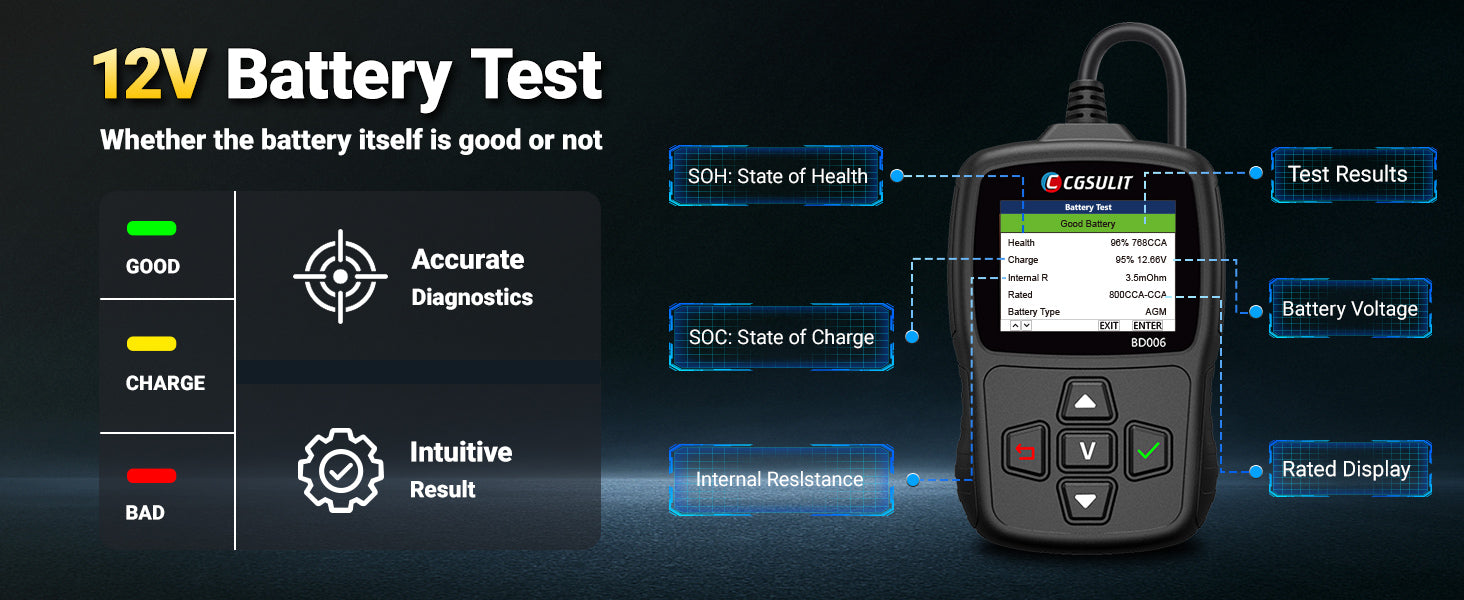
Unlike a standard multimeter, a professional battery tester can evaluate:
- Battery State of Health (SOH)
- State of Charge (SOC)
- Cold Cranking Amps (CCA)
- Internal resistance
- Cranking performance
- Alternator charging output
Modern battery testers use conductance testing technology to analyze how well the battery can actually perform under real operating conditions.
This is why professional mechanics rely on battery testers when diagnosing starting and charging issues.
Battery Tester vs Multimeter: Key Differences
Although both tools connect to the battery terminals, the amount of information they provide is very different.
| Feature | Battery Tester | Multimeter |
|---|---|---|
| Measures Voltage | Yes | Yes |
| Tests Battery Health (SOH) | Yes | No |
| Cranking Test | Yes | No |
| Charging System Test | Yes | Limited |
| Internal Resistance Analysis | Yes | No |
| Beginner Friendly | Yes | Moderate |
| Automotive-Specific Diagnostics | Yes | Limited |
A multimeter tells you what voltage is present at that moment.
A battery tester tells you whether the battery is actually healthy enough to perform reliably.
That distinction matters more than most drivers realize.
Can a Multimeter Test a Car Battery?
Technically, yes.
A multimeter can help you check battery voltage and identify obvious charging problems. If the reading is extremely low, the battery is likely discharged or damaged.
However, voltage testing has limitations.
For example, some failing batteries still display around 12 volts while being unable to deliver enough power during startup. In those cases, a multimeter may incorrectly suggest the battery is healthy.
This is one reason many DIY mechanics become frustrated after replacing alternators, starters, or batteries unnecessarily.
The problem was never accurately diagnosed in the first place.
Why Mechanics Use Battery Testers
Professional repair shops rarely rely on voltage readings alone.
Instead, they use dedicated battery testers because modern vehicles place far greater demands on electrical systems than older cars did. Start-stop systems, infotainment displays, heated seats, and advanced electronics all require stable battery performance.
A battery tester allows mechanics to quickly identify:
- Weak batteries
- Failing alternators
- Charging irregularities
- Starter system problems
- Internal battery deterioration
More importantly, it reduces guesswork.
That saves both time and money.
When a Multimeter Is Enough
Despite its limitations, a multimeter is still a valuable tool.
For basic electrical troubleshooting, it works well for:
- Checking battery voltage
- Testing fuses
- Measuring continuity
- Diagnosing wiring issues
- Verifying power connections
If you only want a simple voltage reading occasionally, a multimeter may be sufficient.
Many car owners already own one for household electrical work or garage projects.
When You Need a Battery Tester
A dedicated battery tester becomes far more useful when diagnosing actual battery performance issues.
You should consider using a battery tester if you experience:
- Slow engine cranking
- Frequent jump starts
- Battery warning lights
- Charging system concerns
- Unexplained battery drain
- Intermittent starting problems
Battery testers are especially useful for modern AGM and EFB batteries, which are commonly found in newer vehicles and start-stop systems.
Tools like the CGSULIT BD006 Battery Tester can provide fast diagnostics within seconds, including battery health analysis, cranking tests, and charging system evaluation.
Instead of guessing, you get a much clearer picture of what’s happening inside the electrical system.
Which Tool Is Better for Beginners?
For most beginners, a battery tester is actually easier to use.
A multimeter requires users to manually interpret voltage readings and understand what those numbers mean. That can be confusing for someone without electrical experience.
Battery testers simplify the process by translating complex electrical data into easy-to-understand results such as:
- GOOD BATTERY
- RECHARGE
- REPLACE
- BAD CELL
Many modern testers also include automatic testing modes and built-in safety protections, making them much more beginner-friendly.
Can a Battery Tester Detect Alternator Problems?
Yes.
One major advantage of a dedicated battery tester is the ability to perform charging system diagnostics.
A charging test can reveal whether the alternator is properly charging the battery while the engine is running.
This is important because alternator problems often mimic battery failure symptoms.
Without proper testing, many drivers replace the battery only to discover the new battery also dies shortly afterward.
Frequently Asked Questions
Can a multimeter tell if a battery is bad?
Not always. A multimeter measures voltage, but it cannot fully evaluate battery health or cranking performance.
Is a battery tester more accurate than a multimeter?
For automotive battery diagnostics, yes. Battery testers provide more detailed analysis and can detect problems that voltage readings alone may miss.
Can a battery show 12 volts and still be bad?
Absolutely. Some failing batteries maintain normal voltage while lacking the ability to deliver sufficient power under load.
Do professional mechanics use battery testers?
Yes. Most repair shops use dedicated battery analyzers because they provide faster and more accurate diagnostics.
Is a battery tester worth buying?
If you regularly maintain vehicles, drive long distances, own multiple cars, or want to avoid unexpected breakdowns, a battery tester can be a very worthwhile investment.
Final Thoughts
Both tools have their place.
A multimeter is excellent for general electrical testing and simple voltage checks. But when it comes to diagnosing real battery health, charging problems, and starting system issues, a dedicated battery tester provides far more useful information.
For modern vehicles packed with electronics, accurate diagnostics matter more than ever.
Using the right tool not only saves money on unnecessary repairs — it also helps prevent the frustration of being stranded with a battery problem that could have been detected much earlier.
Sources
- Battery Council International (BCI)
- Society of Automotive Engineers (SAE)
- Interstate Batteries Technical Center
- U.S. Department of Energy – Automotive Battery Basics
- AAA Vehicle Battery Maintenance Guidelines