
Few car problems are more frustrating than turning the key and hearing nothing happen. Maybe the engine cranks slowly. Maybe you hear a rapid clicking noise. Or perhaps the dashboard lights flicker while the car refuses to start altogether.
In many cases, the issue is not the starter motor or the alternator. It is simply a weak or failing battery.
The good news is that most car batteries show warning signs before they completely die. Recognizing those symptoms early can help you avoid unexpected breakdowns, expensive towing bills, and unnecessary repairs.
In this guide, we’ll explain the most common signs of a bad car battery, what causes battery failure, and how to test your battery at home before it leaves you stranded.
What Causes a Car Battery to Go Bad?
A car battery slowly loses performance over time. Even a high-quality battery will eventually struggle to hold a charge.
Several factors can accelerate battery wear:
- Extreme summer heat
- Freezing winter temperatures
- Frequent short-distance driving
- Leaving lights or accessories on
- Corroded terminals
- Long periods without driving
- Charging system problems
In the U.S., most automotive batteries last between 3 and 5 years depending on climate and driving habits. Vehicles exposed to excessive heat often experience shorter battery life because high temperatures speed up internal chemical degradation.
1. Slow Engine Crank
A slow engine crank is often the earliest sign of a weak battery.
When you start the vehicle, the engine may turn over more slowly than usual. Instead of a quick and strong startup, the crank feels sluggish and delayed.
This typically means the battery can no longer provide enough cold cranking amps (CCA) to properly power the starter motor.
Drivers often notice this symptom first during cold mornings or after the vehicle has been parked for several days.
2. Clicking Noise When Starting the Car
If you hear a rapid clicking sound when turning the key or pressing the push-start button, the battery may not have enough power to engage the starter.
Many people immediately assume the starter motor has failed. However, low battery voltage is actually one of the most common causes of clicking noises during startup.
This symptom becomes more noticeable as the battery weakens further.
3. Dim Headlights and Electrical Problems
Your battery powers far more than just the engine starter.
A failing battery can also affect:
- Headlights
- Interior lights
- Power windows
- Dashboard electronics
- Infotainment systems
If the headlights dim while idling or electronics behave inconsistently, unstable battery voltage may be the cause.
Modern vehicles rely heavily on stable electrical systems, and even minor voltage drops can trigger unusual behavior.
4. Battery Warning Light on the Dashboard
The battery warning light is one of the clearest signs that something in the charging system is not working properly.
However, the warning light does not always mean the battery itself is defective.
Possible causes include:
- A weak battery
- Alternator failure
- Loose battery connections
- Charging system issues
- Voltage irregularities
This is why performing both a battery test and charging system test is important before replacing parts unnecessarily.
5. Swollen or Bloated Battery Case
Take a quick look under the hood.
If the battery case appears swollen, cracked, or bloated, excessive heat may have damaged the internal components.
Overheating can significantly shorten battery lifespan and reduce charging efficiency.
A swollen battery should never be ignored. In many cases, replacement is the safest solution.
6. Corroded Battery Terminals
White, blue, or green corrosion around the battery terminals can interfere with electrical flow and reduce starting performance.
Corroded terminals may cause:
- Intermittent starting issues
- Weak electrical performance
- Charging problems
- Difficulty jump-starting the vehicle
Cleaning the terminals can help temporarily, but severe corrosion may indicate deeper battery or charging system issues.
7. Frequent Jump Starts
If your vehicle constantly needs a jump start, the battery is already warning you that something is wrong.
A healthy battery should consistently start the vehicle without assistance.
Repeated jump starts usually indicate:
- Battery aging
- Internal battery damage
- Poor charging performance
- Excessive parasitic drain
At this stage, testing the battery is far safer than continuing to guess.
How to Test a Car Battery at Home
Testing a battery at home is easier than many drivers realize.
Modern battery testers can quickly analyze battery condition without removing the battery from the vehicle.
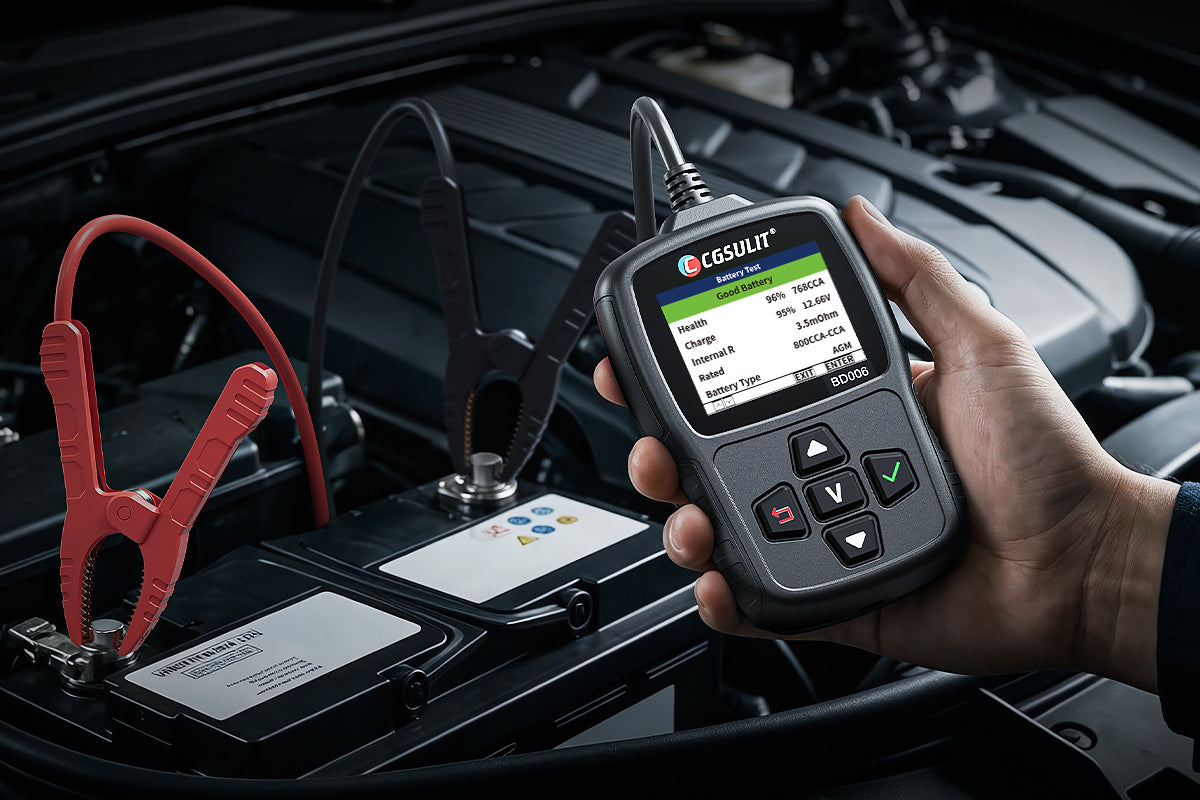
A professional battery tester like the CGSULIT BD006 can check:
- Battery voltage
- State of Health (SOH)
- State of Charge (SOC)
- Cold Cranking Amps (CCA)
- Internal resistance
- Cranking performance
- Charging system condition
Simply connect the red clamp to the positive terminal and the black clamp to the negative terminal. The tester powers on automatically and begins analyzing the battery.
Unlike a standard multimeter, a dedicated battery tester provides a more complete picture of actual battery health under real operating conditions.
This helps avoid unnecessary battery replacements and reduces the risk of misdiagnosing alternator problems.
What Voltage Indicates a Bad Car Battery?
Battery voltage provides a quick overview of battery condition.
| Battery Voltage | Battery Condition |
|---|---|
| 12.6V or higher | Healthy |
| 12.4V | Normal |
| 12.2V | Weak |
| Below 12V | Likely failing |
Keep in mind that voltage alone does not always reveal the full condition of a battery. A battery may still display normal voltage while failing under startup load.
That is why conductance testing and cranking tests are important.
Battery vs Alternator: How to Tell the Difference
Many drivers replace their battery only to discover that the alternator was the real issue.
Here is a simple way to tell the difference:
- If the battery repeatedly dies after driving, the alternator may not be charging correctly.
- If the vehicle mainly struggles during startup, the battery itself is more likely the problem.
Running both a battery test and charging test is the fastest way to identify the actual cause.
Frequently Asked Questions
Can a bad battery still show 12 volts?
Yes. A battery can show normal resting voltage while still failing under load. This is why cranking tests and conductance testing are important for accurate diagnosis.
What are the first signs of a weak car battery?
Slow engine cranking, dim headlights, clicking noises, and needing frequent jump starts are among the earliest warning signs.
Can cold weather kill a car battery?
Cold weather does not directly damage the battery, but low temperatures reduce battery performance and make it harder for weak batteries to start the engine.
How often should I test my car battery?
Testing your battery every few months is a smart habit, especially before winter road trips or during extreme summer temperatures.
Is a battery tester better than a multimeter?
A multimeter only measures voltage. A dedicated battery tester can analyze SOH, SOC, cranking performance, charging system condition, and internal resistance for a much more accurate diagnosis.
Final Thoughts
A failing car battery rarely dies without warning. Slow cranking, flickering lights, clicking sounds, and repeated jump starts are all signs that your battery may be reaching the end of its lifespan.
Catching these symptoms early can save time, money, and frustration.
Regular battery testing is one of the easiest ways to prevent unexpected breakdowns and avoid replacing parts unnecessarily. Whether you drive a daily commuter, pickup truck, motorcycle, RV, or boat, monitoring battery health before problems appear is always a smart investment.
Sources
- Battery Council International (BCI)
- U.S. Department of Energy – Vehicle Battery Basics
- Society of Automotive Engineers (SAE) Battery Standards
- Interstate Batteries Technical Learning Center
- AAA Automotive Battery Maintenance Guidelines