
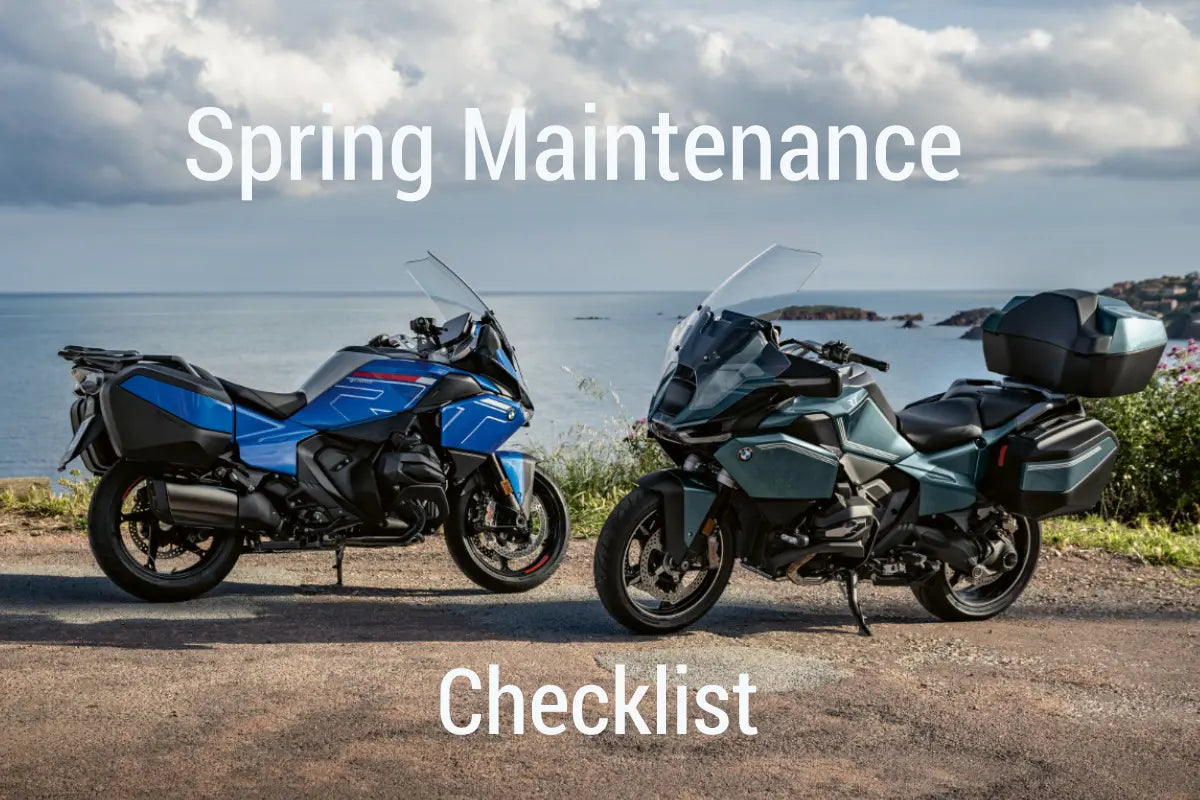
The garage door groans as it rolls upward.
A thin slice of spring sunlight cuts across the fairing of your GS, revealing a winter’s worth of dust. You’ve been waiting for this moment since November—the long nights, the salted roads, the battery tender humming quietly in the background.
Your thumb hovers over the starter.
But here’s the uncomfortable truth most riders learn the hard way: a BMW that looks ready after winter storage isn’t always one that is ready. Three months of sitting can quietly undo a lot of good intentions.
BMW motorcycles are extraordinary machines—precise, powerful, and deeply engineered. They’re also unforgiving when neglected. Spring prep isn’t about cosmetics or superstition. It’s about understanding how modern BMWs behave when electronics, fluids, and mechanical systems wake up after a long sleep.
In this BMW Motorrad Spring Prep 2026 guide, we’re going deeper than the usual checklist. No fluff. No dealer scare tactics. Just the seven checks that actually matter—whether you ride an R1250GS, an F850GS, or a long-distance K1600GT.
1. The Heartbeat: Battery Health and Terminal Integrity
Modern BMW motorcycles are, for better or worse, rolling computers. CAN-Bus systems, ECUs, ABS modules, ESA—none of them tolerate weak voltage. When the battery isn’t exactly right, the bike doesn’t gently warn you. It throws fault codes. Sometimes real. Sometimes not.
Many riders rely on a BMW motorcycle battery tender connection over winter. That’s fine—if it was connected properly and actually working. If not, resist the temptation to jump-start and ride away.
A lead-acid or AGM battery that sits discharged can develop sulfation. Once that happens, capacity drops fast—and no amount of riding will save it.
The test:
Grab a multimeter. A healthy battery should show 12.6V or higher at rest. During cranking, voltage should not dip below 10V. If it does, you’re living on borrowed time.
The terminals:
Boxer engines vibrate. Touring bikes vibrate less—but they still vibrate. Check that both terminals are tight and clean. White, fuzzy oxidation is resistance, and resistance is the enemy of BMW electronics. Clean it. Tighten it. Add a touch of dielectric grease.
2. The Lifeblood: Oil, Filter, and Fluid Reality Check
Spring is when many riders ask the wrong question:
“Can I stretch this oil change a little longer?”
The better question is: “What happened to my oil while the bike sat?”
Even if mileage is low, oil experiences condensation during storage. Temperature swings draw moisture into the crankcase, especially on air- and liquid-cooled Boxers.
If you’re following the BMW Motorrad service schedule, spring is often the ideal time to reset the clock.
Engine oil:
For riders searching for the best oil for BMW R1200GS, the answer still depends on generation and climate. High-quality synthetic 5W-40 or 15W-50 oils remain the gold standard for older Boxers. Fresh oil quiets cold-start clatter and protects cam surfaces during those first dry seconds after ignition.
Brake fluid:
BMW braking systems are powerful—and hygroscopic. Brake fluid absorbs moisture. If it looks dark, cloudy, or anything closer to maple syrup than white wine, it’s done. Old fluid compromises ABS performance long before it feels “spongy.”
Coolant:
If you ride a water-cooled Boxer, don’t skip this. Coolant isn’t just about freezing protection—it prevents internal corrosion. Check the expansion tank, not just the radiator cap.
3. Where the Rubber Meets the Road: Tires and TPMS
Tires don’t like winter storage. Especially when parked on cold concrete.
Pressure first:
Ignore guesswork. Check the swingarm sticker and inflate accordingly. Tire pressure drops significantly over months, even indoors.
The TPMS headache:
A BMW motorcycle tire pressure sensor reset warning is incredibly common in spring. Sometimes the system just needs a 10-minute ride above highway speed to wake up. Sometimes it doesn’t. When it doesn’t, you’ll need a diagnostic tool to reinitialize or verify sensor status.
Dry rot:
Look closely at the sidewalls. Tiny cracks—known as checking—mean the rubber is aging. Tires older than five years might hold air, but they don’t grip like they used to. In an emergency stop, that matters.
4. The Digital Brain Scan: Clearing the “Ghost Gremlins”
Winter storage is prime time for false fault codes. Low voltage events, sensor inactivity, and interrupted wake cycles leave behind electronic breadcrumbs.
This is where a BMW GS code scanner stops being a luxury and starts being common sense.
Using a professional-grade tool like the CGSULIT SC530 Pro, perform a full system scan—engine, ABS, ZFE, suspension.
Clear BMW motorcycle fault codes:
You’ll often see an “under-voltage” fault stored from the first cold start attempt. Clear it. Restart the bike. If it doesn’t return, it was historical noise—not a real problem.
Safety note:
If ABS pump faults or ESA errors remain active, take them seriously. These systems directly affect braking and handling. Find out now, not mid-corner in the mountains.
5. The Drive System: Shaft vs. Chain Reality
Spring prep looks different depending on how power reaches the rear wheel.
Shaft drive (Paralever):
Inspect the final drive area carefully. Any oil misting or seepage near the rear wheel is a red flag. That’s not cosmetic—it’s a safety issue.
Chain drive (F-series):
Chains dry out over winter. Clean with a proper solvent, dry thoroughly, then lubricate. Check slack with rider weight on the bike. Too tight is worse than too loose—it destroys output shaft bearings.
6. Control Interfaces: Small Parts, Big Consequences
This is where small neglect turns dangerous.
Throttle:
It must snap back instantly. No hesitation. No “creep.” Check for bar-end interference or cable wear.
Levers and pivots:
One drop of lubricant on clutch and brake lever pins makes the bike feel years newer. Sticky levers reduce feel—and confidence.
Foot controls:
On a K1600GT maintenance DIY check, don’t ignore the shift linkage. That complex mechanism rewards lubrication with noticeably smoother shifts.
7. The Final Ritual: Resetting the Service Interval
Nothing ruins a clean TFT display like a glowing yellow service triangle.
If you’ve done your own maintenance—oil, air filter, inspections—you’ll need to reset service interval any modern BMW manually. Disconnecting the battery won’t do it.
This is where the reset tool functionality of the SC530 Pro shines. Plug in, verify the date and mileage, set the next interval (typically 6,000 miles or 12 months), and you’re done. (Click to learn more about How to reset service light on BMW motorcycle with SC530 Pro)
No dealership visit. No $150 “reset fee.”
DIY vs. Dealer: Why 2026 Belongs to the Home Mechanic
With dealership labor rates climbing past $180/hour in many U.S. cities, the Motorcycle spring startup guide is no longer optional—it’s economic survival.
Using a proper BMW motorcycle spring maintenance checklist builds familiarity. You notice things early: a loose fairing bolt, a damp gasket, a wire routed wrong. Things rushed technicians often miss.
Frequently Asked Questions (Q&A)
Q: Can I use any OBDII scanner on my BMW motorcycle?
A: No. While many 2017+ BMWs use an OBD-style connector, standard car scanners cannot communicate with BMW Motorrad systems. You need a scanner specifically designed for BMW bikes, such as the SC530 Pro.
Q: What’s the most common spring prep mistake?
A: Over-tightening the oil drain plug. BMW sumps are often aluminum. Always use a torque wrench—typically around 42 Nm for GS models, but verify in your manual.
Q: My TPMS light stays on after setting correct pressure. Why?
A: BMW TPMS sensors sleep during storage. Ride above 19 mph (30 km/h) for several minutes. If the warning persists, the sensor battery may be dead—a common issue after 5–8 years.
Conclusion: Ready for the First Ride?
BMW Motorrad Spring Prep 2026 isn’t about paranoia. It’s about preparation.
By working through these seven checks—especially battery health, diagnostics, and service resets—you’re not just avoiding breakdowns. You’re ensuring your BMW rides exactly as Munich intended.
Clear the codes. Reset the service light. Trust the machine again.
The road has been waiting. Now your Beemer is ready to answer.
References & Resources
-
BMW Motorrad USA — Official Maintenance Intervals & Standards (2025–2026)
-
BMW Motorcycle Owners of America (BMW MOA) — Technical Archive
-
Haynes Manuals — BMW R1200 & R1250 Liquid-Cooled Twins
- CGSULIT Diagnostics — SC530 BMW Motorrad Function Documentation
Related Article:
How to Reset BMW Motorcycle Service Light with OBD2 Scanner?
The Best BMW Motorrad OBD2 Scanner: CGSULIT SC530 Pro vs Hex GS-911?
Top 5 Scenic Motorcycle Routes for Your BMW GS in the USA
Top BMW Motorrad Error Codes: What They Mean and How to Fix Them