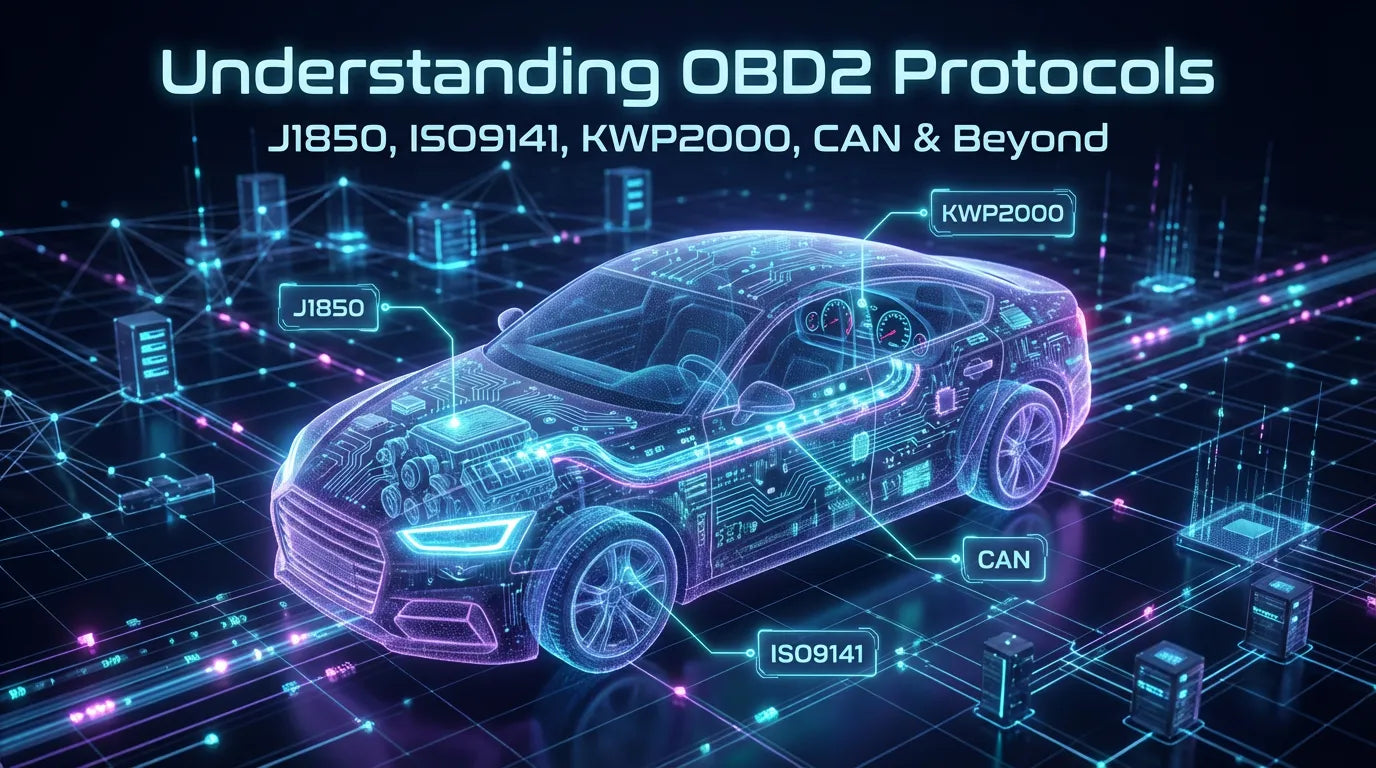
Modern cars are no longer just engines, transmissions, and suspension systems. They are complex electronic networks made up of dozens of computers constantly exchanging information. These computers—known as electronic control units (ECUs)—monitor everything from fuel injection to emissions performance.
When a technician or DIY car owner connects an OBD2 scanner to a vehicle, the tool communicates with these ECUs to retrieve diagnostic information. But this communication only works because both the vehicle and the diagnostic tool follow the same set of rules.
Those rules are called OBD2 protocols.
Since the introduction of OBD2 regulations in the United States in 1996, different manufacturers have used several communication protocols to allow scan tools to access vehicle data. Understanding how these protocols work helps mechanics troubleshoot connection issues, choose compatible diagnostic tools, and perform more accurate vehicle diagnostics.
In this guide, we’ll break down the major OBD2 communication protocols, explain how they differ, and show how modern diagnostic scanners automatically detect and communicate with vehicles using these systems.
What Is an OBD2 Protocol?
An OBD2 protocol is the communication standard that allows a diagnostic tool to exchange information with a vehicle’s onboard computers.
When a scanner plugs into the 16-pin OBD2 diagnostic connector, it sends commands requesting data from the vehicle’s electronic control units. These requests might ask for:
-
Diagnostic Trouble Codes (DTCs)
-
Engine RPM
-
Oxygen sensor readings
-
Fuel trim data
-
Vehicle speed
-
System status information
The ECU then responds with the requested information.
However, the scanner and the vehicle must communicate using the same protocol. If the scanner does not support the vehicle’s communication protocol, it will not be able to establish a connection.
That’s why understanding OBD2 protocols is important when selecting a diagnostic scanner.
The Evolution of Vehicle Diagnostic Communication
Before the mid-1990s, vehicle diagnostics were far from standardized. Each manufacturer used its own diagnostic connectors, proprietary software, and unique fault code systems.
This meant mechanics often needed different tools for different brands of vehicles.
To improve emissions monitoring and simplify diagnostics, the United States introduced OBD2 regulations in 1996. These regulations required all vehicles sold in the country to include:
-
A standardized 16-pin diagnostic connector
-
Standardized emissions-related diagnostic trouble codes
-
At least one supported OBD2 communication protocol
While the connector became universal, manufacturers were still free to choose from several communication protocols. As a result, multiple protocols were used across different brands and model years.
The Main OBD2 Protocols Explained
Several communication protocols have been used since OBD2 was introduced, but four major standards dominate vehicle diagnostics.
SAE J1850 Protocol
The SAE J1850 protocol was commonly used in early OBD2 vehicles produced by American manufacturers.
Two variants exist: J1850 PWM and J1850 VPW.
J1850 PWM (Pulse Width Modulation)
J1850 PWM was primarily used by Ford vehicles. It operates at approximately 41.6 kbps and uses a two-wire communication system.
This differential signaling system provides relatively stable communication between the diagnostic tool and the vehicle's control modules.
Ford vehicles produced from the late 1990s through the early 2000s commonly relied on this protocol.
J1850 VPW (Variable Pulse Width)
The second version of the J1850 protocol is VPW, which was mainly used by General Motors vehicles.
VPW operates at approximately 10.4 kbps and uses a single-wire communication system.
Many GM vehicles produced between 1996 and 2003 used this protocol before transitioning to newer communication standards.
ISO 9141-2 Protocol
The ISO 9141-2 protocol became widely used among European and Asian vehicle manufacturers.
Brands that commonly used ISO9141 include:
-
Toyota
-
Honda
-
BMW
-
Volkswagen
-
Mercedes-Benz
This protocol uses a communication line known as the K-Line and operates at around 10.4 kbps.
Although slower than modern communication systems, ISO9141 provided reliable diagnostic communication for early OBD2 vehicles.
Vehicles produced between 1996 and approximately 2004 frequently used this protocol.
Keyword Protocol 2000 (KWP2000)
Keyword Protocol 2000, often referred to as KWP2000 or ISO 14230, was developed as an improvement over ISO9141.
This protocol introduced several enhancements:
-
Expanded diagnostic services
-
Improved communication efficiency
-
Better error handling
-
Support for additional vehicle modules
KWP2000 became common in vehicles produced between 2001 and 2008, particularly among European manufacturers.
During this period, many vehicles transitioned from ISO9141 to KWP2000 before eventually adopting CAN networks.
Controller Area Network (CAN)
The Controller Area Network (CAN) protocol represents a major advancement in vehicle communication technology.
Unlike earlier protocols that primarily connected a diagnostic scanner to a single ECU, CAN allows multiple electronic control modules to communicate over a shared network.
Starting in 2008, all vehicles sold in the United States were required to support CAN-based OBD2 communication.
CAN offers several advantages over earlier protocols.
Faster Data Transmission
CAN networks support speeds up to 1 Mbps, allowing rapid communication between vehicle systems and diagnostic tools.
Network-Based Communication
Multiple ECUs share the same communication network, reducing wiring complexity and improving efficiency.
Improved Reliability
CAN includes advanced error detection and message prioritization, making communication more stable.
Because of these advantages, CAN has become the global standard for modern vehicle diagnostics.
OBD2 Protocol by Manufacturer
Different manufacturers adopted different protocols during the early years of OBD2.
| Manufacturer | Common Protocol |
|---|---|
| Ford | J1850 PWM |
| General Motors | J1850 VPW |
| Toyota | ISO9141 / KWP2000 |
| Honda | ISO9141 |
| BMW | ISO9141 / KWP2000 |
| Volkswagen | ISO9141 / KWP2000 |
| Chrysler | J1850 |
| Modern vehicles (all brands) | CAN |
Today, nearly all modern vehicles use CAN-based diagnostics.
OBD2 Connector Pinout Explained
All OBD2 vehicles use the same 16-pin diagnostic connector, but different pins are used depending on the protocol.
Here are some key pins used by common protocols:
| Pin | Function |
|---|---|
| Pin 4 | Chassis Ground |
| Pin 5 | Signal Ground |
| Pin 6 | CAN High |
| Pin 14 | CAN Low |
| Pin 7 | K-Line (ISO9141 / KWP2000) |
| Pin 2 | J1850 Bus + |
| Pin 10 | J1850 Bus − |
| Pin 16 | Battery Power |
By examining the pins used by a vehicle, technicians can often determine which protocol the vehicle uses.
How to Identify Your Vehicle’s OBD2 Protocol
The easiest way to identify a vehicle’s protocol is by looking at its model year.
General guideline:
-
1996–2004 vehicles often use J1850 or ISO9141
-
2001–2008 vehicles may use KWP2000
-
2008 and newer vehicles almost always use CAN
Another method is to use a diagnostic scanner that automatically detects the protocol.
Modern scanners—including tools such as the CGSULIT SC530 Pro diagnostic scanner—support multiple communication standards and automatically identify the correct protocol when connected to a vehicle.
This makes it much easier for technicians and DIY users to diagnose vehicles without manually selecting communication settings.
Why Protocol Support Matters When Choosing a Scanner
Not all diagnostic scanners support every OBD2 protocol.
Basic code readers may only work with modern CAN vehicles, while older vehicles require scanners capable of communicating using earlier protocols.
A multi-protocol diagnostic scanner offers several advantages:
-
Compatibility with both older and modern vehicles
-
Faster vehicle identification
-
Fewer communication errors
-
Access to more diagnostic systems
For mechanics and enthusiasts working with multiple vehicles, choosing a scanner with full protocol support ensures reliable diagnostics.
The Future of Vehicle Diagnostics
Vehicle communication systems continue to evolve as automotive technology advances.
Two emerging standards are already shaping the future of diagnostics.
Diagnostics over Internet Protocol (DoIP) uses Ethernet networks to enable extremely fast communication between diagnostic tools and vehicle systems.
Another innovation is CAN FD (Flexible Data Rate), an upgraded version of the CAN protocol that allows larger data packets and higher communication speeds.
As vehicles incorporate more advanced electronics, these technologies will play a major role in next-generation diagnostics.
Common OBD2 Communication Problems
Even when using the correct protocol, communication issues can occur.
Common causes include:
-
Damaged OBD2 connector
-
Blown fuse powering the diagnostic port
-
Low vehicle battery voltage
-
Faulty ECU communication
-
Incompatible diagnostic scanner
When troubleshooting, technicians should first verify that the scanner supports the vehicle’s protocol and confirm that the OBD2 port is receiving power.
Using a professional multi-protocol diagnostic scanner can often eliminate these issues.
People Also Ask
What is the most common OBD2 protocol today?
The most common OBD2 protocol used in modern vehicles is Controller Area Network (CAN). Since 2008, all vehicles sold in the United States are required to support CAN communication.
Do all cars use the same OBD2 protocol?
No. While all OBD2 vehicles use the same 16-pin connector, manufacturers may use different communication protocols depending on the model year and brand.
Can one scan tool support multiple OBD2 protocols?
Yes. Most modern diagnostic scanners support multiple protocols and automatically detect the correct communication standard when connected to a vehicle.
Why can’t my OBD2 scanner connect to my car?
Possible causes include protocol incompatibility, a damaged OBD2 connector, blown fuses, low battery voltage, or ECU communication problems.
Are older vehicles harder to diagnose?
Older vehicles often use legacy protocols such as J1850 or ISO9141, which means some basic scanners may not support them.
Do electric vehicles still use OBD2?
Most modern electric vehicles still support OBD2 diagnostics, though some systems also use newer communication technologies such as DoIP.
Conclusion
OBD2 protocols form the foundation of modern vehicle diagnostics.
From early communication standards such as J1850 and ISO9141 to modern CAN-based networks, these protocols determine how diagnostic tools communicate with vehicle systems.
Understanding these protocols helps technicians troubleshoot communication problems, select compatible diagnostic equipment, and perform more effective vehicle diagnostics.
As automotive technology continues to evolve—with innovations like DoIP and CAN FD—diagnostic communication systems will become even more advanced.
For technicians and DIY mechanics alike, using a scanner that supports multiple OBD2 protocols ensures reliable access to vehicle data across different manufacturers and model years.