
Introduction
Modern vehicles rely on dozens of electronic control modules to manage everything from engine performance to interior lighting. Among them, one of the most important—but least understood—is the Body Control Module (BCM).
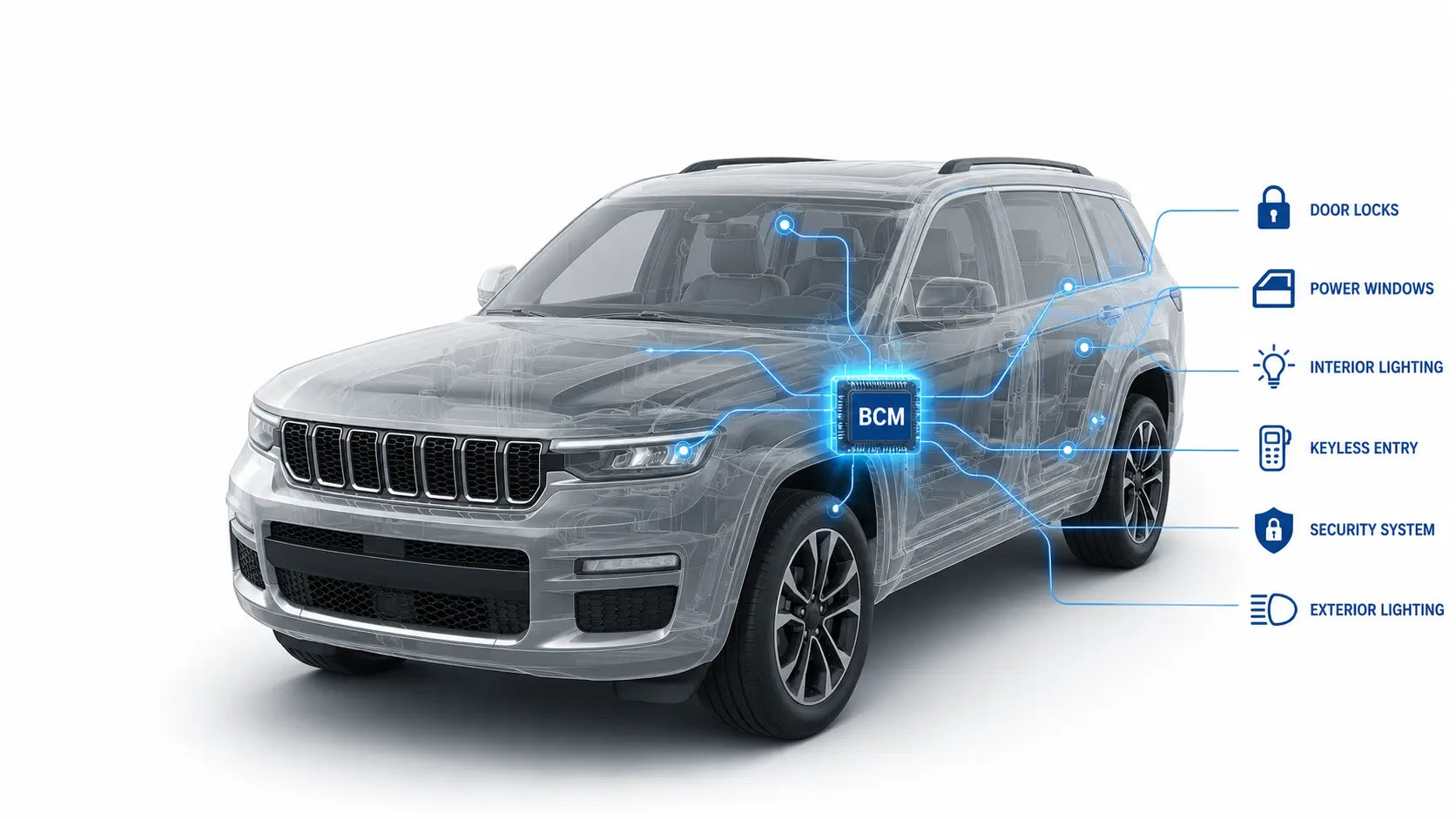
Unlike the Powertrain Control Module (PCM), which manages engine and transmission functions, the BCM is responsible for many of the convenience, comfort, and body-related electrical features drivers use every day. Door locks, power windows, interior lighting, keyless entry, security systems, and warning chimes often depend on the BCM working correctly.
When the BCM develops a fault, the symptoms can be confusing. A vehicle may experience intermittent electrical problems, accessories that stop working without warning, or multiple unrelated issues at the same time. Because these symptoms often resemble wiring faults or battery problems, accurately identifying the root cause can be challenging.
Understanding what the BCM does—and what it doesn't do—is the first step toward diagnosing electrical problems with confidence.
In this guide, we'll explain how the Body Control Module works, what systems it typically manages in Chrysler, Dodge, and Jeep vehicles, common signs of BCM-related issues, possible causes of failure, and how it differs from other control modules such as the TIPM and PCM.
What Is a Body Control Module (BCM)?
The Body Control Module (BCM) is an electronic control unit responsible for managing many of a vehicle's body-related electrical functions.
Rather than supplying power directly to every component, the BCM monitors inputs from switches, sensors, and other control modules, then sends commands that help coordinate the operation of various electrical systems throughout the vehicle.
Think of the BCM as the vehicle's body electronics coordinator.
For example, when you press the unlock button on your key fob, the signal is received and processed by the appropriate control system. The BCM then determines the appropriate response, such as unlocking the doors, illuminating the interior lights, or activating other convenience features, depending on the vehicle's configuration.
The BCM also exchanges information with other modules over the vehicle's communication network, allowing different systems to operate together seamlessly. Instead of functioning independently, modern vehicle electronics rely on continuous communication between modules to deliver the features drivers expect.
Although every manufacturer uses slightly different architectures, the BCM has become a standard component in today's electronically controlled vehicles, particularly as comfort, convenience, and safety features continue to expand.
Why Do Modern Vehicles Need a BCM?
Decades ago, many body-related electrical functions operated independently.
A door switch controlled a door lock. A headlight switch powered the headlights. Interior lights relied on simple mechanical circuits.
As vehicles became more sophisticated, this approach quickly became impractical.
Modern vehicles include dozens of electronic features that need to communicate with one another. Remote keyless entry, automatic lighting, retained accessory power, anti-theft systems, power mirrors, memory seats, rain-sensing wipers, and numerous other functions all depend on coordinated electronic control.
Instead of building a separate controller for every feature, manufacturers introduced the Body Control Module to centralize these operations.
The BCM reduces wiring complexity, improves communication between systems, supports advanced convenience features, and simplifies diagnostics by allowing technicians to monitor many body-related functions through a single control module.
Just as importantly, the BCM helps different modules work together.
For example, unlocking the driver's door at night may trigger several actions simultaneously: the interior lights illuminate, the security system disarms, and the retained accessory power logic is updated. Rather than multiple independent circuits handling these tasks, the BCM coordinates them as part of an integrated electrical system.
This centralized approach improves efficiency while making it easier to add new electronic features as vehicle technology evolves.
How Does a Body Control Module Work?
The Body Control Module doesn't simply turn electrical components on and off.

Instead, it acts as a decision-making hub for many of the vehicle's body-related functions. It constantly monitors signals from switches, sensors, the key fob, and other control modules, then determines how different electrical systems should respond.
Here's a simple example.
When you press the unlock button on your key fob, the doors don't unlock because the key fob is directly connected to the door lock actuators. Instead, the request is received by the appropriate vehicle system and communicated to the BCM. After verifying the command, the BCM coordinates the unlocking process and, depending on the vehicle's configuration, may also trigger the interior lights, disable the security system, or activate retained accessory power.
All of this happens in a fraction of a second.
The same principle applies to many everyday functions. Opening a door may illuminate the interior lights. Turning off the ignition may keep the power windows operational for a short period. Locking the vehicle may arm the anti-theft system and confirm the action with the horn or exterior lights.
Rather than operating as isolated circuits, these features are coordinated through the BCM working together with other control modules over the vehicle's communication network.
A simplified workflow looks like this:
Driver Input / Sensor
          ↓
        BCM
          ↓
Processes the Request
          ↓
Communicates with Other Modules (when required)
          ↓
Activates the Appropriate Vehicle Function
This centralized approach reduces wiring complexity, improves system coordination, and allows manufacturers to add new electronic features without redesigning every individual circuit.
What Does a BCM Control?
The exact responsibilities of a BCM vary by manufacturer, vehicle platform, model year, and equipment level.
However, in many Chrysler, Dodge, and Jeep vehicles, the BCM typically manages or coordinates a wide range of body-related electrical functions.
| Vehicle Function | Typically Coordinated by the BCM* |
|---|---|
| Power Door Locks | ✓ |
| Remote Keyless Entry | ✓ |
| Interior Lighting | ✓ |
| Courtesy Lights | ✓ |
| Power Windows (varies by model) | ✓ |
| Security / Anti-Theft System | ✓ |
| Warning Chimes | ✓ |
| Power Mirrors (varies by model) | ✓ |
| Automatic Headlamp Logic (varies by model) | ✓ |
| Wiper Logic (selected models) | ✓ |
| Retained Accessory Power | ✓ |
| Seat Memory (selected models) | ✓ |
*Functions vary depending on the vehicle model, model year, and factory equipment.
Notice that many of these features are related to convenience rather than engine performance.
That's one of the easiest ways to distinguish the BCM from other control modules.
If a function involves the driver's daily interaction with the vehicle—locking the doors, operating the interior lights, or responding to the key fob—the BCM is often involved in coordinating that operation.
BCM vs. TIPM vs. PCM: What's the Difference?
Modern vehicles contain multiple control modules, each designed for a different purpose.
Although they communicate continuously, their responsibilities are quite different.
| Module | Primary Responsibility |
|---|---|
| BCM | Coordinates body electronics, convenience features, and security-related functions |
| TIPM | Manages electrical power distribution and supplies power to multiple vehicle circuits |
| PCM | Controls engine performance, fuel delivery, ignition timing, emissions, and transmission operation |
A simple way to think about these modules is to compare them to members of a team.
The PCM focuses on how the vehicle runs.
The BCM manages how the vehicle interacts with the driver.
The TIPM helps distribute electrical power so many of those systems can operate as intended.
Because these modules exchange information over the CAN bus, a problem affecting one module may produce warning messages or unexpected behavior elsewhere in the vehicle.
For example, if the BCM doesn't receive the expected information from another module, certain convenience features may stop working even though the BCM itself isn't defective.
Likewise, low battery voltage or communication faults can sometimes create symptoms that resemble BCM failure.
For that reason, professional diagnosis always considers the complete electrical system rather than a single control module in isolation.
Where Is the Body Control Module Located?
One of the most common questions owners ask is, "Where is the BCM located?"
The answer depends on the vehicle.
Unlike components such as the battery or air filter, the Body Control Module does not have a universal mounting location across all Chrysler, Dodge, and Jeep models. Its position varies depending on the vehicle platform, model year, and electrical system design.
In many vehicles, the BCM is commonly found in one of the following areas:
- Behind the dashboard
- Under the driver's side dashboard
- Behind the glove box
- Near the interior fuse panel
- Behind a kick panel
- Under the center console (selected models)
Manufacturers place the BCM inside the passenger compartment because it needs to communicate with numerous switches, sensors, and body electronics while remaining protected from heat, moisture, and road debris.
If you're trying to locate the BCM on a specific vehicle, always refer to the factory service information or a model-specific repair manual. Removing trim panels unnecessarily can damage clips or wiring, especially on newer vehicles with tightly integrated electrical systems.
Common Symptoms of a Bad BCM
A failing Body Control Module can produce a wide variety of electrical symptoms.
Because the BCM coordinates many body-related functions, problems often affect convenience features rather than engine performance. In some cases, only one system is affected. In others, several unrelated electrical functions may begin behaving unpredictably at the same time.
The following symptoms are commonly associated with BCM-related issues.
Power Door Locks Stop Working
If the power door locks fail to respond to the key fob or interior switch—or work only intermittently—the BCM may be one of several components that requires inspection.
However, door lock actuators, wiring, blown fuses, or a weak key fob battery can produce similar symptoms.
Power Windows Operate Erratically
Power windows that stop working unexpectedly, operate only from certain switches, or function intermittently may indicate an electrical control issue.
Depending on the vehicle's design, the BCM may coordinate part of this operation, although window switches, motors, and wiring should also be inspected during diagnosis.
Interior Lights Stay On or Fail to Illuminate
The BCM often manages courtesy lighting logic.
If the dome lights remain on after the doors are closed—or fail to turn on when a door is opened—the issue may involve the BCM, a faulty door-ajar switch, damaged wiring, or another related component.
Remote Keyless Entry Stops Responding
When the key fob suddenly becomes unreliable, many owners immediately suspect the battery inside the remote.
While that's often the simplest explanation, communication issues involving the BCM or related systems may also affect keyless entry operation.
Security System or Alarm Behaves Unexpectedly
Because the BCM typically coordinates many anti-theft functions, abnormal alarm behavior can sometimes be linked to communication or electrical faults within the body control system.
Unexpected alarm activation, difficulty arming the system, or warning messages may warrant further inspection.
Multiple Warning Messages Appear
Modern vehicles constantly exchange information between electronic modules.
If communication is interrupted, multiple warning indicators or information messages may appear even when the underlying problem originates elsewhere in the electrical system.
For that reason, warning lights alone should never be used to diagnose a faulty BCM.
Several Convenience Features Fail at the Same Time
One of the strongest indicators of a possible BCM-related issue is when multiple body functions stop working together.
For example, you might notice:
- Door locks become unresponsive
- Interior lights behave abnormally
- Power windows stop working
- Keyless entry becomes unreliable
- Warning chimes disappear
- Security system functions unexpectedly
Although these symptoms may point toward the BCM, they can also result from low battery voltage, poor ground connections, damaged wiring, or communication network faults.
A systematic diagnosis is always more reliable than replacing parts based on symptoms alone.
What Causes BCM Failure?
Like any electronic control module, the BCM is designed to operate reliably for many years.
When problems do occur, they're often influenced by the surrounding electrical system rather than the module itself.
Below are some of the most common factors that can contribute to BCM-related issues.
Moisture Intrusion
Water is one of the biggest enemies of automotive electronics.
If moisture enters electrical connectors or reaches the BCM housing, corrosion can develop over time. This increases electrical resistance and may lead to intermittent communication or circuit problems.
Low Battery Voltage
Modern control modules rely on stable system voltage.
A weak battery or repeated low-voltage events can cause unexpected electrical behavior, communication errors, or accessory malfunctions that resemble BCM failure.
For that reason, battery condition should always be checked before suspecting the BCM.
Poor Ground Connections
Every electronic control module depends on clean and reliable ground connections.
Corrosion, loose terminals, or damaged ground straps can interrupt communication and produce a wide range of electrical symptoms throughout the vehicle.
Damaged Wiring or Connectors
The BCM communicates with numerous switches, sensors, and other control modules.
A damaged wiring harness, bent connector pin, or poor electrical connection can interrupt these signals and create symptoms similar to an internal BCM fault.
Voltage Spikes
Improper jump-start procedures, faulty charging equipment, or electrical surges can place unnecessary stress on sensitive electronic components.
Although not every voltage spike causes permanent damage, protecting the vehicle's electrical system helps reduce unnecessary risk.
Normal Electronic Aging
Like any electronic module, the BCM contains internal components that gradually age over time.
Heat cycles, vibration, and years of operation may eventually affect solder joints or electronic circuitry, particularly in older vehicles.
However, it's worth remembering that true BCM failures are generally less common than issues involving batteries, wiring, connectors, or grounding.
Replacing the BCM should therefore be considered only after the rest of the electrical system has been properly evaluated.
Can a Body Control Module Be Repaired or Does It Need Replacement?
It depends on what's causing the problem.
Many electrical issues that appear to involve the BCM are actually caused by low battery voltage, damaged wiring, corroded connectors, blown fuses, or poor ground connections. Replacing the module without confirming the root cause may not solve the problem—and can add unnecessary expense.
Before considering BCM replacement, technicians typically inspect:
- Battery voltage and charging system performance
- Fuses and power supply circuits
- Ground connections
- Wiring harnesses and electrical connectors
- Communication between control modules
- Diagnostic Trouble Codes (DTCs)
Only after these checks suggest an internal module fault should BCM replacement be considered.
In some cases, a damaged BCM can be repaired by a specialized electronics repair service. However, replacement is often the more practical solution when the module has suffered internal circuit damage or water intrusion.
It's also important to remember that many replacement BCMs require programming or configuration after installation. Depending on the vehicle, this process may include writing vehicle-specific information, synchronizing security functions, or initializing certain body electronics.
Always follow the manufacturer's recommended service procedures when replacing a control module.
[See how the CGSULIT SC530 helps diagnose BCM-related problems in Chrysler, Dodge, and Jeep vehicles.]
How to Help Prevent BCM Problems
While electronic modules eventually age like any other vehicle component, a few simple maintenance habits can reduce the risk of electrical problems over time.
Maintain a Healthy Battery
The BCM depends on stable system voltage.
Testing the battery periodically and replacing it when necessary helps prevent low-voltage conditions that may affect multiple electronic modules.
Keep Electrical Connections Clean
Corrosion at battery terminals, ground points, or electrical connectors increases resistance and can interfere with communication between modules.
Routine inspection and cleaning can help maintain reliable operation.
Protect the Vehicle from Water Intrusion
Leaks around the windshield, sunroof, or door seals may allow moisture to reach sensitive electrical components inside the cabin.
Addressing water leaks early helps protect connectors and electronic modules from corrosion.
Avoid Improper Electrical Modifications
Poorly installed aftermarket accessories can introduce electrical problems that are difficult to diagnose.
Whenever possible, electrical accessories should be installed using proper wiring practices and components designed for the vehicle.
Diagnose Before Replacing Parts
Modern vehicle electronics are highly interconnected.
When multiple electrical symptoms appear, replacing parts based on assumptions often leads to unnecessary repairs.
A systematic diagnostic process remains the most effective way to identify the actual cause of the problem.
Frequently Asked Questions
What does a Body Control Module (BCM) do?
The BCM coordinates many body-related electrical functions, including door locks, interior lighting, keyless entry, security features, warning chimes, and other convenience systems. The exact functions vary by vehicle model and equipment.
Can a bad BCM cause a no-start condition?
In some vehicles, BCM-related communication or security system issues may contribute to a no-start condition.
However, engine starting problems are more commonly associated with the battery, starter, ignition system, PCM, or fuel delivery system. A complete diagnosis is recommended before replacing any components.
Can a BCM drain the battery?
Yes, it's possible.
If the BCM or another electrical circuit remains active when the vehicle is turned off, battery drain may occur. However, parasitic battery drain can also be caused by other control modules, accessories, or wiring faults.
Does every Chrysler, Dodge, and Jeep have a BCM?
Most modern vehicles are equipped with a Body Control Module or an equivalent body electronics controller.
The design, functions, and location vary depending on the manufacturer, model year, and vehicle platform.
Does a replacement BCM require programming?
In many cases, yes.
Replacement modules often need to be programmed or configured so they can communicate correctly with other vehicle systems and recognize the vehicle's factory options.
Can I replace a BCM myself?
Physical replacement may be straightforward on some vehicles.
However, programming requirements, anti-theft functions, and system initialization procedures often make professional installation the safest option.
Will disconnecting the battery reset the BCM?
Disconnecting the battery may temporarily reset certain learned settings or clear some temporary conditions.
However, it does not repair an internal BCM fault or permanently resolve underlying electrical problems.
Can a scan tool diagnose BCM problems?
A professional diagnostic scan tool can communicate with the BCM, retrieve diagnostic trouble codes, monitor live data, and identify communication faults.
However, scan results should always be interpreted alongside electrical testing and manufacturer service information.
Conclusion
The Body Control Module (BCM) is one of the key electronic control units responsible for managing the everyday convenience and body-related functions that drivers rely on. From power door locks and interior lighting to keyless entry and security systems, the BCM helps coordinate numerous electrical features across the vehicle.
Because modern Chrysler, Dodge, and Jeep vehicles rely on multiple control modules working together, BCM-related symptoms can sometimes resemble battery, wiring, or communication problems. For that reason, accurate diagnosis requires evaluating the entire electrical system rather than assuming the module itself has failed.
Understanding how the BCM works—and how it interacts with modules such as the TIPM and PCM—provides a stronger foundation for troubleshooting electrical issues efficiently and avoiding unnecessary parts replacement.
Disclaimer
This article is provided for educational and informational purposes only. Vehicle electrical system designs, BCM functions, and repair procedures vary by manufacturer, model year, trim level, and equipment. Always consult the appropriate factory service information or a qualified automotive technician before performing diagnostics, programming, or repairs.
References
- Mopar Owner's Manuals and Service Information — https://www.mopar.com/
- Bosch. Automotive Handbook, 10th Edition.
- SAE International. Automotive Electrical and Electronic Systems — https://www.sae.org/
- ISO 11898 — Road Vehicles — Controller Area Network (CAN).
- National Highway Traffic Safety Administration (NHTSA) — https://www.nhtsa.gov/
- Chrysler Factory Service Manuals (model-specific editions).
Related Article
What Is a TIPM? Understanding Chrysler, Dodge, and Jeep's Totally Integrated Power Module