
Introduction
If you've researched electrical issues on a Chrysler, Dodge, or Jeep, chances are you've seen the term TIPM.
It's often mentioned alongside problems like a no-start condition, battery drain, malfunctioning lights, or a fuel pump that won't shut off. Because these symptoms can affect completely different systems, many owners assume the TIPM itself is the problem.
That's not always the case.
The Totally Integrated Power Module (TIPM) is one of the most important components in many modern Mopar vehicles. Rather than acting as a simple fuse box, it manages power distribution, controls multiple electrical circuits, and communicates with other onboard control modules to keep essential systems operating correctly.
Understanding how the TIPM works makes diagnosing electrical problems much easier. It also helps explain why a single fault can sometimes trigger several seemingly unrelated symptoms.
In this guide, you'll learn what a TIPM is, why Chrysler introduced it, how it differs from a traditional fuse box, what systems it controls, and the common signs that may indicate a problem.
What Is a TIPM?
TIPM stands for Totally Integrated Power Module.
It is an intelligent power distribution module used in many Chrysler, Dodge, and Jeep vehicles. While it contains fuses and relays like a conventional fuse box, it also incorporates electronic control circuitry that manages power delivery throughout the vehicle.
Instead of relying solely on mechanical switches and relays, the TIPM receives commands from other electronic control modules and supplies power only when specific operating conditions are met. This allows different vehicle systems to work together more efficiently while reducing unnecessary wiring and improving diagnostic capabilities.
Think of the TIPM as the vehicle's electrical power manager.
When you start the engine, switch on the headlights, activate the windshield wipers, or engage the cooling fan, the TIPM helps determine when and how electrical power reaches those components. It continuously monitors multiple circuits and responds to commands from modules such as the Powertrain Control Module (PCM) and Body Control Module (BCM).
Because it controls so many systems, a single TIPM-related issue may affect several electrical functions at the same time. That's one reason it receives so much attention whenever owners experience unusual electrical behavior.
Why Did Chrysler, Dodge, and Jeep Introduce the TIPM?
As vehicles became more advanced, traditional fuse boxes were no longer enough.
Modern cars contain dozens of electronic modules that constantly exchange information. Features like electronic throttle control, automatic climate control, power accessories, advanced lighting, stability control, and remote start all require intelligent power management.
Instead of adding more relays and increasingly complex wiring, Chrysler introduced the TIPM to centralize power distribution.
By combining fuses, relays, and electronic controls into a single module, engineers were able to simplify the vehicle's electrical architecture while improving communication between different systems. This design reduced wiring complexity, saved space, and made it easier for various control modules to coordinate electrical operations.
The TIPM also supports faster diagnostics.
Because it communicates with other modules over the vehicle's network, technicians can often identify electrical abnormalities more efficiently than with older relay-based systems.
While this integrated design offers many advantages, it also means that when power distribution is interrupted, the symptoms can appear in multiple systems simultaneously. Understanding that relationship is essential before assuming the TIPM itself has failed.
How Does a TIPM Work?

Although the TIPM is often compared to a fuse box, it performs a much more sophisticated role.
A traditional fuse box simply distributes electrical power through fuses and mechanical relays. The TIPM does that too—but it also makes decisions based on information received from other control modules throughout the vehicle.
Here's a simplified example.
When you switch on the headlights, the headlight switch doesn't always send power directly to the bulbs. Instead, it sends a signal to the appropriate control module. That module communicates with the TIPM over the vehicle's Controller Area Network (CAN bus), requesting power for the headlights.
The TIPM verifies the request and energizes the correct output circuit, supplying power where it's needed.
The process happens almost instantly.
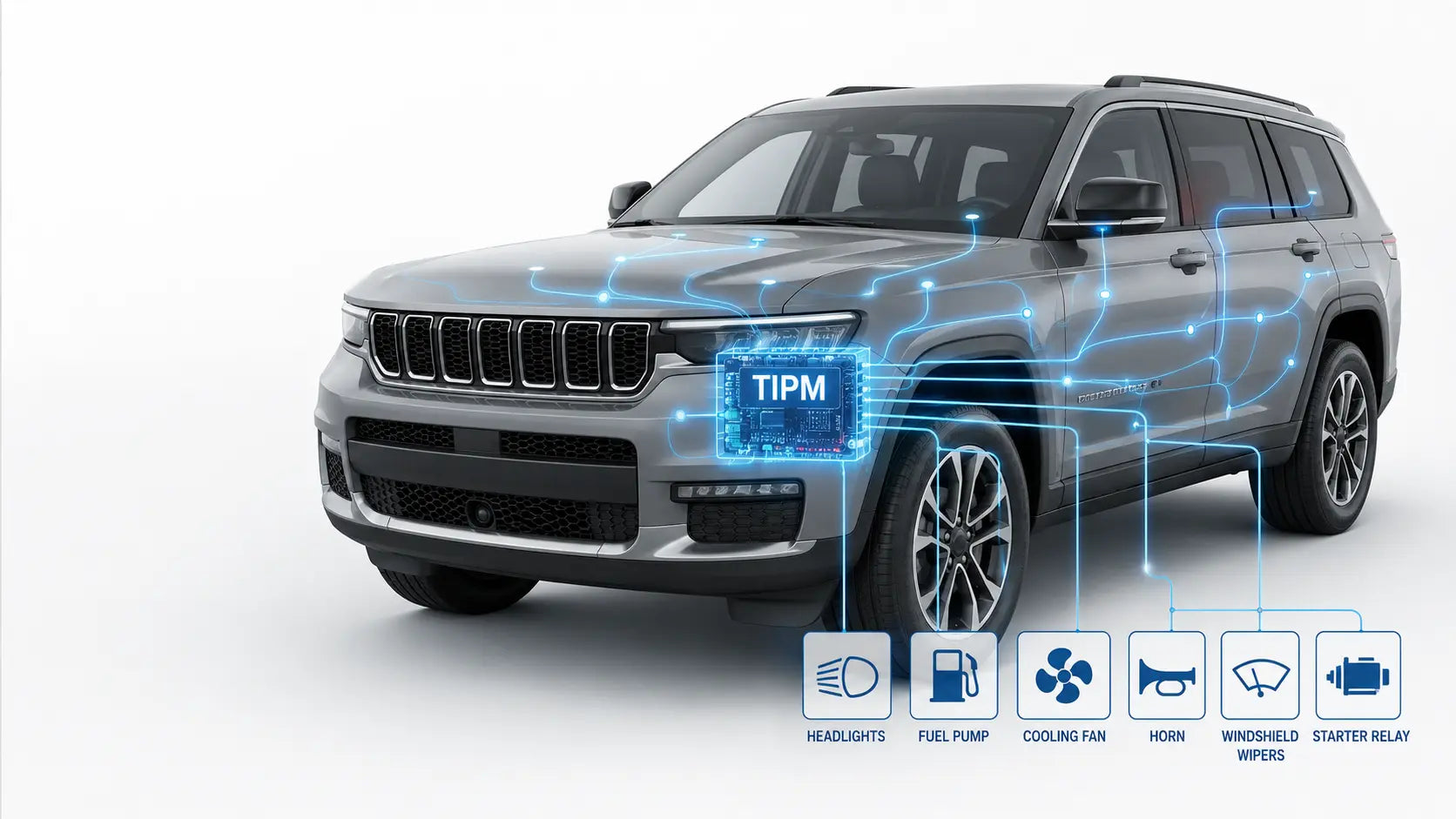
The same principle applies to many other vehicle systems, including the fuel pump, cooling fan, windshield wipers, horn, and starter relay. Rather than each component operating independently, they're coordinated through electronic communication and centralized power management.
This design offers several advantages:
- Reduces unnecessary wiring throughout the vehicle
- Replaces multiple standalone relays with integrated electronic control
- Improves communication between control modules
- Supports advanced diagnostic capabilities
- Enables modern convenience and safety features
To better understand the process, think of the TIPM as the middleman between the battery and the vehicle's electrical systems.
A simplified workflow looks like this:
Battery
      ↓
    TIPM
      ↓
Receives commands from control modules
      ↓
Processes the request
      ↓
Supplies power to the required circuit
      ↓
Electrical component operates
Instead of electricity flowing directly from a switch to every component, the TIPM manages when, where, and how power is delivered.
That level of control is one of the reasons modern Chrysler, Dodge, and Jeep vehicles can support increasingly complex electronic systems without dramatically increasing wiring complexity.
What Does the TIPM Control?
One of the biggest misconceptions about the TIPM is that it only manages fuses.
In reality, it serves as the central power distribution hub for many electrical systems throughout the vehicle. While the exact configuration varies by model and year, the TIPM commonly controls or supplies power to the following components:
| Vehicle System | Typically Managed by the TIPM |
|---|---|
| Fuel Pump | ✓ |
| Starter Relay | ✓ |
| Cooling Fan | ✓ |
| Headlights | ✓ |
| Fog Lights | ✓ |
| Turn Signals | ✓ |
| Horn | ✓ |
| Windshield Wipers | ✓ |
| Washer Pump | ✓ |
| Door Locks | ✓ |
| Power Windows (varies by model) | ✓ |
| Trailer Tow Lighting | ✓ |
| HVAC Relays | ✓ |
| Exterior Lighting | ✓ |
Because so many systems depend on the TIPM, a fault within the module—or a loss of communication with it—can produce symptoms that appear completely unrelated.
For example, a vehicle experiencing intermittent starting problems may also develop lighting issues or erratic windshield wiper operation. While those problems seem independent, they can sometimes share the same electrical source.
That doesn't necessarily mean the TIPM has failed.
Loose connectors, damaged wiring, poor grounds, low battery voltage, or communication problems elsewhere in the electrical system can create similar symptoms. That's why accurate diagnosis is essential before replacing the module.
TIPM vs. a Traditional Fuse Box
At first glance, a TIPM looks similar to a conventional fuse box.
Lift the cover, and you'll still find fuses protecting individual electrical circuits. That's where the similarities end.
A traditional fuse box is designed to distribute electrical power and protect circuits from overload. It doesn't make decisions or communicate with other modules.
The TIPM does both.
It combines power distribution with electronic control, allowing multiple vehicle systems to be managed through a single intelligent module.
The differences become easier to understand when compared side by side.
| Feature | Traditional Fuse Box | TIPM |
|---|---|---|
| Contains Fuses | ✓ | ✓ |
| Uses Relays | ✓ | ✓ (plus electronic switching on some models) |
| Distributes Electrical Power | ✓ | ✓ |
| Communicates with Other Modules | ✗ | ✓ |
| Controls Multiple Vehicle Systems | Limited | ✓ |
| Supports Advanced Diagnostics | ✗ | ✓ |
| Software-Controlled Functions | ✗ | ✓ |
For vehicle owners, this means diagnosing electrical problems has changed significantly.
On older vehicles, replacing a faulty relay might solve the issue.
On vehicles equipped with a TIPM, technicians often need to evaluate the entire electrical system—including battery voltage, wiring integrity, communication networks, and module data—before determining whether the TIPM is actually responsible.
Understanding that distinction helps prevent unnecessary parts replacement and leads to a more accurate repair process.
TIPM vs. BCM vs. PCM: What's the Difference?
Modern Chrysler, Dodge, and Jeep vehicles rely on multiple electronic control modules, each with a specific job. Because these modules communicate constantly, it's easy to confuse their responsibilities when diagnosing electrical problems.
The TIPM focuses on power distribution.
The Body Control Module (BCM) manages many of the vehicle's body-related features, while the Powertrain Control Module (PCM) oversees engine and transmission operation.
Although they work together, they are not interchangeable.
| Module | Primary Responsibility |
|---|---|
| TIPM | Distributes electrical power, controls relays and many vehicle circuits |
| BCM | Controls body electronics such as interior lighting, door locks, security systems, and power accessories |
| PCM | Manages engine performance, fuel injection, ignition timing, emissions, and transmission operation |
| ABS Module | Monitors wheel speed sensors and controls the anti-lock braking system |
| TCM (if equipped) | Controls transmission shift strategy and adaptive learning |
A simple way to remember their roles is this:
- The PCM decides how the engine should run.
- The BCM manages comfort and convenience features.
- The TIPM supplies electrical power to many of the systems that make those commands possible.
Because these modules exchange information over the CAN bus, a fault in one system can sometimes trigger warning messages in another. That's why technicians evaluate the entire electrical system instead of replacing modules based on a single fault code.
Which Chrysler, Dodge, and Jeep Models Use a TIPM?
The TIPM was widely used across Chrysler, Dodge, Jeep, and Ram vehicles for many years, particularly during the late 2000s and early 2010s.
However, not every model uses the same version.
Hardware design, software calibration, and controlled circuits can vary depending on the vehicle, model year, engine, and trim level.
Some of the most commonly associated vehicles include:
| Brand | Common Models |
|---|---|
| Jeep | Wrangler, Grand Cherokee, Liberty, Compass, Patriot |
| Dodge | Charger, Challenger, Durango, Grand Caravan, Journey |
| Chrysler | 300, 200, Town & Country |
| Ram | Ram 1500, Ram 2500, Ram 3500 (selected model years) |
Because of these differences, repair procedures and replacement requirements aren't always identical.
Before diagnosing or replacing a TIPM, it's important to confirm the correct part number and follow the service information for the specific vehicle. Assuming that all TIPMs function the same way can lead to unnecessary repairs or compatibility issues.
Why Did the TIPM Become So Controversial?
If you've searched for TIPM-related information online, you've probably noticed that opinions vary widely.
Some owners describe years of trouble-free operation, while others report repeated electrical issues that seem difficult to diagnose.
So why does the TIPM receive so much attention?
One reason is its role within the vehicle.
Unlike a traditional relay or fuse, the TIPM manages power for numerous systems. When an internal fault occurs—or when another electrical issue affects the module—the symptoms can appear unrelated.
A single problem may lead to a no-start condition, inoperative headlights, erratic windshield wipers, or a fuel pump that continues running after the ignition is turned off.
That makes the TIPM an easy target whenever multiple electrical problems appear at the same time.
Another factor is the popularity of certain Chrysler, Dodge, Jeep, and Ram models built during the late 2000s and early 2010s. Because so many of these vehicles remain on the road today, discussions about TIPM-related failures continue to appear on owner forums, repair websites, and social media.
It's also important to keep the issue in perspective.
Not every electrical problem points to a defective TIPM.
Weak batteries, poor ground connections, damaged wiring, corroded connectors, communication faults, or failed sensors can produce symptoms that closely resemble a TIPM failure.
Replacing the module without confirming the root cause may solve nothing—and can become an expensive mistake.
The most effective approach is always systematic diagnosis.
Start with the basics, verify power and ground, inspect the wiring, and evaluate fault codes before concluding that the TIPM itself is responsible.
Common Signs of a Failing TIPM
A failing TIPM doesn't always produce the same symptoms.
Because it manages power for multiple electrical systems, the warning signs can vary widely depending on which circuits are affected. In some cases, the symptoms appear only occasionally. In others, they may become more frequent as the underlying problem develops.
The following are some of the most commonly reported symptoms associated with TIPM-related electrical issues.
Intermittent No-Start Condition
One of the most recognized symptoms is a vehicle that refuses to start without an obvious mechanical reason.
You may turn the key or press the start button only to find that the engine doesn't crank—or it cranks inconsistently. Sometimes the vehicle starts normally after several attempts, making the problem difficult to reproduce.
While a failing TIPM can contribute to this condition, similar symptoms may also result from a weak battery, a faulty starter, or poor electrical connections. That's why proper diagnosis is essential before replacing any components.
Fuel Pump Continues Running
Some owners report hearing the fuel pump continue to run even after the ignition has been switched off.
Normally, the TIPM controls when the fuel pump receives power. If the circuit doesn't shut down correctly, the pump may continue operating longer than intended, potentially leading to excessive battery discharge if left unresolved.
Although this symptom has often been associated with TIPM-related faults, other electrical issues should also be considered during diagnosis.
Battery Drain
A vehicle that repeatedly develops a dead battery despite having a healthy charging system deserves closer inspection.
When certain electrical circuits remain energized after the vehicle has been turned off, battery drain can occur over time.
However, parasitic battery drain isn't unique to the TIPM.
Interior lights, aftermarket accessories, damaged wiring, and other electronic modules can produce similar symptoms, making a complete electrical inspection the best approach.
Exterior Lights Behaving Abnormally
Lighting problems are another frequently reported complaint.
Examples may include:
- Headlights that remain on after the vehicle is turned off
- Turn signals operating unexpectedly
- Fog lights functioning intermittently
- Exterior lights that fail to illuminate
Since the TIPM manages several exterior lighting circuits, irregular lighting behavior may indicate an issue somewhere within the vehicle's power distribution system.
Windshield Wipers Operating Unexpectedly
Windshield wipers that activate without driver input—or refuse to turn off—can be both frustrating and distracting.
Although faulty switches or wiring can produce similar behavior, unexpected wiper operation has also been reported in some vehicles experiencing TIPM-related electrical faults.
Horn Sounds Without Warning
Another unusual symptom involves the vehicle's horn.
In rare situations, the horn may sound unexpectedly or continue operating until power is disconnected.
Because the horn circuit is managed electronically, diagnosing this type of problem requires evaluating the complete electrical system rather than focusing on the horn itself.
Cooling Fan Runs Continuously
The radiator cooling fan is designed to operate only when cooling is required.
If the fan continues running after the engine has been turned off—or starts unexpectedly during normal operation—it may indicate that the power control circuit isn't functioning correctly.
As with other symptoms, this doesn't automatically confirm a defective TIPM, but it does warrant further inspection.
Multiple Electrical Problems at the Same Time
Perhaps the strongest warning sign is when several unrelated electrical systems begin acting up simultaneously.
For example, a vehicle may experience:
- Intermittent starting problems
- Lighting malfunctions
- Power window issues
- Horn or wiper abnormalities
- Battery drain
When unrelated electrical functions begin failing together, it's often a sign that the underlying issue affects the vehicle's power distribution or communication system rather than a single component.
That doesn't necessarily mean the TIPM has failed—but it does suggest the need for a systematic diagnosis.
What Causes TIPM Failure?
Like any electronic component, the TIPM isn't immune to wear or electrical stress.
In many cases, the module itself isn't the root cause. External conditions, poor electrical connections, or long-term exposure to heat and moisture may contribute to problems that eventually affect TIPM operation.
Understanding these factors can help prevent unnecessary repairs and improve diagnostic accuracy.
Heat and Age
Electronic components naturally degrade over time.
Years of repeated heating and cooling cycles can gradually affect internal circuits, solder joints, and electronic switching components. Older vehicles are therefore more likely to experience age-related electrical issues than newer models.
Moisture and Corrosion
Water and electronics rarely mix well.
Moisture entering electrical connectors or the TIPM housing can lead to corrosion, increased electrical resistance, or unreliable circuit operation.
Vehicles frequently exposed to heavy rain, flooding, road salt, or high humidity may be more susceptible to connector-related problems over time.
Loose or Damaged Electrical Connections
Not every electrical fault originates inside the TIPM.
Loose connectors, damaged wiring, poor ground connections, or corroded terminals can interrupt power delivery and create symptoms that closely resemble an internal module failure.
That's one reason experienced technicians inspect wiring before replacing major electrical components.
Voltage Spikes and Improper Jump Starting
Modern electronic modules are designed to operate within a specific voltage range.
Improper jump-start procedures, poor-quality battery chargers, or sudden voltage spikes may place unnecessary stress on sensitive electronic circuits.
While these situations don't always damage the TIPM, following the manufacturer's recommended procedures helps reduce unnecessary electrical risk.
Aftermarket Electrical Modifications
Additional lighting, audio equipment, remote starters, winches, or other accessories can increase electrical complexity if installed incorrectly.
Poor wiring practices, overloaded circuits, or low-quality electrical connections may contribute to intermittent electrical problems that complicate diagnosis.
Professionally installed accessories are generally far less likely to create these issues.
Manufacturing Defects and Component Wear
Like any automotive electronic module, the TIPM contains numerous internal components that can eventually wear or fail.
Although most modules provide years of reliable service, certain model years have received more owner complaints than others. The likelihood of failure depends on factors such as vehicle age, operating conditions, maintenance history, and overall electrical system health.
For that reason, diagnosis should always focus on the vehicle's actual symptoms rather than assuming every electrical issue is caused by the TIPM.
Can a TIPM Be Repaired or Does It Need Replacement?
The answer depends on the underlying problem.
Not every electrical issue requires replacing the TIPM, and not every malfunction originates inside the module itself. Before considering an expensive repair, it's important to verify that the TIPM is actually responsible for the symptoms.
Technicians typically begin by checking the basics:
- Battery condition and voltage
- Charging system performance
- Power and ground connections
- Wiring harnesses and electrical connectors
- Diagnostic trouble codes (DTCs)
- Communication between control modules
Only after these checks should the TIPM become the primary suspect.
If the problem is caused by a loose connector, corroded terminal, damaged wiring, or a weak battery, replacing the TIPM is unlikely to solve it.
However, if testing confirms an internal fault—such as a failed relay, damaged circuit board, or malfunctioning electronic switching component—the module may need to be repaired or replaced.
Some TIPMs can be professionally rebuilt, while others require replacement with a new or remanufactured unit. Depending on the vehicle and model year, programming or configuration may also be necessary after installation to ensure proper communication with other control modules.
Following the manufacturer's service procedures is always recommended.
How to Help Prevent TIPM Problems
Although no electronic module lasts forever, good electrical system maintenance can reduce unnecessary stress on the TIPM and other control modules.
A few preventive habits can make a meaningful difference over the life of the vehicle.
Keep the Battery Healthy
Low battery voltage is one of the most common causes of abnormal electrical behavior.
Regularly testing the battery and replacing it when necessary helps maintain stable system voltage and reduces unnecessary strain on electronic modules.
Inspect Battery Terminals and Ground Connections
Loose or corroded connections can interrupt power delivery and create symptoms that resemble module failures.
Periodically cleaning battery terminals and inspecting major ground points is a simple but worthwhile maintenance practice.
Avoid Improper Jump Starting
Incorrect jump-start procedures may expose sensitive electronics to voltage spikes.
Always follow the vehicle manufacturer's recommendations and use quality charging equipment whenever possible.
Protect Electrical Components from Moisture
Water intrusion can damage connectors and increase electrical resistance.
If the engine compartment has been exposed to flooding or significant water intrusion, electrical connectors should be inspected before corrosion develops.
Diagnose Problems Before Replacing Parts
Electrical symptoms often share similar causes.
Rather than replacing components based on online advice or guesswork, diagnosing the complete electrical system first usually saves both time and money.
Frequently Asked Questions
What does TIPM stand for?
TIPM stands for Totally Integrated Power Module. It combines power distribution, fuse protection, relay control, and electronic switching into a single module used on many Chrysler, Dodge, Jeep, and Ram vehicles.
Is the TIPM just a fuse box?
No.
While it contains fuses and relays, the TIPM also communicates with other control modules and electronically manages power delivery to multiple vehicle systems.
Can a bad TIPM cause a no-start condition?
Yes, it can.
However, a no-start condition can also result from a weak battery, starter problems, wiring faults, or other electrical issues. Proper diagnosis is essential before replacing the TIPM.
Can the TIPM drain the battery?
In certain situations, yes.
If a circuit remains energized when it shouldn't, the battery may gradually discharge. That said, parasitic battery drain can also be caused by other modules, accessories, or wiring problems.
Does every Chrysler, Dodge, or Jeep have a TIPM?
No.
Many models built during the late 2000s and early 2010s use a TIPM, but the design varies by vehicle and model year. Always refer to the service information for your specific vehicle.
Does a replacement TIPM need programming?
Some replacement modules require programming or configuration after installation, while others may not.
The exact procedure depends on the vehicle, model year, and replacement part being used.
Can I drive with a faulty TIPM?
That depends on the symptoms.
Minor electrical issues may allow the vehicle to remain drivable, but problems affecting the fuel pump, starter, lighting, or other safety-related systems should be inspected as soon as possible.
Can a scan tool detect TIPM problems?
A professional diagnostic scan tool can often identify communication faults and related diagnostic trouble codes. However, fault codes alone do not confirm that the TIPM has failed. Electrical testing and circuit inspection are usually required for an accurate diagnosis.
Conclusion
The Totally Integrated Power Module (TIPM) plays a central role in the electrical architecture of many Chrysler, Dodge, Jeep, and Ram vehicles. By combining power distribution, relay control, and electronic communication into a single module, it helps modern vehicles operate more efficiently while supporting an increasing number of electronic systems.
Because the TIPM manages so many circuits, electrical problems involving starting, lighting, fuel delivery, or other vehicle functions can sometimes appear to point toward the module. In reality, similar symptoms may also be caused by battery issues, wiring faults, poor ground connections, or failures in other control modules.
Understanding how the TIPM works is the first step toward accurate diagnosis.
Rather than replacing parts based on symptoms alone, a systematic inspection of the vehicle's electrical system remains the most reliable approach. Identifying the root cause not only reduces unnecessary repair costs but also helps ensure that the problem is resolved correctly the first time.
Disclaimer
This article is intended for educational and informational purposes only. Vehicle specifications, electrical system designs, and repair procedures may vary depending on the model, model year, engine, and trim level. Always consult the appropriate factory service manual or a qualified automotive technician before performing diagnostics or repairs on your vehicle.
References
- Mopar Owner's Manuals and Service Information. https://www.mopar.com/
- Bosch. Automotive Handbook, 10th Edition.
- SAE International. Technical Papers on Automotive Electrical and Electronic Systems. https://www.sae.org/
- ISO 11898 Road Vehicles — Controller Area Network (CAN).
- National Highway Traffic Safety Administration (NHTSA). https://www.nhtsa.gov/
Related Article
What Is a Body Control Module (BCM)? A Complete Guide for Chrysler, Dodge, and Jeep Owners
How to Fix P1745 Code with an OBD2 Scanner?