
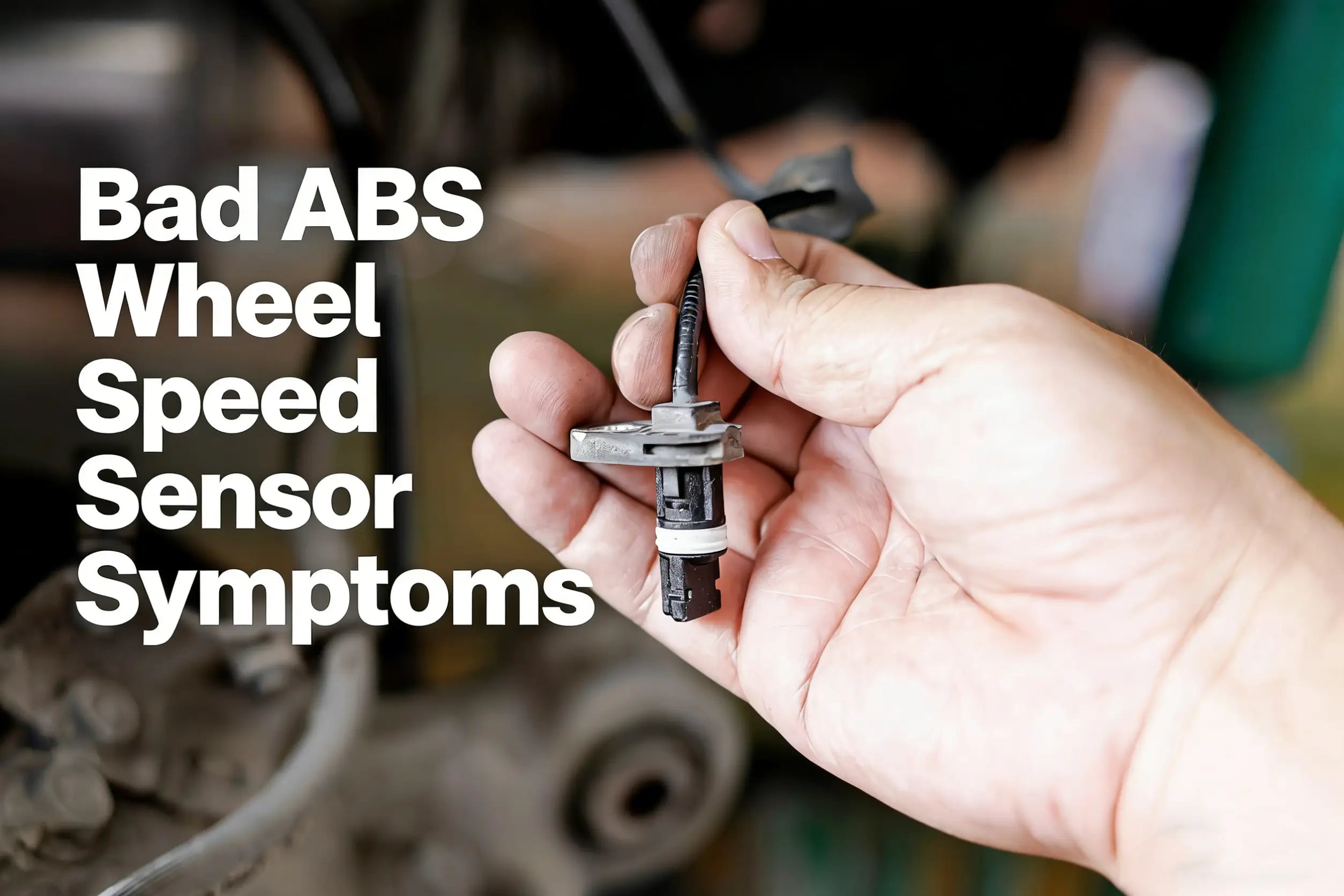
How to Spot Early Warning Signs and Avoid Costly Brake Repairs
Your car’s ABS system is something you rarely think about—until it stops working properly.
For most drivers, the first sign of trouble is a glowing ABS warning light on the dashboard. But by the time that light turns on, the problem may already be affecting your braking performance, safety, and even your wallet.
One of the most common causes behind ABS issues is a failing wheel speed sensor. It’s a small component, easy to overlook, but it plays a critical role in how your vehicle brakes, handles, and maintains stability.
In this guide, we’ll break down every major symptom of a bad ABS wheel speed sensor, explain why they happen, and show you how to diagnose the problem early—before it turns into an expensive repair.
What Does an ABS Wheel Speed Sensor Do?
Before diving into symptoms, it helps to understand what this sensor actually does.
Each wheel on modern vehicles is equipped with a wheel speed sensor. Its job is simple in theory:
measure how fast each wheel is rotating and send that data to the ABS control module.
In practice, that information is used by multiple systems, including:
-
ABS (Anti-lock Braking System)
-
Traction Control System (TCS)
-
Electronic Stability Control (ESC)
-
In some vehicles, even the speedometer
The ABS module constantly compares wheel speeds. If it detects that one wheel is slowing down too quickly during braking—indicating a potential lock-up—it rapidly modulates brake pressure to keep the wheel rotating.
This all happens in milliseconds. And it only works if the sensor data is accurate.
When a wheel speed sensor fails, sends erratic signals, or drops out intermittently, the system starts making the wrong decisions.
That’s when problems begin.
Why ABS Wheel Speed Sensors Fail
Wheel speed sensors operate in one of the harshest environments on your car.
They are exposed to:
-
Heat from brakes
-
Water, snow, and road salt
-
Mud, sand, and metal debris
-
Constant vibration
Over time, common failure causes include:
-
Sensor contamination (metal shavings stuck to magnetic tips)
-
Wiring damage from road debris or corrosion
-
Broken reluctor rings / tone rings
-
Internal sensor failure due to age
Because failures are often gradual, the symptoms don’t always appear all at once.
Symptom 1: ABS Warning Light Stays On
This is the most obvious—and most ignored—warning sign.
When the ABS control module detects a problem with a wheel speed sensor, it stores a fault code and illuminates the ABS warning light.
Important things to know:
-
Your regular brakes still work
-
ABS functionality is usually disabled
-
Traction control and stability control may also be disabled
Many drivers assume the light is harmless since the car still stops. That’s a mistake.
Without ABS, your wheels can lock up under hard braking—especially on wet or icy roads.
Why the Light Turns On
The module sees:
-
No signal
-
An implausible signal
-
A wheel speed that doesn’t match the others
Even a slightly inconsistent reading can trigger the warning.
Symptom 2: Traction Control or Stability Control Warning Light
On many modern vehicles, the ABS system shares data with traction and stability control.
That means one bad sensor can trigger multiple warning lights, including:
-
Traction Control (TCS)
-
Electronic Stability Control (ESC)
-
“Service Stabilitrak” (GM vehicles)
You might notice:
-
Traction control light flashing unexpectedly
-
System disabling itself entirely
-
Reduced power during acceleration
This happens because the system can’t accurately determine which wheel is slipping.
Symptom 3: Inaccurate or Erratic Speedometer Readings
This symptom surprises many drivers.
In some vehicles, the vehicle speed signal comes from one or more wheel speed sensors—not the transmission.
When a sensor starts failing, you may notice:
-
Speedometer jumping up and down
-
Speed reading dropping to zero while driving
-
Cruise control disengaging unexpectedly
If your speedometer issues appear alongside an ABS light, a wheel speed sensor should be one of the first things you check.
Symptom 4: ABS Activates When It Shouldn’t
This is one of the most dangerous symptoms—and one that drivers often misinterpret.
You may experience:
-
ABS pedal pulsation at low speeds
-
Grinding or buzzing noises during gentle braking
-
ABS activating on dry, smooth pavement
This usually means one sensor is reporting a wheel slowing down faster than it actually is.
The system thinks the wheel is about to lock—so it intervenes.
In reality, nothing is wrong with the road conditions. The data is wrong.
Symptom 5: Longer Braking Distance
While ABS doesn’t necessarily shorten stopping distance in every situation, it helps maintain control and consistent braking.
When ABS is disabled due to a faulty sensor:
-
Wheels may lock under panic braking
-
Tires lose traction more easily
-
Steering control is reduced
On wet or icy roads, this can significantly increase stopping distance.
Many drivers don’t notice this until an emergency stop reveals the problem.
Symptom 6: Intermittent ABS Issues
One of the most frustrating aspects of wheel speed sensor problems is inconsistency.
The sensor may:
-
Work when cold
-
Fail when hot
-
Cut out over bumps
-
Lose signal at certain speeds
This leads to:
-
ABS light turning on and off
-
Random warning messages
-
Hard-to-reproduce symptoms
Intermittent faults are often caused by:
-
Cracked wiring insulation
-
Loose connectors
-
Corroded terminals
Symptom 7: Stored ABS Trouble Codes
Even if you don’t feel anything wrong while driving, your car’s computer might already know there’s an issue.
Common ABS wheel speed sensor codes include:
-
C0035 – C0051 (varies by manufacturer)
-
“Wheel Speed Sensor Circuit Malfunction”
-
“Implausible Signal”
Reading these codes requires a scanner that supports ABS systems, not a basic engine-only OBD2 reader.
How to Diagnose a Bad ABS Wheel Speed Sensor Properly
Guessing leads to wasted money.
A proper diagnosis involves three steps:
1. Read ABS Fault Codes
Use a scan tool capable of:
-
Accessing ABS modules
-
Reading manufacturer-specific codes
This tells you which wheel is affected.
2. Check Live Wheel Speed Data
With the vehicle moving:
-
All four wheel speeds should match closely
-
A bad sensor may drop to zero or spike
This step is crucial for confirming intermittent faults.
3. Inspect the Sensor and Wiring
Physically check:
-
Sensor mounting
-
Wiring near suspension components
-
Reluctor ring condition
Many “bad sensors” turn out to be wiring issues.
Can You Drive with a Bad ABS Wheel Speed Sensor?
Technically, yes.
Practically, it’s not a good idea.
Here’s what happens:
-
ABS is disabled
-
Traction control may not work
-
Stability control may be limited
-
Emergency braking performance is reduced
In normal city driving, you might not notice much difference.
In an emergency, the difference can be critical.
Replacement Cost: What to Expect
Costs vary depending on the vehicle and sensor location.
Typical ranges in the U.S.:
-
Sensor part: $30 – $150
-
Labor: $80 – $200
-
Total: $120 – $350 per wheel
Vehicles with integrated hub assemblies can cost more.
Catching the problem early can prevent damage to:
-
Wheel bearings
-
ABS modules
-
Brake components
Preventing Future ABS Sensor Problems
You can’t prevent wear entirely, but you can reduce risk:
-
Avoid driving with damaged wheel bearings
-
Address ABS lights immediately
-
Keep brake components clean during service
-
Avoid cheap aftermarket sensors with poor shielding
Quality parts and proper installation matter more than most people realize.
Final Thoughts: Don’t Ignore the Signs
A bad ABS wheel speed sensor rarely fails all at once.
It starts small. A warning light. A strange brake pulse. A traction control message you dismiss.
But those early signs are your opportunity to fix the problem before safety is compromised.
If your ABS light is on—or if your brakes don’t feel quite right—don’t guess.
Scan it. Diagnose it. Fix it correctly.
Your brakes are not the place to cut corners.
Frequently Asked Questions
Q1: Can I drive with a bad ABS wheel speed sensor?
Yes, you can still drive the vehicle, but it’s not recommended. When an ABS wheel speed sensor fails, the ABS system is usually disabled, which increases the risk of wheel lock-up during hard braking—especially on wet or icy roads.
Q2: Will a bad ABS sensor affect normal braking?
In most cases, normal braking still works. However, without ABS assistance, braking control is reduced during emergency stops, and stopping distances may increase under low-traction conditions.
Q3: What causes ABS wheel speed sensors to fail?
Common causes include road debris, corrosion, damaged wiring, metal shavings sticking to magnetic sensors, and wear over time due to heat and vibration near the brakes.
Q4: How much does it cost to replace an ABS wheel speed sensor?
In the U.S., replacement typically costs between $120 and $350 per wheel, depending on the vehicle, sensor design, and labor rates. Integrated hub sensors may cost more.
Q5: Can a bad ABS sensor cause traction control problems?
Yes. ABS wheel speed sensors share data with traction control and stability control systems. A faulty sensor can disable or interfere with both systems, triggering warning lights or reduced engine power.
Q6: How do I know which ABS wheel speed sensor is bad?
You need a diagnostic scanner that can read ABS fault codes and live wheel speed data. The code usually identifies the specific wheel (front left, rear right, etc.).
Related Articles
ABS Light On After Brake Replacement: What to Check First
The Best ABS Code Reader For Cars In 2026
Understanding ABS Bleeding: A Vital Maintenance Procedure for Your Car